
Standard models of economics:
1. People are rational and aim to maximize their utility
2. People are driven by monetary incentive (any action is only motivated for financial
action)
3. Optimal decisions are made at the margin (only act if benefits>costs)
Behavior theories:
Expected utility theory (normative theory behavior)
- Rational decision maker can maximize their utility by selecting among superior
alternatives
- When alternatives have similar outcomes, decision maker should be indifferent to
these alternatives
- Utility is dependent of final wealth (i.e., deviations from current state wealth are
inconsequential)
Not a real-life situation
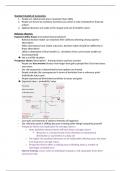
Prospector theory (descriptive) – framing choices and loss aversion
- People are loss aversive (losses room larger than gains) people like it but hate losses
even more
- Our risk propensity is determined by how options are framed
- People evaluate the consequences in terms of deviation from a reference point
(individuals status quo)
- People experienced diminished sensitivity to losses and gains
Expected value = probability*value
-
- Loss>gain and Intensity of sadness>intensity of happiness
- Our reference point is shifting because of seeing other things/comparing yourself
- Prospector theory has implication for average returns:
o More positively skewed stocks will have lower average returns
Skewness is a measurement of the distortion of symmetrical
distribution or asymmetry in a data set
o The higher the predicted skewness of an initial public offering stock, the lower
is its long-term average return
o Prospector theory offers a unifying way of thinking about a number of
seemingly unrelated facts
- Narrow framing: occurs when an individual evaluates a risk separately from other
concurrent risks
, - Aggregate stock market is the context for the best-known application of prospect
theory in finance: it can explain the famous equity premium puzzle
- Disposition effect: both individual investors and mutual fund managers have a great
propensity to sell stocks that have risen in value since purchase, rather stocks have
fallen in value
o Reluctance to sell assets as a loss follows from prospect theory: if a stock
performs poorly, this brings its owner into loss region of value function,
where, because of the convexity, the owner becomes risk seeking. As a result,
the investor holds on to the stock in the hope of breaking even later
o Realization utility: the idea that people derive utility directly from selling an
asset at a gain relative to purchase price (think is long term wealth)
- Prospect theory had been used to shed a light on property and causality insurance
and mortality insurance
o People are willing to pay a higher premium, because the intuition is that,
since a premium is a payment that sometimes is expected to make, while a
deductible is a payment that arises only in the unlikable event of a claim, the
person doesn’t experience as much loss aversion when it pays the premium
as it does when it pays the deductible
- Endowment effect: more sensitive to lose than to gain (2 findings) IN LINE WITH LOSS
AVERSION
o Exchange asymmetries
89% want to keep the mug, while 10% wants to change candy for mug
Initial allocation has huge effect on subsequent choice
o WTA/WTP gaps (gaps between willingness to accept and willingness to pay)
At what price would you sell the mug/at what price would you buy the
mug
Risk aversion: not maximizing utility but making sure there is no risk
- You fear being disappointed if your luck does not hold and you and in the chance that
you would get nothing
- Leads you to taking the sure gamble
Risk seeking: trying not to lose
- Fear of loss leads most people to reject sure loss and gamble on the chance of losing
something instead
Implications of the prospect theory:
- Framing effect*
- Mental accounting
- Loss aversion
- Endowment effect
- Status quo bias
* a type of cognitive bias or error in thinking. “Framing” refers to whether an option is
presented as a loss (negative) or a gain (positive). People are generally biased toward picking
an option they view as a gain over one they view as a loss, even if both options lead to the
same result
,Experiments: manipulate so you have a certain outcome
- The key features are control over variables, careful measurement, and establishing
cause and effect relationships (causal relationships)
- The independent variable (cause) is manipulated and the dependent variable (effect)
is measured and any extraneous variables are controlled
- Randomly allocating participants to independent variable conditions means that all
participants should have equal chance of taking part in each condition. The principle
of random allocation is to avoid bias in the way the experiment is carried out and to
limit the effects of participant variables
Motivation
- Pay-for-effort market (relationship) does not accurately explain human behavior.
Often, we go to great lengths for someone or something without monetary
incentives
- The standard model of labor is one where motivation=payment. That is, individuals
trade their effort for monetary rewards. That is how the system operates
Status quo bias:
the status quo bias describes our preference for the current state of affairs, resulting in
resistance to change
- Opt-out condition: You have to describe if you’re not going
Sum up:
- Prospect theory came about to explain human behavior in ways the expected utility
theory couldn’t
- Although the prosect theory started off with outlining decision making under
conditions of risks and uncertainty. The implication of the theory was so far reaching
that it formed the groundwork required to explain other unexplainable human
behavior
- Experimental research describes the process by which researchers purposefully
change, after, or influence the independent variables in an experimental research
design. This process allows researchers to explore causal relationships between IV’s
and dependent variables of interest in a particular study. Specifically, manipulation of
an IV allows researchers to explore whether the IV causes change in a study’s DV’s
- Experimental research is key to understanding human behavior as it enables
researchers to isolate cause and effects
, Cognitive biases:
System 1: happens to you System 2: is something you do
Fast/intuitive slow
unconscious conscious
Automatic Effortful
Everyday decision Complex/first time decisions
Error prone reliable
System 1
- Advantages:
o Responds quickly in crisis
o Comfortable with the familiar
o Makes associations which is good for expansive thinking
o Easy completion of routine or repetitive tasks
- Disadvantages
o Jumps to conclusion
o Unhelpful emotional responses
o Makes ‘mistakes’ unconsciously which can lead to biases and error prone
judgements
System 2
- Advantaged
o Demands consideration
o Weighs up pros and cons
o Establishes consequences
o Good for reductive thinking
- Disadvantages
o Slow to decide
o Requires energy and effort
o Prone to decision fatigue
Cognitive misers
- Heuristics are commonly defined as cognitive shortcuts or rules of thumb that
simplify decisions, especially under conditions of fatigue and uncertainty
Heuristics can also lead to cognitive biases, systematic error in thinking
1. People are rational and aim to maximize their utility
2. People are driven by monetary incentive (any action is only motivated for financial
action)
3. Optimal decisions are made at the margin (only act if benefits>costs)
Behavior theories:
Expected utility theory (normative theory behavior)
- Rational decision maker can maximize their utility by selecting among superior
alternatives
- When alternatives have similar outcomes, decision maker should be indifferent to
these alternatives
- Utility is dependent of final wealth (i.e., deviations from current state wealth are
inconsequential)
Not a real-life situation
Prospector theory (descriptive) – framing choices and loss aversion
- People are loss aversive (losses room larger than gains) people like it but hate losses
even more
- Our risk propensity is determined by how options are framed
- People evaluate the consequences in terms of deviation from a reference point
(individuals status quo)
- People experienced diminished sensitivity to losses and gains
Expected value = probability*value
-
- Loss>gain and Intensity of sadness>intensity of happiness
- Our reference point is shifting because of seeing other things/comparing yourself
- Prospector theory has implication for average returns:
o More positively skewed stocks will have lower average returns
Skewness is a measurement of the distortion of symmetrical
distribution or asymmetry in a data set
o The higher the predicted skewness of an initial public offering stock, the lower
is its long-term average return
o Prospector theory offers a unifying way of thinking about a number of
seemingly unrelated facts
- Narrow framing: occurs when an individual evaluates a risk separately from other
concurrent risks
, - Aggregate stock market is the context for the best-known application of prospect
theory in finance: it can explain the famous equity premium puzzle
- Disposition effect: both individual investors and mutual fund managers have a great
propensity to sell stocks that have risen in value since purchase, rather stocks have
fallen in value
o Reluctance to sell assets as a loss follows from prospect theory: if a stock
performs poorly, this brings its owner into loss region of value function,
where, because of the convexity, the owner becomes risk seeking. As a result,
the investor holds on to the stock in the hope of breaking even later
o Realization utility: the idea that people derive utility directly from selling an
asset at a gain relative to purchase price (think is long term wealth)
- Prospect theory had been used to shed a light on property and causality insurance
and mortality insurance
o People are willing to pay a higher premium, because the intuition is that,
since a premium is a payment that sometimes is expected to make, while a
deductible is a payment that arises only in the unlikable event of a claim, the
person doesn’t experience as much loss aversion when it pays the premium
as it does when it pays the deductible
- Endowment effect: more sensitive to lose than to gain (2 findings) IN LINE WITH LOSS
AVERSION
o Exchange asymmetries
89% want to keep the mug, while 10% wants to change candy for mug
Initial allocation has huge effect on subsequent choice
o WTA/WTP gaps (gaps between willingness to accept and willingness to pay)
At what price would you sell the mug/at what price would you buy the
mug
Risk aversion: not maximizing utility but making sure there is no risk
- You fear being disappointed if your luck does not hold and you and in the chance that
you would get nothing
- Leads you to taking the sure gamble
Risk seeking: trying not to lose
- Fear of loss leads most people to reject sure loss and gamble on the chance of losing
something instead
Implications of the prospect theory:
- Framing effect*
- Mental accounting
- Loss aversion
- Endowment effect
- Status quo bias
* a type of cognitive bias or error in thinking. “Framing” refers to whether an option is
presented as a loss (negative) or a gain (positive). People are generally biased toward picking
an option they view as a gain over one they view as a loss, even if both options lead to the
same result
,Experiments: manipulate so you have a certain outcome
- The key features are control over variables, careful measurement, and establishing
cause and effect relationships (causal relationships)
- The independent variable (cause) is manipulated and the dependent variable (effect)
is measured and any extraneous variables are controlled
- Randomly allocating participants to independent variable conditions means that all
participants should have equal chance of taking part in each condition. The principle
of random allocation is to avoid bias in the way the experiment is carried out and to
limit the effects of participant variables
Motivation
- Pay-for-effort market (relationship) does not accurately explain human behavior.
Often, we go to great lengths for someone or something without monetary
incentives
- The standard model of labor is one where motivation=payment. That is, individuals
trade their effort for monetary rewards. That is how the system operates
Status quo bias:
the status quo bias describes our preference for the current state of affairs, resulting in
resistance to change
- Opt-out condition: You have to describe if you’re not going
Sum up:
- Prospect theory came about to explain human behavior in ways the expected utility
theory couldn’t
- Although the prosect theory started off with outlining decision making under
conditions of risks and uncertainty. The implication of the theory was so far reaching
that it formed the groundwork required to explain other unexplainable human
behavior
- Experimental research describes the process by which researchers purposefully
change, after, or influence the independent variables in an experimental research
design. This process allows researchers to explore causal relationships between IV’s
and dependent variables of interest in a particular study. Specifically, manipulation of
an IV allows researchers to explore whether the IV causes change in a study’s DV’s
- Experimental research is key to understanding human behavior as it enables
researchers to isolate cause and effects
, Cognitive biases:
System 1: happens to you System 2: is something you do
Fast/intuitive slow
unconscious conscious
Automatic Effortful
Everyday decision Complex/first time decisions
Error prone reliable
System 1
- Advantages:
o Responds quickly in crisis
o Comfortable with the familiar
o Makes associations which is good for expansive thinking
o Easy completion of routine or repetitive tasks
- Disadvantages
o Jumps to conclusion
o Unhelpful emotional responses
o Makes ‘mistakes’ unconsciously which can lead to biases and error prone
judgements
System 2
- Advantaged
o Demands consideration
o Weighs up pros and cons
o Establishes consequences
o Good for reductive thinking
- Disadvantages
o Slow to decide
o Requires energy and effort
o Prone to decision fatigue
Cognitive misers
- Heuristics are commonly defined as cognitive shortcuts or rules of thumb that
simplify decisions, especially under conditions of fatigue and uncertainty
Heuristics can also lead to cognitive biases, systematic error in thinking



