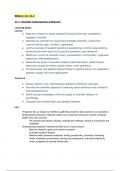
Midterm: Ch. 1-5, 8
Ch. 1: Scientific Understanding of Behavior
Learning Goals:
Lecture
● State four reasons to study research methods (informed, competitive,
engaged, involved)
● Describe six methods for acquiring knowledge (authority, empiricism,
common sense, logic, intuition, experience)
● List four sources of research questions (questioning common assumptions,
observing the world around us, practical problems, past research)
● Define four norms of scientific inquiry (universalism, communality, organized
skepticism, disinterestedness)
● Generate five goals of scientific research (describe behav, predict behav,
determine causes for behav, explain behav, solve problems)
● Compare basic and applied research (basic is explore theory w/o application.
Applied is apply real world application)
Textbook
● Explain reasons why understanding research methods is important.
● Describe the scientific approach to learning about behaviour and contrast it
with pseudoscience.
● Define and give examples of the four goals of scientific research in
psychology.
● Compare and contrast basic and applied research.
LG 1
- Research lets us shape our beliefs by gathering evidence abt answers to our questions
- Understanding research methods makes us an informed consumer of news, products,
health care, and services
- We should read reports critically, evaluate the methods, decide if conclusions are
justifiable
- Understanding research methods benefits you in many careers
- Need to interpret, apply, and conduct research
- Evaluate research reports
- Mental health (treatment methods, testing procedures), business (marketing
strats, employee productiving, training new employees), educators (teaching
strats, programs for special needs kids)
, - Understanding research methods informs us so we can participate in debates abt public
policy
- Gov’ proposes legislation based on research
- Research affects legal practices and decisions
- Eg. looking at pics 1 at a time instead of sequentially affects court cases
- Understanding research methods help us evaluate community programs that we want to
implement or participate in
- Programs that enhances parenting skills, teach students how to reduce stress
- We rely on intuition and authority for explanations. But science helps us avoid biases
- Intuition: relying on experience or judgment instead of being critical or questioning
- Finding an explanation for our or others’s behaviours
- Eg. finding love when you’re not looking for it
- But we make mistaken conclusions bc of cog and motivational biases
- Illusory correlation: cog bias where 2 events occur closely in time and we
mistaken it for 1 causing the other
- Eg. stops looking for love, finds a partner. Could be a coincident/ not correlated
- Even more correlated if we believe not looking for love is the key to finding it
which can lead to inaccurate conclusions
- Authority: trusting someone who knows more than we do
- Problematic bc they can draw incorrect conclusions from stats
- Many ppl readily accept what they’re taught
- Scientific approach: lots of good quality evidence b4 conclusion
LG 2
- Scientific approach doesn’t accept intuition and authority as truths w/o evidence
- Scientific skepticism: our ideas can be wrong. Question everything, don’t accept things
undoubtedly
- Empiricism: gain knowledge based on structured, systematic observations (conducting
research)
- Dev hypothesis, collect data, evaluate data to test hypothesis
- Generate idea → look at past research → state hypothesis → design study → get ethics
approval → collect data → analyze data → conduct new replicated study (optional) → go
thru hypothesis etc. steps again → write manuscript → submit manuscript to peer
reviewed journal
- Science is imperfect (can be used to build career, egotism, desire to be viewed as more
important)
- 4 norms for scientific inquiry:
- Universalism: use accepted methods for scientific observations
- Eg. 1 group publishes research, arrives at a conclusion. Another group
disagrees and publishes their own research. Both sides can be objectively
evaluated by others
- Communality: methods and results are shared openly
- So others can replicate a study and get the same results
- Replication is to solidify research (make sure there’s no fraud or chance)
, - Meta analyses: combines results from past studies to examine overall
effects
- Disinterestedness: should be motivated by an honest, careful quest for truth. Not
for fame, ego, personal gain
- For observations to be accurate
- Organized skepticism: evidence should be based on scientific merit even if it
challenges one’s own work and beliefs
- Be critical of work even tho if contradicts our own beliefs
- Use peer review by other experts to evaluate research and to see if it can
be published
- Scientific approach: provides an objective way to gather, evaluate, report
evidence
- Only interested in falsifiable ideas (ideas that can be shown to be false)
- Eg. can’t test to see if God exists, but can test belief in religion and
altruism
- Science only tackles empirical questions (questions that can be answered thru
systematic observation)
- Empirical Qs are useful even when proven false bc it dev new/ better
ideas
- Be skeptical bc we don’t know the motivations of the research (eg. promote their
drug co)
- Pseudoscience: uses scientific terms to make claims look scientific
- Doesn’t use scientific methods
- Eg. astrology, self help
- Signs of pseudoscience: claims aren’t falsfiable, peer review is not cited,
ignores evidence that’s contradictory
LG 3
- 4 goals: describe behaviour, predict behaviour, determine the causes of behaviour,
understand/ explain behaviour
- Describing behaviour: eg. use a survey to ask ppl if they’ve experienced depression.
Sees that more women than men will have depression
- Understand what the phenomenon is first, who it’s for, how often it occurs
- Predicting behaviour: predict if it’ll occur or not
- If 2 events are consistently related, we can predict when an event can occur
- Determine causes of behaviour: eg. hs grades don’t cause uni grades, although they’re
related
- We need to conduct focused research into these factors
- Criteria for causal claims:
- Covariation of cause and effect: when cause is present, effect occurs
(multitasking on laptop scored 55%. No multitasking scored 66%)
- Temporal precedence: cause must precede effect in time (listening to
lecture while multitasking occurred before the test)
Ch. 1: Scientific Understanding of Behavior
Learning Goals:
Lecture
● State four reasons to study research methods (informed, competitive,
engaged, involved)
● Describe six methods for acquiring knowledge (authority, empiricism,
common sense, logic, intuition, experience)
● List four sources of research questions (questioning common assumptions,
observing the world around us, practical problems, past research)
● Define four norms of scientific inquiry (universalism, communality, organized
skepticism, disinterestedness)
● Generate five goals of scientific research (describe behav, predict behav,
determine causes for behav, explain behav, solve problems)
● Compare basic and applied research (basic is explore theory w/o application.
Applied is apply real world application)
Textbook
● Explain reasons why understanding research methods is important.
● Describe the scientific approach to learning about behaviour and contrast it
with pseudoscience.
● Define and give examples of the four goals of scientific research in
psychology.
● Compare and contrast basic and applied research.
LG 1
- Research lets us shape our beliefs by gathering evidence abt answers to our questions
- Understanding research methods makes us an informed consumer of news, products,
health care, and services
- We should read reports critically, evaluate the methods, decide if conclusions are
justifiable
- Understanding research methods benefits you in many careers
- Need to interpret, apply, and conduct research
- Evaluate research reports
- Mental health (treatment methods, testing procedures), business (marketing
strats, employee productiving, training new employees), educators (teaching
strats, programs for special needs kids)
, - Understanding research methods informs us so we can participate in debates abt public
policy
- Gov’ proposes legislation based on research
- Research affects legal practices and decisions
- Eg. looking at pics 1 at a time instead of sequentially affects court cases
- Understanding research methods help us evaluate community programs that we want to
implement or participate in
- Programs that enhances parenting skills, teach students how to reduce stress
- We rely on intuition and authority for explanations. But science helps us avoid biases
- Intuition: relying on experience or judgment instead of being critical or questioning
- Finding an explanation for our or others’s behaviours
- Eg. finding love when you’re not looking for it
- But we make mistaken conclusions bc of cog and motivational biases
- Illusory correlation: cog bias where 2 events occur closely in time and we
mistaken it for 1 causing the other
- Eg. stops looking for love, finds a partner. Could be a coincident/ not correlated
- Even more correlated if we believe not looking for love is the key to finding it
which can lead to inaccurate conclusions
- Authority: trusting someone who knows more than we do
- Problematic bc they can draw incorrect conclusions from stats
- Many ppl readily accept what they’re taught
- Scientific approach: lots of good quality evidence b4 conclusion
LG 2
- Scientific approach doesn’t accept intuition and authority as truths w/o evidence
- Scientific skepticism: our ideas can be wrong. Question everything, don’t accept things
undoubtedly
- Empiricism: gain knowledge based on structured, systematic observations (conducting
research)
- Dev hypothesis, collect data, evaluate data to test hypothesis
- Generate idea → look at past research → state hypothesis → design study → get ethics
approval → collect data → analyze data → conduct new replicated study (optional) → go
thru hypothesis etc. steps again → write manuscript → submit manuscript to peer
reviewed journal
- Science is imperfect (can be used to build career, egotism, desire to be viewed as more
important)
- 4 norms for scientific inquiry:
- Universalism: use accepted methods for scientific observations
- Eg. 1 group publishes research, arrives at a conclusion. Another group
disagrees and publishes their own research. Both sides can be objectively
evaluated by others
- Communality: methods and results are shared openly
- So others can replicate a study and get the same results
- Replication is to solidify research (make sure there’s no fraud or chance)
, - Meta analyses: combines results from past studies to examine overall
effects
- Disinterestedness: should be motivated by an honest, careful quest for truth. Not
for fame, ego, personal gain
- For observations to be accurate
- Organized skepticism: evidence should be based on scientific merit even if it
challenges one’s own work and beliefs
- Be critical of work even tho if contradicts our own beliefs
- Use peer review by other experts to evaluate research and to see if it can
be published
- Scientific approach: provides an objective way to gather, evaluate, report
evidence
- Only interested in falsifiable ideas (ideas that can be shown to be false)
- Eg. can’t test to see if God exists, but can test belief in religion and
altruism
- Science only tackles empirical questions (questions that can be answered thru
systematic observation)
- Empirical Qs are useful even when proven false bc it dev new/ better
ideas
- Be skeptical bc we don’t know the motivations of the research (eg. promote their
drug co)
- Pseudoscience: uses scientific terms to make claims look scientific
- Doesn’t use scientific methods
- Eg. astrology, self help
- Signs of pseudoscience: claims aren’t falsfiable, peer review is not cited,
ignores evidence that’s contradictory
LG 3
- 4 goals: describe behaviour, predict behaviour, determine the causes of behaviour,
understand/ explain behaviour
- Describing behaviour: eg. use a survey to ask ppl if they’ve experienced depression.
Sees that more women than men will have depression
- Understand what the phenomenon is first, who it’s for, how often it occurs
- Predicting behaviour: predict if it’ll occur or not
- If 2 events are consistently related, we can predict when an event can occur
- Determine causes of behaviour: eg. hs grades don’t cause uni grades, although they’re
related
- We need to conduct focused research into these factors
- Criteria for causal claims:
- Covariation of cause and effect: when cause is present, effect occurs
(multitasking on laptop scored 55%. No multitasking scored 66%)
- Temporal precedence: cause must precede effect in time (listening to
lecture while multitasking occurred before the test)