Ornamental and Turfgrass Pest Control Category 3 with Complete Solutions!
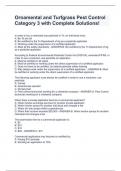
In order to buy a restricted-use pesticide in Tn, an individual must: A. Be 16 yrs old B. Be certified by the Tn Department of Ag as a pesticide applicator C. Working under the supervision of a certified applicator D. Meet all the safety standards - ANSWER-B. Be certified by the Tn Department of Ag as a pesticide applicator According to Federal Environmental Pesticide Control Act (FEPCA), amended FIFRA, in order to use a restriced- use pesticide an applicator: A. Must be certified in all cases B. Must be certified or working under the direct supervision of a certified applicator. C. Does not have to be certified, but attend pesticide safety training D. May always work under the supervision of a certified applicator. - ANSWER-B. Must be certified or working under the direct supervision of a certified applicator The following applicator must always be certified in order to use a restricted- use pesticide: A. Farmer B. Greenhouse operator C. Nurseryman D. Pest control technician working for a chartered company - ANSWER-D. Pest Control technician working for a chartered company When does a private applicator become a commercial applicator? A. When he/she exchange services for another private applicator B. When he/she sprays for another individual and charges a fee C. When he/ she sprays within a greenhouse D. When their income exceeds $25,000 - ANSWER-B. When he/she sprays for another individual and charges a fee The examination fee for a commercial applicator is: A. $5 B. $10 C. $15 D. $20 - ANSWER-C. $15 Commercial applicators may become re certified by: A. Paying $15 annually B. Sending an application to TDA C. Earning a certain number of re certification points during the designated period D. Attending a re certification meeting during the last year of the re certification period - ANSWER-C. Earning a certain number of re certification points during the designated period Commercial applicators who violate any provision of FIFRA may be fined: A. Civil penalty of $5,000 for each offense; Criminal penalty of $25,000 or one year in prison B. Civil penalty of $1,000 for each offense; Criminal penalty of $5,000 or one year in prison Civil penalty of $5,000 for each offense; Criminal penalty of $100,000 D. None of the above - ANSWER-A. Civil penalty of $5,000 for each offense; Criminal penalty of $25,000 or one year in prison Commercial applicators must keep records of: A. General-use pesticides B. Restricted-use pesticides C. General and Restricted-use pesticides D. Pesticides with skull and cross bones - ANSWER-C. General and Restricted-use pesticides Records of pesticide application must be maintained for a period of: A. One year B. Two years C. Three years D. Five years - ANSWER-B. Two years Symptoms of phytotoxicity do not include: A. abnormal growth B. holes in leaves C. leaf drop D. foliar burn - ANSWER-B. holes in leaves Which plants are usually most susceptible to pesticide damage? A. woody plants B. flowering plants C. Potted plants D. Herbaceous plants - ANSWER-D. herbaceous plants Pesticide persistence is influence by: A. application rate B. temperature C. Moisture conditions D. all o

Geschreven voor
- Instelling
- Ornamental and Turfgrass Pest Control
- Vak
- Ornamental and Turfgrass Pest Control
Documentinformatie
- Geüpload op
- 1 februari 2024
- Aantal pagina's
- 16
- Geschreven in
- 2023/2024
- Type
- Tentamen (uitwerkingen)
- Bevat
- Vragen en antwoorden
Onderwerpen
-
ornamental and turfgrass pest control category 3 w
-
ornamental and turfgrass pest control stuvia
-
in order to buy a restricted use pesticide in tn
-
according to federal environmental pesticide contr

Ook beschikbaar in voordeelbundel