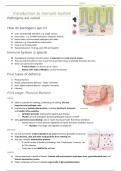
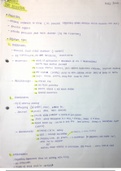
Introduction to Immune System
Pathogens are varied
How do pathogens get in?
Cuts/ wounds/post-operation -e.g. Staph. aureus
Insect bites – e.g. Sandfly-leishmania, mosquito- malaria
Animal bites- environmental pathogens and rabies
Airborne- e.g. Mycobacterium tuberculosis
Food- E.coli & Salmonella
Human behaviour- IV drugs users HIV and hepatitis
Immune System is special
Development of proper immune system is important and costs a lot of energy
They are only cells able to move in and out of any other tissue- essentially they have free rein
Some can survive very long time
o T-cells in blood- can live for up to 9 years
o Plasma cells- make antibodies- can live for decades
Four types of defence
1) Physical barriers
2) Rapid, indiscriminate defences- ‘innate’ immunity
3) Slow, highly targeted defence- ‘adaptive’ immunity
4) Memory
First stage- Physical Barriers
SALIVA
Saliva is essential for chewing, swallowing and talking- also has
important anti-pathogen roles
Contains lot of antimicrobial proteins- including lactoferrin, lysozyme
and smaller active peptides
o Hydrogen peroxide- helps protect against gum disease
o Mucins- prevent pathogenic bacteria getting grip of gums or teeth
Saliva promotes wound healing- cuts in mouth heal much faster than those elsewhere
o Growth factors in saliva promote epithelial cell repair and other mediators such as:
Histatins- encourage cell migration to would site
EAR WAX
Ear wax (cerumen)- made by glands in ear canal and moves gradually towards ear
Traps bacteria, dust and other small particles from entering ear
Wax also contains antimicrobial proteins
o It can kill variety of bacteria (including E.Coli, H Influenzae, S aureus) -up
to 99% effective
o Fungi seen to be inhibited by ear wax
MUCUS
Mucus important to health of tissues- interact with environment- respiratory tract, gastrointestinal tract and
female reproductive system
Major component of mucus is mucin- large family of glycosylated proteins
, Mucin-containing mucus has many roles:
o Dense- bacteria struggle to get through it and get trapped
o Slippery- they are unable to get foothold on tissue
o Also contains many antimicrobial peptides and proteins – directly kill pathogens
COUGHING and SNEEZING
CILIA
Bronchi contain some cells- coated in small hairs called cilia
Beat in coordinated manner to shift water, mucus and pathogens from surface of cells- allow
them to be coughed up- Mucociliary clearance
Cilia are shortened by cigarette smoke
Summary of physical barriers
1) It’s critical that pathogens are prevented from entering tissue- so many defences are present at interface of body
with environment
2) These include- waterproof, repellent surfaces coated with mucus, wax and hairs
3) These defences are very successful at preventing infection
Innate immunity- antimicrobial peptides
Antimicrobial peptide example of action Innate immunity-cells
In which organs does cellular immunity develop?
Primary lymphoid organs- where immune cells are generated and mature
o Thymus- Site of T cell differentiation and maturation
o Bone marrow- where most immune cells are produced and divide
Secondary lymphoid organs- where immune cells mature and activated
o Lymph nodes- found throughout lymphatic system. Humans are over
200, number varies between people
Multiplication of T and B cells in lymph nodes occurs in response to
infection (swollen glands)
o Spleen- in upper left abdomen. T and B cells are stored here and it can
filter germs in bloodstream
o Peyer’s patches are embedded in small intestine.
Important for generating responses against gut pathogens
Pathogens are varied
How do pathogens get in?
Cuts/ wounds/post-operation -e.g. Staph. aureus
Insect bites – e.g. Sandfly-leishmania, mosquito- malaria
Animal bites- environmental pathogens and rabies
Airborne- e.g. Mycobacterium tuberculosis
Food- E.coli & Salmonella
Human behaviour- IV drugs users HIV and hepatitis
Immune System is special
Development of proper immune system is important and costs a lot of energy
They are only cells able to move in and out of any other tissue- essentially they have free rein
Some can survive very long time
o T-cells in blood- can live for up to 9 years
o Plasma cells- make antibodies- can live for decades
Four types of defence
1) Physical barriers
2) Rapid, indiscriminate defences- ‘innate’ immunity
3) Slow, highly targeted defence- ‘adaptive’ immunity
4) Memory
First stage- Physical Barriers
SALIVA
Saliva is essential for chewing, swallowing and talking- also has
important anti-pathogen roles
Contains lot of antimicrobial proteins- including lactoferrin, lysozyme
and smaller active peptides
o Hydrogen peroxide- helps protect against gum disease
o Mucins- prevent pathogenic bacteria getting grip of gums or teeth
Saliva promotes wound healing- cuts in mouth heal much faster than those elsewhere
o Growth factors in saliva promote epithelial cell repair and other mediators such as:
Histatins- encourage cell migration to would site
EAR WAX
Ear wax (cerumen)- made by glands in ear canal and moves gradually towards ear
Traps bacteria, dust and other small particles from entering ear
Wax also contains antimicrobial proteins
o It can kill variety of bacteria (including E.Coli, H Influenzae, S aureus) -up
to 99% effective
o Fungi seen to be inhibited by ear wax
MUCUS
Mucus important to health of tissues- interact with environment- respiratory tract, gastrointestinal tract and
female reproductive system
Major component of mucus is mucin- large family of glycosylated proteins
, Mucin-containing mucus has many roles:
o Dense- bacteria struggle to get through it and get trapped
o Slippery- they are unable to get foothold on tissue
o Also contains many antimicrobial peptides and proteins – directly kill pathogens
COUGHING and SNEEZING
CILIA
Bronchi contain some cells- coated in small hairs called cilia
Beat in coordinated manner to shift water, mucus and pathogens from surface of cells- allow
them to be coughed up- Mucociliary clearance
Cilia are shortened by cigarette smoke
Summary of physical barriers
1) It’s critical that pathogens are prevented from entering tissue- so many defences are present at interface of body
with environment
2) These include- waterproof, repellent surfaces coated with mucus, wax and hairs
3) These defences are very successful at preventing infection
Innate immunity- antimicrobial peptides
Antimicrobial peptide example of action Innate immunity-cells
In which organs does cellular immunity develop?
Primary lymphoid organs- where immune cells are generated and mature
o Thymus- Site of T cell differentiation and maturation
o Bone marrow- where most immune cells are produced and divide
Secondary lymphoid organs- where immune cells mature and activated
o Lymph nodes- found throughout lymphatic system. Humans are over
200, number varies between people
Multiplication of T and B cells in lymph nodes occurs in response to
infection (swollen glands)
o Spleen- in upper left abdomen. T and B cells are stored here and it can
filter germs in bloodstream
o Peyer’s patches are embedded in small intestine.
Important for generating responses against gut pathogens