
Squaring The Circular Economy (GEO4-2338)
Lecture 1: The concept of a Circular Economy
Summary Article 1: Circular Economy
- W.R. Stahel (2016)
Summary Article 2: The history and current applications of the circular economy concept
- K. Winans, A. Kendall, H. Deng (2017)
Summary Article 3: Circular Economy: The Concept and its Limitations
- J. Korhonen, Antero Honkasalo, Jyri Seppälä (2018)
Different backgrounds
1. Growing environmentalism (1960s)
2. System thinking (1970s)
o Spaceship earth
o Club of Rome
3. Industrial Metabolism/ecology (1990s)
4. Alternative economic systems (2000s-2010s)
Different backgrounds
1. Contributions from various disciplines
2. Economics
o Industrial Metabolism/ecology
o Material efficiency
3. Sciences/engineering
4. Architects
5. Environmental sciences
o Life cycle analysis
o Material flow analysis
Policy background
1
,The Waste Hierarchy (Ladder van Lansink)
Global policy development
1. Waste management
• Public health
• Waste volume reduction (incineration)
• Resource management
2. Integrated Environmental Policy
• Sustainability: Brundtland Commission (1987) defined sustainability as “meeting the needs of the
present without compromising the ability of future generations to meet their own needs.”
• Sustainable Development Goals
Embracing a CE
• Companies
• Countries: China, EU (Finland, Netherlands, Slovenia)
• Regions
In practice, goals and approaches vary widely
What is a circular economy?
Circular economy: an industrial system that is restorative or regenerative by intention and design. It replaces the
‘end-of-life’ concept with restoration, shifts towards the use of renewable energy, eliminates the use of toxic
chemicals, which impair reuse, and aims for the elimination of waste through the superior design of materials,
products, systems, and, within this, business models.
Definitions of CE vary
Kirchherr et al. identified 114 definitions
What is circular economy (revisited)?
Circular economy: an economic system that replaces the ‘end of-life’ concept with reducing, alternatively reusing,
recycling, and recovering materials in production, distribution, and consumption processes. It operates at the micro
level (products, companies, consumers), meso level (eco-industrial parks) and macro level (city, region, nation and
beyond), with the aim to accomplish sustainable development, thus simultaneously creating environmental quality,
economic prosperity, and social equity, to the benefit of current and future generations.
2
,Definition for policy (Netherlands)
“In a circular economy we manage products, materials and resources in an efficient and socially responsible way
within the carrying capacity of planet Earth, so that future generations remain having access to material prosperity”
3
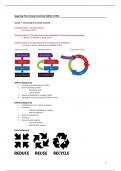
, 3, 5, 7, 8 or 10 R’s, essentially:
Drivers for a circular economy
1. Economics
• Need to decouple economic growth from resource use
• Geo-politics, criticality & scarcity
• Local jobs generation
2. Environment and sustainability
• Mining
• Waste
• Energy, climate, and air pollution
Measuring Material Use
1. Material use: apparent consumption
2. Environmental Kuznets Curve
3. Material intensity: intensity of use, per capita consumption
𝑋𝑖
𝐼𝑛𝑡𝑒𝑛𝑠𝑖𝑡𝑦 𝑜𝑓 𝑢𝑠𝑒 (𝐼𝑈) =
𝐺𝐷𝑃
Where:
• IU = intensity of material use
• Xi = the apparent consumption of a specific material during year I
• GDP = gross domestic product (total output of economy)
Understanding decoupling
Three indicators to measure progress
4
Lecture 1: The concept of a Circular Economy
Summary Article 1: Circular Economy
- W.R. Stahel (2016)
Summary Article 2: The history and current applications of the circular economy concept
- K. Winans, A. Kendall, H. Deng (2017)
Summary Article 3: Circular Economy: The Concept and its Limitations
- J. Korhonen, Antero Honkasalo, Jyri Seppälä (2018)
Different backgrounds
1. Growing environmentalism (1960s)
2. System thinking (1970s)
o Spaceship earth
o Club of Rome
3. Industrial Metabolism/ecology (1990s)
4. Alternative economic systems (2000s-2010s)
Different backgrounds
1. Contributions from various disciplines
2. Economics
o Industrial Metabolism/ecology
o Material efficiency
3. Sciences/engineering
4. Architects
5. Environmental sciences
o Life cycle analysis
o Material flow analysis
Policy background
1
,The Waste Hierarchy (Ladder van Lansink)
Global policy development
1. Waste management
• Public health
• Waste volume reduction (incineration)
• Resource management
2. Integrated Environmental Policy
• Sustainability: Brundtland Commission (1987) defined sustainability as “meeting the needs of the
present without compromising the ability of future generations to meet their own needs.”
• Sustainable Development Goals
Embracing a CE
• Companies
• Countries: China, EU (Finland, Netherlands, Slovenia)
• Regions
In practice, goals and approaches vary widely
What is a circular economy?
Circular economy: an industrial system that is restorative or regenerative by intention and design. It replaces the
‘end-of-life’ concept with restoration, shifts towards the use of renewable energy, eliminates the use of toxic
chemicals, which impair reuse, and aims for the elimination of waste through the superior design of materials,
products, systems, and, within this, business models.
Definitions of CE vary
Kirchherr et al. identified 114 definitions
What is circular economy (revisited)?
Circular economy: an economic system that replaces the ‘end of-life’ concept with reducing, alternatively reusing,
recycling, and recovering materials in production, distribution, and consumption processes. It operates at the micro
level (products, companies, consumers), meso level (eco-industrial parks) and macro level (city, region, nation and
beyond), with the aim to accomplish sustainable development, thus simultaneously creating environmental quality,
economic prosperity, and social equity, to the benefit of current and future generations.
2
,Definition for policy (Netherlands)
“In a circular economy we manage products, materials and resources in an efficient and socially responsible way
within the carrying capacity of planet Earth, so that future generations remain having access to material prosperity”
3
, 3, 5, 7, 8 or 10 R’s, essentially:
Drivers for a circular economy
1. Economics
• Need to decouple economic growth from resource use
• Geo-politics, criticality & scarcity
• Local jobs generation
2. Environment and sustainability
• Mining
• Waste
• Energy, climate, and air pollution
Measuring Material Use
1. Material use: apparent consumption
2. Environmental Kuznets Curve
3. Material intensity: intensity of use, per capita consumption
𝑋𝑖
𝐼𝑛𝑡𝑒𝑛𝑠𝑖𝑡𝑦 𝑜𝑓 𝑢𝑠𝑒 (𝐼𝑈) =
𝐺𝐷𝑃
Where:
• IU = intensity of material use
• Xi = the apparent consumption of a specific material during year I
• GDP = gross domestic product (total output of economy)
Understanding decoupling
Three indicators to measure progress
4



