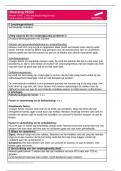
PYC2614
EXAM PACK
FOR ASSISTANCE WITH THIS MODULE +27 67 171 1739
,CONTENTS
Feedback on Assignment 1
Assignment 01 provided an opportunity for you to familiarise yourself with this module. Below is
a summary of the relevant texts in the Study Guide and the prescribed texts (where appropriate)
to support the answer that is deemed correct for each question. We have provided the question
first in green for easy reference. The correct answer is stated in grey at the beginning of each
question discussion.
QUESTION 01
The question
The learning outcomes of Theme 1 do NOT include this outcome:
(a) Define the concept of “community” in various contexts.
(b) Explain the focus of community psychology as a sub-discipline.
(c) Train the student as a fully-fledged professional that can perform and implement formal
community interventions.
(d) Discuss the importance and relevance of context to understanding community
psychology.
The correct answer is (c) – Train the student as a fully-fledged professional that can
perform and implement formal community interventions.
In the Study Guide in Theme 1, we show that the outcomes of the theme are to:
• Define the concept of “community” in various contexts.
• Explain the focus of community psychology as a sub-discipline.
• Discuss the importance and relevance of context to understanding community psychology.
Therefore, option (c) – Train the student as a fully-fledged professional that can perform and
implement formal community interventions, is not relevant here. This is one of the purposes of
this module, Community psychology: Building foundations, as shown under the section, Purpose
and Approach of the Module.
This makes the following options relevant to the outcomes of Theme 1:
• Option (a) – Define the concept of “community” in various contexts.
• Option (b) – Explain the focus of community psychology as a sub-discipline.
• Option (d) – Discuss the importance and relevance of context to understanding community
psychology.
2
, PYC2614/201
QUESTION 02
The question
The following statement is NOT correct with regard to worldviews, epistemologies, and the
understanding of psychological phenomena.
(a) There are Western and non-Western epistemologies (worldviews/ways of viewing reality)
on understanding psychological phenomena and community.
(b) The mainstream modern psychology epistemology emanates from the Western way of
viewing reality.
(c) Mainstream modern psychology claims to function as a value-free science without any
political undertones.
(d) The bio-medical model relies on the assumptions of cause and effect and is embedded in
the African psychology.
The correct answer is (d) – The bio-medical model relies on the assumptions of cause
and effect and is embedded in African psychology.
In Section A, Theme 1 (1.2.2) in the Study Guide we show the following regarding the bio-
medical model:
• The model is closely aligned with Western medicine.
• It places focus on the individual as the unit of analysis.
• It emphasises the role of biological factors (particularly the brain) in influencing and
affecting human behaviour – psychological challenges are thus viewed as brain diseases
(Deacon, 2013).
• It relies on the assumptions of cause and effect – mental or psychological illness is
interpreted as having an underlying biological cause.
• It focuses on the cure of individuals who are already ill – the belief is that treating the
biological cause of the illness through pharmacological remedies will produce the
desired effects (Deacon, 2013).
In Section A, Theme 1 (1.2.3) in the Study Guide we also show that the following are the
premises of African psychology:
• It organises the world in a hierarchy of beings.
• The ancestors play an important role in this hierarchy. The universe is seen as organic
and ecological, and no or little distinction is made between nature and culture.
• Therefore, causality is understood to be linked to the interaction of life forces. This leads
to a holistic view of life as a cosmic unity.
• Knowledge is gained through participation and connecting, not so much through
separation and abstraction. Therefore, the observer (researcher or psychology practitioner)
is part of the system that is observed and influences it profoundly.
• Life is viewed as communal and personhood (who a person is) is defined in relation to
the community, not the self. Parental responsibilities also reside not just with the father and
mother, but also the extended family and the community. Therefore, it can be said that
personhood is relationally defined (in terms of Ubuntu, that is humanity). Individuals and
communities are seen as interdependent.
3
, Therefore, option (d), the bio-medical model relies on the assumptions of cause and effect, and
is embedded in African psychology, is not correct as the two worldviews, the bio-medical model
and African psychology, focus on different aspects regarding community living as follows:
• The bio-medical model is rooted in Western beliefs, including individualism (putting the
wellbeing and progress of individual people above that of groups or communities) and
cause-and-effect.
• African psychology emphasises communal living and understands causality in
relation to the interaction of life forces.
The other options are correct:
• Option (a) – There are Western and non-Western epistemologies (worldviews/ways of
viewing reality) on understanding psychological phenomena and community.
See Section A, Theme 1 (1.2) in the Study Guide – we show that it is clear from
psychology texts today that there are Western and non-Western epistemologies
(worldviews/ways of viewing reality) on understanding psychological phenomena, including
the concept “community”. These epistemologies signify the European knowledge and
values, as well as the knowledge and values derived from other continents, including
Africa, respectively.
• Option (b) – The mainstream modern psychology epistemology emanates from the
Western way of viewing reality.
See Section A, Theme 1 (1.2.1) in the Study Guide – we show that the mainstream
modern psychology epistemology emanates from the Western way of viewing reality
and assumes that psychology is an objective and universal science. In other words, it is
seen as the only scientific and fact-based way of understanding an individual. It does not
consider contextual particularities such as sex, race, culture, and the values and meanings
of others in understanding an individual (Mkhize, 2013).
• Option (c) – Mainstream modern psychology claims to function as a value-free science
without any political undertones.
See Section A, Theme 1 (1.2.1) in the Study Guide – we have shown that Western
culture also believes that knowledge should be produced through methods of science, in
that objective truth can be discovered if methods of research are refined. Western scientific
methods claim that objective knowledge can be created without considering the role of the
observer or researcher in the process of research. Due to this approach, mainstream
psychology claims to function as a value-free science without any political undertones.
These values gave rise to the idea that the psychologist is the expert. Moreover, the expert
can claim to be an individual of a high order due to the knowledge that has been gained
through scientific research. This claim is used to empower individuals (Prilleltensky & Fox,
1997). In a particular situation, the so-called “expert” can claim to have more knowledge
regarding a group of individuals in a community. This power dynamic can have immense
consequences when the expert approaches the community in need, as they would govern
or have an influence on how the community lives.
4
EXAM PACK
FOR ASSISTANCE WITH THIS MODULE +27 67 171 1739
,CONTENTS
Feedback on Assignment 1
Assignment 01 provided an opportunity for you to familiarise yourself with this module. Below is
a summary of the relevant texts in the Study Guide and the prescribed texts (where appropriate)
to support the answer that is deemed correct for each question. We have provided the question
first in green for easy reference. The correct answer is stated in grey at the beginning of each
question discussion.
QUESTION 01
The question
The learning outcomes of Theme 1 do NOT include this outcome:
(a) Define the concept of “community” in various contexts.
(b) Explain the focus of community psychology as a sub-discipline.
(c) Train the student as a fully-fledged professional that can perform and implement formal
community interventions.
(d) Discuss the importance and relevance of context to understanding community
psychology.
The correct answer is (c) – Train the student as a fully-fledged professional that can
perform and implement formal community interventions.
In the Study Guide in Theme 1, we show that the outcomes of the theme are to:
• Define the concept of “community” in various contexts.
• Explain the focus of community psychology as a sub-discipline.
• Discuss the importance and relevance of context to understanding community psychology.
Therefore, option (c) – Train the student as a fully-fledged professional that can perform and
implement formal community interventions, is not relevant here. This is one of the purposes of
this module, Community psychology: Building foundations, as shown under the section, Purpose
and Approach of the Module.
This makes the following options relevant to the outcomes of Theme 1:
• Option (a) – Define the concept of “community” in various contexts.
• Option (b) – Explain the focus of community psychology as a sub-discipline.
• Option (d) – Discuss the importance and relevance of context to understanding community
psychology.
2
, PYC2614/201
QUESTION 02
The question
The following statement is NOT correct with regard to worldviews, epistemologies, and the
understanding of psychological phenomena.
(a) There are Western and non-Western epistemologies (worldviews/ways of viewing reality)
on understanding psychological phenomena and community.
(b) The mainstream modern psychology epistemology emanates from the Western way of
viewing reality.
(c) Mainstream modern psychology claims to function as a value-free science without any
political undertones.
(d) The bio-medical model relies on the assumptions of cause and effect and is embedded in
the African psychology.
The correct answer is (d) – The bio-medical model relies on the assumptions of cause
and effect and is embedded in African psychology.
In Section A, Theme 1 (1.2.2) in the Study Guide we show the following regarding the bio-
medical model:
• The model is closely aligned with Western medicine.
• It places focus on the individual as the unit of analysis.
• It emphasises the role of biological factors (particularly the brain) in influencing and
affecting human behaviour – psychological challenges are thus viewed as brain diseases
(Deacon, 2013).
• It relies on the assumptions of cause and effect – mental or psychological illness is
interpreted as having an underlying biological cause.
• It focuses on the cure of individuals who are already ill – the belief is that treating the
biological cause of the illness through pharmacological remedies will produce the
desired effects (Deacon, 2013).
In Section A, Theme 1 (1.2.3) in the Study Guide we also show that the following are the
premises of African psychology:
• It organises the world in a hierarchy of beings.
• The ancestors play an important role in this hierarchy. The universe is seen as organic
and ecological, and no or little distinction is made between nature and culture.
• Therefore, causality is understood to be linked to the interaction of life forces. This leads
to a holistic view of life as a cosmic unity.
• Knowledge is gained through participation and connecting, not so much through
separation and abstraction. Therefore, the observer (researcher or psychology practitioner)
is part of the system that is observed and influences it profoundly.
• Life is viewed as communal and personhood (who a person is) is defined in relation to
the community, not the self. Parental responsibilities also reside not just with the father and
mother, but also the extended family and the community. Therefore, it can be said that
personhood is relationally defined (in terms of Ubuntu, that is humanity). Individuals and
communities are seen as interdependent.
3
, Therefore, option (d), the bio-medical model relies on the assumptions of cause and effect, and
is embedded in African psychology, is not correct as the two worldviews, the bio-medical model
and African psychology, focus on different aspects regarding community living as follows:
• The bio-medical model is rooted in Western beliefs, including individualism (putting the
wellbeing and progress of individual people above that of groups or communities) and
cause-and-effect.
• African psychology emphasises communal living and understands causality in
relation to the interaction of life forces.
The other options are correct:
• Option (a) – There are Western and non-Western epistemologies (worldviews/ways of
viewing reality) on understanding psychological phenomena and community.
See Section A, Theme 1 (1.2) in the Study Guide – we show that it is clear from
psychology texts today that there are Western and non-Western epistemologies
(worldviews/ways of viewing reality) on understanding psychological phenomena, including
the concept “community”. These epistemologies signify the European knowledge and
values, as well as the knowledge and values derived from other continents, including
Africa, respectively.
• Option (b) – The mainstream modern psychology epistemology emanates from the
Western way of viewing reality.
See Section A, Theme 1 (1.2.1) in the Study Guide – we show that the mainstream
modern psychology epistemology emanates from the Western way of viewing reality
and assumes that psychology is an objective and universal science. In other words, it is
seen as the only scientific and fact-based way of understanding an individual. It does not
consider contextual particularities such as sex, race, culture, and the values and meanings
of others in understanding an individual (Mkhize, 2013).
• Option (c) – Mainstream modern psychology claims to function as a value-free science
without any political undertones.
See Section A, Theme 1 (1.2.1) in the Study Guide – we have shown that Western
culture also believes that knowledge should be produced through methods of science, in
that objective truth can be discovered if methods of research are refined. Western scientific
methods claim that objective knowledge can be created without considering the role of the
observer or researcher in the process of research. Due to this approach, mainstream
psychology claims to function as a value-free science without any political undertones.
These values gave rise to the idea that the psychologist is the expert. Moreover, the expert
can claim to be an individual of a high order due to the knowledge that has been gained
through scientific research. This claim is used to empower individuals (Prilleltensky & Fox,
1997). In a particular situation, the so-called “expert” can claim to have more knowledge
regarding a group of individuals in a community. This power dynamic can have immense
consequences when the expert approaches the community in need, as they would govern
or have an influence on how the community lives.
4