Principles of Management IIB (Entrepreneurship) by ProfessorBurgerQueen
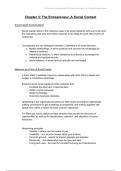
Chapter 3: The Entrepreneur, A Social Context
Social Capital Contextualised
- Social Capital refers to the collective value of all social networks (who you know) and
the inclinations that arise from these networks to do things for each other (norms of
reciprocity)
- Conceptually one can distinguish between 3 dimensions of social structure:
a. Market relationships, in which products and services are exchanged for
money or bartered.
b. Hierarchical relations, in which obedience to authority is exchanged for
material and spiritual security.
c. Social relations, in which favours and gifts are exchanged.
Networks as a Form of Social Capital
- A firm's effort to establish long-term relationships with other firms to obtain and
sustain a competitive advantage.
- Entrepreneurial social capital provides networks that:
- Facilitate the discovery of opportunities;
- Obtain scarce resources;
- Obtain knowledge;
- Overcome business obstacles.
- Networking in the organisational behaviour field means knowing the right people,
making connections to get something accomplished, and working together with
people from within a system to reach common objectives.
- For Start-ups, social capital provides networks that provide the discovery of
opportunities, as well as the identification, collection, and allocation of scarce
resources.
- Networking principles
- Visibility – others must be aware of you
- Credibility – you must be honest about your motives
- Common ground – search for shared interests and activities
- Reciprocity – the relationship must be ‘give and take’
- A long term view - the need for constant nurturing and maintenance
Chapter 3: The Entrepreneur, A Social Context
Social Capital Contextualised
- Social Capital refers to the collective value of all social networks (who you know) and
the inclinations that arise from these networks to do things for each other (norms of
reciprocity)
- Conceptually one can distinguish between 3 dimensions of social structure:
a. Market relationships, in which products and services are exchanged for
money or bartered.
b. Hierarchical relations, in which obedience to authority is exchanged for
material and spiritual security.
c. Social relations, in which favours and gifts are exchanged.
Networks as a Form of Social Capital
- A firm's effort to establish long-term relationships with other firms to obtain and
sustain a competitive advantage.
- Entrepreneurial social capital provides networks that:
- Facilitate the discovery of opportunities;
- Obtain scarce resources;
- Obtain knowledge;
- Overcome business obstacles.
- Networking in the organisational behaviour field means knowing the right people,
making connections to get something accomplished, and working together with
people from within a system to reach common objectives.
- For Start-ups, social capital provides networks that provide the discovery of
opportunities, as well as the identification, collection, and allocation of scarce
resources.
- Networking principles
- Visibility – others must be aware of you
- Credibility – you must be honest about your motives
- Common ground – search for shared interests and activities
- Reciprocity – the relationship must be ‘give and take’
- A long term view - the need for constant nurturing and maintenance