Principles of Management IIB (Entrepreneurship) by ProfessorBurgerQueen
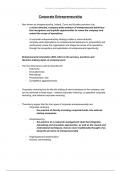
Corporate Entrepreneurship
- Also known as intrapreneurship, Ireland, Covin and Kuratko perceive it as:
- a vision-directed, company-wide embrace of entrepreneurial behaviour
that recognises and exploits opportunities to renew the company and
extend the scope of operations;
- A corporate entrepreneurship strategy implies a vision-directed,
company-wide dependence on entrepreneurial behaviour to purposefully and
continuously renew the organisation and shape the scope of its operations
through the recognition and exploitation of entrepreneurial opportunity;
- Entrepreneurial orientation (EO) refers to the process, practices and
decision-making styles at company-level
- The five dimensions used to describe EO
- Autonomy;
- Innovativeness;
- Risk-taking;
- Proactiveness; and,
- Competitive aggressiveness
- Corporate venturing has do with the adding of new businesses to the company, and
can be achieved in three ways – internal corporate venturing, co-operative corporate
venturing, and external corporate venturing;
- Thornberry argues that the four types of corporate entrepreneurship are:
- Corporate venturing
- the practice of directly investing corporate funds into external
startup companies
- Intrapreneuring
- the practice of a corporate management style that integrates
risk-taking and innovation approaches, as well as the reward and
motivational techniques, that are more traditionally thought of as
being the province of entrepreneurship
- Organisational transformation
- Industry rule-breaking
Corporate Entrepreneurship
- Also known as intrapreneurship, Ireland, Covin and Kuratko perceive it as:
- a vision-directed, company-wide embrace of entrepreneurial behaviour
that recognises and exploits opportunities to renew the company and
extend the scope of operations;
- A corporate entrepreneurship strategy implies a vision-directed,
company-wide dependence on entrepreneurial behaviour to purposefully and
continuously renew the organisation and shape the scope of its operations
through the recognition and exploitation of entrepreneurial opportunity;
- Entrepreneurial orientation (EO) refers to the process, practices and
decision-making styles at company-level
- The five dimensions used to describe EO
- Autonomy;
- Innovativeness;
- Risk-taking;
- Proactiveness; and,
- Competitive aggressiveness
- Corporate venturing has do with the adding of new businesses to the company, and
can be achieved in three ways – internal corporate venturing, co-operative corporate
venturing, and external corporate venturing;
- Thornberry argues that the four types of corporate entrepreneurship are:
- Corporate venturing
- the practice of directly investing corporate funds into external
startup companies
- Intrapreneuring
- the practice of a corporate management style that integrates
risk-taking and innovation approaches, as well as the reward and
motivational techniques, that are more traditionally thought of as
being the province of entrepreneurship
- Organisational transformation
- Industry rule-breaking