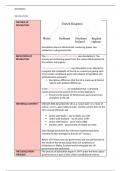
Devolution
DEVOLUTION
THE IDEA OF
DEVOLUTION
Devolution refers to Westminster conferring power and
authority to sub governments
DEFINITIONS OF The house of commons library 2022 says devolution is ‘the
DEVOLUTION process of transferring power from the centre (Westminster) to
the nations and regions’
Masterman and Murray 2022 says devolution is an ‘attempt to
recognise the complexity of the UK as a country by giving each
of its smaller constituent parts some degree of legislative and
administrative autonomy’
Recognises difference that the UK is made up of distinct
nations with political differences
In the continuity bill case, its established that ‘a devolved
system preserves the powers of the central legislature’
Preserves the power of Westminster government over
all aspects in the UK
HISTORICAL CONTEXT Mitchell 2006 described the UK as a ‘union state’ or a ‘state of
unions’ as it is a pluri-national state, and the current form of the
UK is around 100 years old
Union with Wales – law in Wales act 1535
Union with Scotland – act of union 1708
Union with Ireland – act of union 1800
Creation of NI – government of Ireland act 1920
Even though devolution has only been implemented fairly
recently the idea emerged in the late 19th century
Before 1997 there was one government and one parliament for
the whole of the UK but today there are a plethora of
institutions in Wales, Scotland and NI alongside the UK
government and parliament
THE DEVOLUTION The process of devolution began in 1997 under the New Labour
‘PROCESS’ government as a part of their wider constitutional reforms
, Devolution
Devolution occurs in bilateral processes; it wasn’t introduced in
a consolidated form – played out in a series of relationships
between Westminster and the individual constituent parts
As a result of the bilateral approach devolution is
asymmetrical meaning the devolution settlements
between the constituent parts are not the same
Devolution has a statutory basis and was also endorsed by
referendum so has popular legitimacy
Devolution is a dynamic, evolutionary process – it is often
described as a process and not a one-off event
KEY STATUTES Founding statutes:
Government of Wales Act 1998
Scotland Act 1998
Northern Ireland Act 1998
The expansion of devolution has led to these current governing
statutes:
• Government of Wales Act 2006 (as amended by 2014 &
2017 Acts)
• Scotland Act 1998 (as amended by 2012 & 2016 Acts)
• Northern Ireland Act 1998 (as amended by 2006 & 2016
Acts, 2010 Order)
WHY DEVOLVE New Labours manifesto in 1997 made several purposes clear:
POWER??? Preserve the union - by granting a certain amount of
autonomy (which was in demand for a long period of
time) to the constituent parts, then you could prevent
the threat of succession
Recognition of multiple political cultures
Preserve powers/parliamentary sovereignty – UK
parliament would remain sovereign and be free to
change the constitution as it saw fit
WHY DEVOLVE POWER There was an attempt to give Scotland devolution in the 1970s,
TO SCOTLAND??? so this was in response to that failure:
Claim of Right 1988 – pledged to go on and effectively
design blueprint for Scottish devolution and they did,
and this blueprint was published in Scotland’s
Parliament, Scotland’s Right (1995)
This set the terms for what would be implemented in
the Scotland Act years later
WHY DEVOLVE POWER ‘Ending the troubles’ – highly contested debate of a
TO NORTHERN united Ireland and those wanting to remain in the UK –
DEVOLUTION
THE IDEA OF
DEVOLUTION
Devolution refers to Westminster conferring power and
authority to sub governments
DEFINITIONS OF The house of commons library 2022 says devolution is ‘the
DEVOLUTION process of transferring power from the centre (Westminster) to
the nations and regions’
Masterman and Murray 2022 says devolution is an ‘attempt to
recognise the complexity of the UK as a country by giving each
of its smaller constituent parts some degree of legislative and
administrative autonomy’
Recognises difference that the UK is made up of distinct
nations with political differences
In the continuity bill case, its established that ‘a devolved
system preserves the powers of the central legislature’
Preserves the power of Westminster government over
all aspects in the UK
HISTORICAL CONTEXT Mitchell 2006 described the UK as a ‘union state’ or a ‘state of
unions’ as it is a pluri-national state, and the current form of the
UK is around 100 years old
Union with Wales – law in Wales act 1535
Union with Scotland – act of union 1708
Union with Ireland – act of union 1800
Creation of NI – government of Ireland act 1920
Even though devolution has only been implemented fairly
recently the idea emerged in the late 19th century
Before 1997 there was one government and one parliament for
the whole of the UK but today there are a plethora of
institutions in Wales, Scotland and NI alongside the UK
government and parliament
THE DEVOLUTION The process of devolution began in 1997 under the New Labour
‘PROCESS’ government as a part of their wider constitutional reforms
, Devolution
Devolution occurs in bilateral processes; it wasn’t introduced in
a consolidated form – played out in a series of relationships
between Westminster and the individual constituent parts
As a result of the bilateral approach devolution is
asymmetrical meaning the devolution settlements
between the constituent parts are not the same
Devolution has a statutory basis and was also endorsed by
referendum so has popular legitimacy
Devolution is a dynamic, evolutionary process – it is often
described as a process and not a one-off event
KEY STATUTES Founding statutes:
Government of Wales Act 1998
Scotland Act 1998
Northern Ireland Act 1998
The expansion of devolution has led to these current governing
statutes:
• Government of Wales Act 2006 (as amended by 2014 &
2017 Acts)
• Scotland Act 1998 (as amended by 2012 & 2016 Acts)
• Northern Ireland Act 1998 (as amended by 2006 & 2016
Acts, 2010 Order)
WHY DEVOLVE New Labours manifesto in 1997 made several purposes clear:
POWER??? Preserve the union - by granting a certain amount of
autonomy (which was in demand for a long period of
time) to the constituent parts, then you could prevent
the threat of succession
Recognition of multiple political cultures
Preserve powers/parliamentary sovereignty – UK
parliament would remain sovereign and be free to
change the constitution as it saw fit
WHY DEVOLVE POWER There was an attempt to give Scotland devolution in the 1970s,
TO SCOTLAND??? so this was in response to that failure:
Claim of Right 1988 – pledged to go on and effectively
design blueprint for Scottish devolution and they did,
and this blueprint was published in Scotland’s
Parliament, Scotland’s Right (1995)
This set the terms for what would be implemented in
the Scotland Act years later
WHY DEVOLVE POWER ‘Ending the troubles’ – highly contested debate of a
TO NORTHERN united Ireland and those wanting to remain in the UK –