
Week 1:
Psychology= communicating mental representations to a person
Focus on two interlocutors
Talking:
Phonology= speech sounds
Semantics/vocab= meaning of units of language
Syntax/morphology= rules on combining words and form of words
Language= series of mental representations
Topics of communication:
- Gossip
- Advertising
- Conflict
- Family
- Leadership
- Complaining
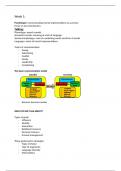
The basic communication model
- Receiver becomes sender
WHAT DO WE TALK ABOUT?
Types of goals:
- Influence
- Identity
- Interaction
- Relational resource
- Personal resource
- Arousal management
These goals lead to strategies:
- Topic of choice
- Type of arguments
- Language intensity
- Interruptions
, - Response latency
- Speaking time
- Accent mobility
- Patronizing talk
Abstract terms = what you do and how you are
Concrete terms = what accidentally happened
A1: Action assembly theory
Cognitive system is best understood in terms of their implications for action. We individuals
store action-outcome contingencies in our procedural memory. A procedural record is
formed when a certain action has a particular outcome.
Week 2:
HOW DO WE SPEAK?
Thru prosody and paralanguage
Voice:
- Objective acoustic aspects
- Judgement of voice characteristics (I think it is fast)
- Personal characteristics
- Psychological states
These determine the voice of someone
Paralanguage: article!!
A1: Paralanguage
This is the nonverbal voice qualities that differentiate individuals
- Timber = organically determined permanent voice register that distinguishes them.
You recognize their voice by timber
- Resonance = vibrations from vocal band thru body
- Loudness = intensity or volume
+ social situational norms: silent in library
+ environmental situations: in traffic you talk louder
- Tempo = fast: willingness, warning, anger etc, cultures differ
- Pitch = highness of tone. With cultural differ
+ occupational functions: nurse high to children
+ social situational setting: change pitch in situation like ‘can you move?’
+ attitudinal functions: low is boredom or fear and high is cheer or anger of joy
- Syllabic duration = control the speed or tempo of each syllable. Hesitation is a long
mmm.
- Rhythm = combination of different patterns of pitches
A2: Intonation and persuasion
The goal of the study was to assess how intonation influences respondents’ behavioral
intention. Intonation is the variation in pitch while speaking. There is an optimum of
intonation when it comes to persuading someone. A greater rate of intonation is associated
with less persuasion.
Psychology= communicating mental representations to a person
Focus on two interlocutors
Talking:
Phonology= speech sounds
Semantics/vocab= meaning of units of language
Syntax/morphology= rules on combining words and form of words
Language= series of mental representations
Topics of communication:
- Gossip
- Advertising
- Conflict
- Family
- Leadership
- Complaining
The basic communication model
- Receiver becomes sender
WHAT DO WE TALK ABOUT?
Types of goals:
- Influence
- Identity
- Interaction
- Relational resource
- Personal resource
- Arousal management
These goals lead to strategies:
- Topic of choice
- Type of arguments
- Language intensity
- Interruptions
, - Response latency
- Speaking time
- Accent mobility
- Patronizing talk
Abstract terms = what you do and how you are
Concrete terms = what accidentally happened
A1: Action assembly theory
Cognitive system is best understood in terms of their implications for action. We individuals
store action-outcome contingencies in our procedural memory. A procedural record is
formed when a certain action has a particular outcome.
Week 2:
HOW DO WE SPEAK?
Thru prosody and paralanguage
Voice:
- Objective acoustic aspects
- Judgement of voice characteristics (I think it is fast)
- Personal characteristics
- Psychological states
These determine the voice of someone
Paralanguage: article!!
A1: Paralanguage
This is the nonverbal voice qualities that differentiate individuals
- Timber = organically determined permanent voice register that distinguishes them.
You recognize their voice by timber
- Resonance = vibrations from vocal band thru body
- Loudness = intensity or volume
+ social situational norms: silent in library
+ environmental situations: in traffic you talk louder
- Tempo = fast: willingness, warning, anger etc, cultures differ
- Pitch = highness of tone. With cultural differ
+ occupational functions: nurse high to children
+ social situational setting: change pitch in situation like ‘can you move?’
+ attitudinal functions: low is boredom or fear and high is cheer or anger of joy
- Syllabic duration = control the speed or tempo of each syllable. Hesitation is a long
mmm.
- Rhythm = combination of different patterns of pitches
A2: Intonation and persuasion
The goal of the study was to assess how intonation influences respondents’ behavioral
intention. Intonation is the variation in pitch while speaking. There is an optimum of
intonation when it comes to persuading someone. A greater rate of intonation is associated
with less persuasion.



