STAT PEARLS- CHSOS Exam 2023 with complete solution
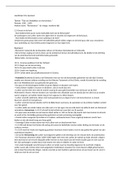
What are the 6 hierarchical levels of Bloom Taxonomy? - The revised Bloom taxonomy has six hierarchical levels: remember, understand, apply, analyze, evaluate, and create Remember- Recall and understanding show basic knowledge of a topic. When a learner moves to the evaluation phase, he/she has the ability to diagnose and treat but move beyond that towards critically appraising other methods. Understand Apply- When a learner applies information, he/she can show how they understand the knowledge and use it in clinical practice. Analyze Evaluate Create What type of simulation is stopped repeatedly during the scenario? When is this type of simulation used? - RAPID CYCLE DELIBERATIVE: Feedback in rapid cycle deliberative practice comes during multiple pauses, and micro debriefs within the scenario. Microdebriefing and the subsequent repetition of some or all of the scenarios allow for the incorporation of this feedback during iterative cycles of the simulation. Rapid cycle deliberative practice allows for multiple learning points to be addressed during different micro debriefs. Highly scripted, algorithmic cases, such as those in a resuscitation, have been studied for use in rapid cycle deliberative practice. A medical simulation program has been started at a facility. While participants seem to enjoy their simulation scenarios, the post-course surveys suggest that they would like better-quality feedback on how they have done. Before the next simulation course, a literature review of recent trends in simulation debriefing is done, and a new debriefing technique is considered to improve the learning experience. Which of the following innovations is most likely to improve the quality of debriefing for the participants? - Giving observers specific tasks to complete while they observe their peers during a scenario and using these during the feedback session. There is some evidence for the use of "collaboration scripts," which are instructional tools with content-specific roles and activities for non-active participants to complete while they watch others. These may result in better quality feedback for the participants at the end of each scenario. High-fidelity simulation is appropriate at all four levels of Miller's pyramid of clinical competence. What are all four levels of Miller's pyramid of clinical competence? And examples of how each level is tested. - An understanding of educational principles such as Miller's pyramid of clinical competence and Benner's novice-to-expert model, guide the determination of the appropriate level of fidelity. "Shows how" refers to the demonstration of clinical skills, which can be tested by OSCE, standardized patients, clinical exams, etc. (competency). "Does" refers to the top of the pyramid and correlates to daily patient care, which can be assessed by direct observation in clinical settings (performance). "Knows how" refers to the application of knowledge and can be tested by clinical problem-solving. "Knows" refers to the bottom of the pyramid and correlates with knowledge, which can be tested by written exams. Miller's pyramid and how it is tested (simplified) - Knows- written exams Knows how- clinical problem solving Shows how- OSCE, clinical exams Does- direct observation in clinical setting In Miller's pyramidal model, a learner progresses from knowledge (having knowledge about a procedure) to competence (having knowledge about how to do a procedure) to performance (being able to demonstrate the procedure) to action (actually performing the procedure in the field). What are latent organizational weaknesses? - unknown human errors in a system from the past that do not surface until triggered by another event. "If you pit a good performer against a bad system, the system will win every time." what is deliberate practice? - Deliberate practice is an educational framework that encompasses defined and achievable learning objectives, focussed and repetitive practice, and informative and personalized feedback in the form of a debrief. These factors ensure that set tasks and skills can be practiced, and feedback can be delivered in a consistent and highly educational format. Simulation with deliberate practice has been shown to be more effective than traditional methods of teaching in multiple studies. However, simulation cannot replace the benefits of actual clinical experience. Deliberate practice is an insight into the skills we are learning. This insight allows for further development, and if performed several times, the learner becomes a teacher and can modify the technique based on experience.

Geschreven voor
- Instelling
- CHSOS - Certified Healthcare Simulation Operations
- Vak
- CHSOS - Certified Healthcare Simulation Operations
Documentinformatie
- Geüpload op
- 29 december 2023
- Aantal pagina's
- 19
- Geschreven in
- 2023/2024
- Type
- Tentamen (uitwerkingen)
- Bevat
- Vragen en antwoorden
Onderwerpen
-
what are the 6 hierarchical levels of bloom taxon

Ook beschikbaar in voordeelbundel