AP Euro Exam Review Questions and Answers 100% Correct
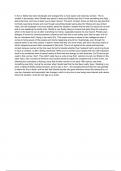
Scientific Revolution advances in the knowledge of how nature works, included new discoveries and solved ancient problems, moved knowledge from uncertainty to uncertainty, came in the fields of physics, astronomy, and medicine alchemy the belief that matter could be understood and transformed by mixing substances and using secret formulas, a famous alchemist was Paracelsus, who said that metals as well as plants might have medicinal properties Vesalius influenced anatomy and astronomy, wrote The Structure of the Human Body, member of the Padua faculty, pointed out errors in the work of Galen, he used dessections to produce anatomical descriptions that opened a new era of careful observation and experimentation in the study of bodies, influenced anatomy to move to a new level Copernicus wrote On the Revolutions of the Heavenly Spheres, said that the calculations of planetary movements of Ptolemy were way too complex but Copernicus's were also complex, he believed in the heliocentric theory, which said the sun is the center of the universe, Polish, successors found his calculations to be indespensable, ideas became a part of inellectual discussion, influenced the creation of the Gregorian calendar, the scholarly community argued over the certainty of Copernicus's ideas Tycho Brahe the leading astronomer of the era, produced the most remarkable observations of the heavens before the invention of the telescope by plotting the path of the moon and planets every night for decades, came up with an uneasy theory that was a compromise between the Ptolemaic and Copernican systems Kepler German, made major advances in the work of Copernicus and helped resolve the uncertainties in astronomy, believed that only the language of math could describe the movements of the heavens, famous astrologer, thought Copernicus was right, wanted to confirm the heliocentric theory right, discovered the three laws of planetary motion, opened a new era in astronomy, proved that orbits of the planets are ellipses and that there is a regularity based on their distance from the sun which determines the movements of all planets Galileo Italian, first to perceive the connection between planetary motion and motion on the earth, came up with the theory of inertia, was 1st to infer that Jupiter has satellites and moons, taught the heliocentric theory, which caused trouble with the church, they told him to quit teaching this and in fear of excommunication, he renounced beliefs, invented the telescope, was one of the first to approach his work in the same way as modern scientists, wrote Dialogue on the Two Great World Systems, advocated experience, reason, and doubt, did not let common sense and theological teachings get in the way Pope Gregory XIII decided to reform the calendar in 1582, creating the Greorian calendar William Harvey English doctor, revolutionized the understanding of the human body when he ientified the function of the heart and proved that the blood circulates Newton contributed to math, physics, and astronomy, he combined these three to explain motion, developed calculus and the basic laws of modern physics, which govern the motion of the moon and the planets, wrote Principia, which said that math and experiments prove science and give it certainty, active participation in meetings of the Royal Society of London, provided the expanation of the movement of objects in space, said that the world was stable and orderly, first scientist to receive a knighthood in England epistemology a new theory of how to obtain and verify knowledge

Geschreven voor
- Instelling
- AP EURO
- Vak
- AP EURO
Documentinformatie
- Geüpload op
- 25 december 2023
- Aantal pagina's
- 35
- Geschreven in
- 2023/2024
- Type
- Tentamen (uitwerkingen)
- Bevat
- Vragen en antwoorden
Onderwerpen
-
ap euro exam review questions and answers 100 cor

Ook beschikbaar in voordeelbundel