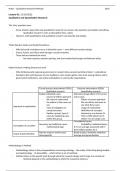
Notes – Qualitative Research Methods 2023
Lecture 01: 31/10/2023
Qualitative and Quantitative Research
The ‘why’ question issue:
- Some scholars argue that only quantitative research can answer why questions and explain something.
- Qualitative research is seen as descriptive (how, what).
- However, both quantitative and qualitative research can describe and explain.
Theda Skocpol: States and Social Revolutions
- Why did social revolutions occur in dissimilar cases -> most different systems design.
- France, Russia, and China went through a social revolution.
- Three factors mattered the most:
- low state capacity, peasant uprising, and clear leadership through revolutionary elites.
Robert Putnam: Making Democracy work
- Why did democratic regional governments in modern Italy succeed and others failed -> subnational.
- Worked in the north because of civic traditions: more social capital, more trust among citizens and in
government institutions, and active participation in community organisations.
Causal-process observations (CPOs) Data-set observations (DSOs)
Qualitative research Quantitative research
Explain individual cases: Estimate average effect of IVs across
- Causes-of-effects approach many cases:
- We want to understand - Effects-of causes approach
the effects of the cause we - We see effects and want to
see. see what they cause.
Approach to explanation
- Close investigation of - Usage of minimalistic
causal processes. definitions of concepts:
- Explain a group/ type of democracy as a dummy IV.
cases by explaining cases - Tells us little about how X
within this group. affects Y in any single case.
Correlational cause:
Necessary and sufficient cause: - Probability/ statistical theory
Conception of causation
- mathematical logic If X is on average associated with Y,
then X likely matters for Y.
Narrow scope to avoid causal Broad scope to maximise statistical
Scope of generalisation
heterogeneity leverage and generalisation
Methodology vs Method
- Methodology refers to the presuppositions concerning ontology – the reality of the thing being studied –
and epistemology – its knowability – which inform a set of methods.
- Method refers to the specific tools through which the research design and its logic are carried out.
- Methods depend on the methodology in which the researcher believes.
,Notes – Qualitative Research Methods 2023
Lecture 02: 03/11/2023
Research Questions and Puzzles for Qualitative Research
What kind of research we undertake depends on presuppositions:
- Ontology: what is the nature of the world out there that we want to study?
- Epistemology: what research can we undertake?
Interpretitive empirical research (Chicago School tradition)
Researchers argue that the world is socially constructed.
- The knowledge is historically situated and entangled in power relationships.
- Researchers access intersubjective understandings.
- Data is co-generated and not just collected.
- Interviewees give data dependent on the interviewer.
- Interviewers want to understand the understanding of the interviewee.
Focuses on actors’ specific situated meanings and meaning-making practices in given contexts.
- Particularly interested in language and other symbolic systems.
- Creation of discursive practices (third world countries, etc.) which creates new understandings.
- Interpretivists show the power relations which are created through discursive practices and
meaning.
- Asks about the political power dimensions of what we do as researchers.
- Power relationships in every dimension -> showing that neutrality is impossible -> making these explicit.
Example: Timothy Pachirat – Every Twelve Seconds
- Research under-cover in a slaughterhouse.
- Slaughterhouses work as a microcosm for life in advanced industrial capitalism.
- Showed not only how the industry works but also how society works.
- How we facilitate violent behaviour, without having implications.
- Those out of sight do the dirty work.
- We are hiding things we benefit from but do not want to contemplate.
- Only specific to advanced industrial capitalism.
Positivist research
- Realist understanding of the world.
- We can observe something in the world that we can study independently.
- Establish what really happened in a setting.
- Positivist are looking for facts.
- Fieldwork gives raw data which needs to be collected.
Research questions
There are not qualitative and quantitative research questions:
- However, some questions might be better suited for one of the methods.
- Some dimensions of the same question might be better suited for one of the methods.
- Some wordings are more in tune with one of the methods.
- Quantitative
- Probability, likelihood, average effect, to what extent, etc.
- Qualitative
- Why, How (deep understandings), etc.
, Notes – Qualitative Research Methods 2023
Lecture 03: 07/11/2023
Case-study Research
Book: Engineers of Jihad
- Why are engineering students overrepresented in suicide missions (puzzle)?
- Islamic countries encourage the study of engineering, however there is a job shortage.
- Particular mindset of the students seeking order and discipline of the students.
- Individual motivations for political violence and selective recruitment to radical activism.
Case study
- Went from mere description to causal inference.
- Shift because we have a higher standard for causality and there are limitations of mainstream
statistics.
- Correlation ≠ causation, incomplete explanations, good in empirics but poor in theory.
- Case studies can be qualitative but also quantitative.
- Intensive study of a single case or a small number of cases where the purpose of the study is to shed light
on a larger class of cases.
- Characterises the depth but does not define the type of data/ evidence.
- Provides guidance regarding the number of cases.
- Defines the purpose of the study.
- Limitation: excludes studies that aim to explain or interpret a single case but not to generalise
beyond it.
- What is a case?
- Spatially and/ or temporally delimited phenomenon.
- Observable at a point in time or over time.
- Compromises the type of phenomenon that we aim to study.
- Cases are always an instance of something else (a theoretically defined class of events)!
- Phenomenon of scientific interest -> class of events -> sub-class of events -> case
- Nuclear proliferation, non-proliferation treaties, sanctions, UN sanctions on Iran
- Migration and refugees, migration policies, refugee resettlement, Syrian refugee crises
- Usage of case studies:
- Provide a thick description of the case.
- Explain historical cases and important outcomes.
- Develop explanations of understudied phenomena.
- Confirm or cast doubt on necessary/ sufficient conditions.
- Explaining causal mechanisms.
- Contribute to theory.
- Develop, refine, or test theory.
Idiographic case studies
- The aim is to describe, explain, interpret, and understand a single case as an end rather than a vehicle for
developing broader theoretical generalisations (descriptive contextualisation).
- Inductive/ descriptive case studies
- It is highly descriptive and lacks an explicit theoretical framework to guide the empirical analysis.
- It takes the form of total history, meaning that everything is connected.
- It just states the facts but does not analyse them.
- Theory-guided case studies
- The aim is to explain or interpret a single historical episode rather than to generalise beyond it.
- Unlike inductive case studies, they are structured by a developed conceptual framework focusing
on some aspects.
Lecture 01: 31/10/2023
Qualitative and Quantitative Research
The ‘why’ question issue:
- Some scholars argue that only quantitative research can answer why questions and explain something.
- Qualitative research is seen as descriptive (how, what).
- However, both quantitative and qualitative research can describe and explain.
Theda Skocpol: States and Social Revolutions
- Why did social revolutions occur in dissimilar cases -> most different systems design.
- France, Russia, and China went through a social revolution.
- Three factors mattered the most:
- low state capacity, peasant uprising, and clear leadership through revolutionary elites.
Robert Putnam: Making Democracy work
- Why did democratic regional governments in modern Italy succeed and others failed -> subnational.
- Worked in the north because of civic traditions: more social capital, more trust among citizens and in
government institutions, and active participation in community organisations.
Causal-process observations (CPOs) Data-set observations (DSOs)
Qualitative research Quantitative research
Explain individual cases: Estimate average effect of IVs across
- Causes-of-effects approach many cases:
- We want to understand - Effects-of causes approach
the effects of the cause we - We see effects and want to
see. see what they cause.
Approach to explanation
- Close investigation of - Usage of minimalistic
causal processes. definitions of concepts:
- Explain a group/ type of democracy as a dummy IV.
cases by explaining cases - Tells us little about how X
within this group. affects Y in any single case.
Correlational cause:
Necessary and sufficient cause: - Probability/ statistical theory
Conception of causation
- mathematical logic If X is on average associated with Y,
then X likely matters for Y.
Narrow scope to avoid causal Broad scope to maximise statistical
Scope of generalisation
heterogeneity leverage and generalisation
Methodology vs Method
- Methodology refers to the presuppositions concerning ontology – the reality of the thing being studied –
and epistemology – its knowability – which inform a set of methods.
- Method refers to the specific tools through which the research design and its logic are carried out.
- Methods depend on the methodology in which the researcher believes.
,Notes – Qualitative Research Methods 2023
Lecture 02: 03/11/2023
Research Questions and Puzzles for Qualitative Research
What kind of research we undertake depends on presuppositions:
- Ontology: what is the nature of the world out there that we want to study?
- Epistemology: what research can we undertake?
Interpretitive empirical research (Chicago School tradition)
Researchers argue that the world is socially constructed.
- The knowledge is historically situated and entangled in power relationships.
- Researchers access intersubjective understandings.
- Data is co-generated and not just collected.
- Interviewees give data dependent on the interviewer.
- Interviewers want to understand the understanding of the interviewee.
Focuses on actors’ specific situated meanings and meaning-making practices in given contexts.
- Particularly interested in language and other symbolic systems.
- Creation of discursive practices (third world countries, etc.) which creates new understandings.
- Interpretivists show the power relations which are created through discursive practices and
meaning.
- Asks about the political power dimensions of what we do as researchers.
- Power relationships in every dimension -> showing that neutrality is impossible -> making these explicit.
Example: Timothy Pachirat – Every Twelve Seconds
- Research under-cover in a slaughterhouse.
- Slaughterhouses work as a microcosm for life in advanced industrial capitalism.
- Showed not only how the industry works but also how society works.
- How we facilitate violent behaviour, without having implications.
- Those out of sight do the dirty work.
- We are hiding things we benefit from but do not want to contemplate.
- Only specific to advanced industrial capitalism.
Positivist research
- Realist understanding of the world.
- We can observe something in the world that we can study independently.
- Establish what really happened in a setting.
- Positivist are looking for facts.
- Fieldwork gives raw data which needs to be collected.
Research questions
There are not qualitative and quantitative research questions:
- However, some questions might be better suited for one of the methods.
- Some dimensions of the same question might be better suited for one of the methods.
- Some wordings are more in tune with one of the methods.
- Quantitative
- Probability, likelihood, average effect, to what extent, etc.
- Qualitative
- Why, How (deep understandings), etc.
, Notes – Qualitative Research Methods 2023
Lecture 03: 07/11/2023
Case-study Research
Book: Engineers of Jihad
- Why are engineering students overrepresented in suicide missions (puzzle)?
- Islamic countries encourage the study of engineering, however there is a job shortage.
- Particular mindset of the students seeking order and discipline of the students.
- Individual motivations for political violence and selective recruitment to radical activism.
Case study
- Went from mere description to causal inference.
- Shift because we have a higher standard for causality and there are limitations of mainstream
statistics.
- Correlation ≠ causation, incomplete explanations, good in empirics but poor in theory.
- Case studies can be qualitative but also quantitative.
- Intensive study of a single case or a small number of cases where the purpose of the study is to shed light
on a larger class of cases.
- Characterises the depth but does not define the type of data/ evidence.
- Provides guidance regarding the number of cases.
- Defines the purpose of the study.
- Limitation: excludes studies that aim to explain or interpret a single case but not to generalise
beyond it.
- What is a case?
- Spatially and/ or temporally delimited phenomenon.
- Observable at a point in time or over time.
- Compromises the type of phenomenon that we aim to study.
- Cases are always an instance of something else (a theoretically defined class of events)!
- Phenomenon of scientific interest -> class of events -> sub-class of events -> case
- Nuclear proliferation, non-proliferation treaties, sanctions, UN sanctions on Iran
- Migration and refugees, migration policies, refugee resettlement, Syrian refugee crises
- Usage of case studies:
- Provide a thick description of the case.
- Explain historical cases and important outcomes.
- Develop explanations of understudied phenomena.
- Confirm or cast doubt on necessary/ sufficient conditions.
- Explaining causal mechanisms.
- Contribute to theory.
- Develop, refine, or test theory.
Idiographic case studies
- The aim is to describe, explain, interpret, and understand a single case as an end rather than a vehicle for
developing broader theoretical generalisations (descriptive contextualisation).
- Inductive/ descriptive case studies
- It is highly descriptive and lacks an explicit theoretical framework to guide the empirical analysis.
- It takes the form of total history, meaning that everything is connected.
- It just states the facts but does not analyse them.
- Theory-guided case studies
- The aim is to explain or interpret a single historical episode rather than to generalise beyond it.
- Unlike inductive case studies, they are structured by a developed conceptual framework focusing
on some aspects.