LE 4 – Chemotherapy and
receptor-mediated therapy
November 17th, 2023
Introduction
Cancer treatment
Local treatment: surgery, radiotherapy
Systemic treatment: distant metastasis
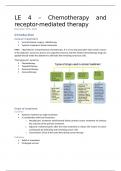
HIPEC – Hyperthermic intraperitoneal chemotherapy. It is a two-step procedure that certain cancers
in the abdomen. Cancerous tumors are surgically removed, and then heated chemotherapy drugs are
applied directly inside the abdomen to eliminate the remaining cancerous cells.
Therapeutic options
Chemotherapy
Targeted therapy
Hormonal therapy
Immunotherapy
Goals of treatment
Curati on
Systemic treatment as single treatment
In combination with local treatment:
o Neoadjuvant: treatment administered before primary cancer treatment to enhance
the outcome of the primary treatment.
o Adjuvant: treatment given after the main treatment to reduce the chance of cancer
coming back by destroying and remaining cancer cells.
o Concomitant: Given at the same time during cancer therapy.
Palliati on
Relief of complaints
Prolonged survival
, Chemotherapy
Mechanisms of acti on
Chemotherapy causes DNA damage in dividing cells:
Inhibition of DNA synthesis
inhibition of DNA repair
Inhibition of DNA transcription
inhibition of the mitotic process
DNA damage to all dividing cells, also normal cells side effects. Cancer cells are fast dividing cells
and thus are sensitive to chemotherapy. Different agents intervene at different steps in the cell cycle.
Principles of chemotherapy
Growth speed: initially exponential
Growth fraction = % of cells that divide actively.
o Decreases when tumor is growing
o Lower blood flown in larger tumors
Thus, smaller tumors are more sensitive/vulnerable for chemotherapy than larger tumors.
Goldie-Coldman hypothesis
Cancer cells are genetically instable; during growth: more mutations
Because of mutations less sensitive for chemotherapy (=resistance)
Larger tumors contain more resistant cells
Thus, combine different chemotherapy agents
Cell-kill hypothesis
Multiple cycles
Eventually resistance
o Intrinsic (cellular)
o Adaptation (post Tx detoxification pathways)
receptor-mediated therapy
November 17th, 2023
Introduction
Cancer treatment
Local treatment: surgery, radiotherapy
Systemic treatment: distant metastasis
HIPEC – Hyperthermic intraperitoneal chemotherapy. It is a two-step procedure that certain cancers
in the abdomen. Cancerous tumors are surgically removed, and then heated chemotherapy drugs are
applied directly inside the abdomen to eliminate the remaining cancerous cells.
Therapeutic options
Chemotherapy
Targeted therapy
Hormonal therapy
Immunotherapy
Goals of treatment
Curati on
Systemic treatment as single treatment
In combination with local treatment:
o Neoadjuvant: treatment administered before primary cancer treatment to enhance
the outcome of the primary treatment.
o Adjuvant: treatment given after the main treatment to reduce the chance of cancer
coming back by destroying and remaining cancer cells.
o Concomitant: Given at the same time during cancer therapy.
Palliati on
Relief of complaints
Prolonged survival
, Chemotherapy
Mechanisms of acti on
Chemotherapy causes DNA damage in dividing cells:
Inhibition of DNA synthesis
inhibition of DNA repair
Inhibition of DNA transcription
inhibition of the mitotic process
DNA damage to all dividing cells, also normal cells side effects. Cancer cells are fast dividing cells
and thus are sensitive to chemotherapy. Different agents intervene at different steps in the cell cycle.
Principles of chemotherapy
Growth speed: initially exponential
Growth fraction = % of cells that divide actively.
o Decreases when tumor is growing
o Lower blood flown in larger tumors
Thus, smaller tumors are more sensitive/vulnerable for chemotherapy than larger tumors.
Goldie-Coldman hypothesis
Cancer cells are genetically instable; during growth: more mutations
Because of mutations less sensitive for chemotherapy (=resistance)
Larger tumors contain more resistant cells
Thus, combine different chemotherapy agents
Cell-kill hypothesis
Multiple cycles
Eventually resistance
o Intrinsic (cellular)
o Adaptation (post Tx detoxification pathways)