LE 3 – Chemical Carcinogenesis
November 17th, 2023
Predictive value of carcinogenicity assays
Mitogens are mutagens.
Mitogens = cells that increase cell growth.
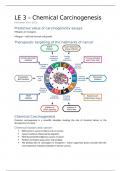
Therapeutic targeting of the hallmarks of cancer
Chemical Carcinogenesis
Chemical carcinogenesis is a scientific discipline studying the role of chemical factors in the
development of cancer.
Chemical factors and cancer
Differences in cancer incidence city vs country
Cancer incidence influenced by migration
Well-documented indigenous causes of cancer
Positive correlation lung cancer and smoking
The binding sites of carcinogens in oncogenes / tumor suppressor genes coincide with the
most important mutations hotspots in human cancers.
,History of chemical carcinogenesis
Chemical compounds carcinogen in animal does not necessarily mean it is also carcinogenic for
humans.
Carcinogens in food
Carcinogens are naturally present in plants (phytotoxins)
Carcinogens are formed by microorganisms (fungi) present in decaying food (mycotoxins)
Synthetic carcinogens that might be present in food (dioxins)
Carcinogenic pyrolytic and pyro synthetic products that are formed during heating up of food
(BBQ)
Carcinogenic nitrosamines that are formed from nitrate and other precursors in the stomach
by the low pH
Aflatoxins
Aflatoxins are naturally occurring products of the molds Aspargilus flavus. Aflatoxin B1 is one of the
most potent carcinogens known. Metabolic activation of aflatoxin B1 to the 8, 9-epoxide produces a
highly electrophilic species, which either is hydraulically inactivated or else can react with DNA bases
and result in covalent binding. GST-mediated conjugation with glutathione (GSH) is therefore an
important way of detoxication.
Initiation – Promotion – Progression
, Initiation
Gene mutation with change of function
Selecitive growth advantage
Irreversible process
No morphological changes
No threshold limits
Promotion
Creating circumstances in which cells are more susceptible for mutations or in which initiated
cells have growth advantage.
No mutations or karyotypic chances, promotion by interference with cellular signaling
pathways.
Reversible process.
Progression
Karyotypic instability: morphological changes in the normal chromosome structure.
Aneuploid, loss of heterozygosity, sister chromatid exchange: results in more/less genes
controlling cell cycle and chromosomal structure.
Leading to metastasis, hyperproliferation, loss of control by cellular environment.
Instability by change of DNA-methylation, proliferation, mutation.
Increased risk of mutating other genes.
November 17th, 2023
Predictive value of carcinogenicity assays
Mitogens are mutagens.
Mitogens = cells that increase cell growth.
Therapeutic targeting of the hallmarks of cancer
Chemical Carcinogenesis
Chemical carcinogenesis is a scientific discipline studying the role of chemical factors in the
development of cancer.
Chemical factors and cancer
Differences in cancer incidence city vs country
Cancer incidence influenced by migration
Well-documented indigenous causes of cancer
Positive correlation lung cancer and smoking
The binding sites of carcinogens in oncogenes / tumor suppressor genes coincide with the
most important mutations hotspots in human cancers.
,History of chemical carcinogenesis
Chemical compounds carcinogen in animal does not necessarily mean it is also carcinogenic for
humans.
Carcinogens in food
Carcinogens are naturally present in plants (phytotoxins)
Carcinogens are formed by microorganisms (fungi) present in decaying food (mycotoxins)
Synthetic carcinogens that might be present in food (dioxins)
Carcinogenic pyrolytic and pyro synthetic products that are formed during heating up of food
(BBQ)
Carcinogenic nitrosamines that are formed from nitrate and other precursors in the stomach
by the low pH
Aflatoxins
Aflatoxins are naturally occurring products of the molds Aspargilus flavus. Aflatoxin B1 is one of the
most potent carcinogens known. Metabolic activation of aflatoxin B1 to the 8, 9-epoxide produces a
highly electrophilic species, which either is hydraulically inactivated or else can react with DNA bases
and result in covalent binding. GST-mediated conjugation with glutathione (GSH) is therefore an
important way of detoxication.
Initiation – Promotion – Progression
, Initiation
Gene mutation with change of function
Selecitive growth advantage
Irreversible process
No morphological changes
No threshold limits
Promotion
Creating circumstances in which cells are more susceptible for mutations or in which initiated
cells have growth advantage.
No mutations or karyotypic chances, promotion by interference with cellular signaling
pathways.
Reversible process.
Progression
Karyotypic instability: morphological changes in the normal chromosome structure.
Aneuploid, loss of heterozygosity, sister chromatid exchange: results in more/less genes
controlling cell cycle and chromosomal structure.
Leading to metastasis, hyperproliferation, loss of control by cellular environment.
Instability by change of DNA-methylation, proliferation, mutation.
Increased risk of mutating other genes.