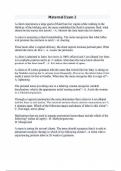
Discuss the working memory model. Refer to research in your answer and discuss
strengths and limitations of the model.
Atkinson and Shiffrin devised the multi-store model in 1968 but it was criticised for being too
simplistic and it became apparent that there were a number of problems with their ideas concerning
the characteristics of STM. As a result of this, Baddeley and Hitch (1974) devised an alternative
model of STM called the working memory model. It is made up of four components: the central
executive, phonological loop, Visio-Spatial sketchpad and episodic buffer.
The most important component of the WMM is the central executive as it controls the subsidiary
systems and drives the whole system. It is sometimes known as the “boss system” and allocates
information to the subsidiary (slave) systems. It controls attention and is also responsible for
cognitive tasks such as problem-solving and decision-making. While the central executive is flexible,
it has a limited capacity therefore it can only attend to a limited number of items at one time. It can
process information in any modality and plays a key part in planning and synthesising information.
The phonological loop is the part of the WMM that deals with spoken and written material. It is
separated into two parts: the phonological store (“the inner ear”) and the articulatory control system
(“the inner voice”). The phonological store is linked to speech perception and allows acoustically
encoded information (i.e. spoken words) to be stored there for a short period of time, approximately
1-2 seconds. The ACS is linked to speech production and is used to rehearse and store verbal
information from the phonological store (subvocal repetition). Articulatory suppression is a
technique used to inhibit memory performance (e.g. saying lalala repeatedly). This is used to prevent
the phonological loop from retaining further information. Articulatory suppression was also used in
Peterson and Peterson’s trigram experiment.
The limited capacity of the phonological loop was established by Baddeley et al (1975) with their
study of the word length effect. The word length effect is the assumption that short items are
remembered better than long items in serial recall tests. They discovered that when participants
were prevented from rehearsing the words through articulatory suppression, the word length effect
appeared to have disappeared as short words were not recalled any better than long words.
Conclusively, it demonstrated that the phonological loop has a limited capacity as the articulatory
suppression task filled the phonological loop thus removing the advantage of rehearsal. However,
judging by their ability to recall some of the words, it suggests that the central executive must have
some influence.
The Visio-Spatial sketchpad, sometimes referred to as “the inner eye”, is responsible for the
temporary storage and manipulation of spatial and visual information (mental images). Like the
phonological loop, it has a limited capacity but the limits of both systems are independent. E.g. you
can rehearse a string of digits using the phonological loop while simultaneously making decisions
about the spatial layout of a set of letters using the VSS.
Logie (1995) suggested that the VSS consists of two components: the visual cache and the inner
scribe. The visual cache stores information about form and colour whereas the inner scribe stores
the arrangement of objects in the visual field and rehearses this information in the visual cache.
Baddeley provided research support for the existence of the VSS. Participants were given a simple
tracking task that involved holding a pointer in contact with a moving stop light. Simultaneously, they
were asked to perform an imagery task, imagining the block capital F and starting from the bottom
left-hand corner. They had to classify each angle as a yes, if it included the top or bottom line of the
letter, or no, if it didn’t. They found that it was difficult for the participants to perform both tasks
together but they were able to complete each task individually alongside a verbal task. This suggests
that the VSS has a limited capacity as it was not able to withstand both the tracking and letter
strengths and limitations of the model.
Atkinson and Shiffrin devised the multi-store model in 1968 but it was criticised for being too
simplistic and it became apparent that there were a number of problems with their ideas concerning
the characteristics of STM. As a result of this, Baddeley and Hitch (1974) devised an alternative
model of STM called the working memory model. It is made up of four components: the central
executive, phonological loop, Visio-Spatial sketchpad and episodic buffer.
The most important component of the WMM is the central executive as it controls the subsidiary
systems and drives the whole system. It is sometimes known as the “boss system” and allocates
information to the subsidiary (slave) systems. It controls attention and is also responsible for
cognitive tasks such as problem-solving and decision-making. While the central executive is flexible,
it has a limited capacity therefore it can only attend to a limited number of items at one time. It can
process information in any modality and plays a key part in planning and synthesising information.
The phonological loop is the part of the WMM that deals with spoken and written material. It is
separated into two parts: the phonological store (“the inner ear”) and the articulatory control system
(“the inner voice”). The phonological store is linked to speech perception and allows acoustically
encoded information (i.e. spoken words) to be stored there for a short period of time, approximately
1-2 seconds. The ACS is linked to speech production and is used to rehearse and store verbal
information from the phonological store (subvocal repetition). Articulatory suppression is a
technique used to inhibit memory performance (e.g. saying lalala repeatedly). This is used to prevent
the phonological loop from retaining further information. Articulatory suppression was also used in
Peterson and Peterson’s trigram experiment.
The limited capacity of the phonological loop was established by Baddeley et al (1975) with their
study of the word length effect. The word length effect is the assumption that short items are
remembered better than long items in serial recall tests. They discovered that when participants
were prevented from rehearsing the words through articulatory suppression, the word length effect
appeared to have disappeared as short words were not recalled any better than long words.
Conclusively, it demonstrated that the phonological loop has a limited capacity as the articulatory
suppression task filled the phonological loop thus removing the advantage of rehearsal. However,
judging by their ability to recall some of the words, it suggests that the central executive must have
some influence.
The Visio-Spatial sketchpad, sometimes referred to as “the inner eye”, is responsible for the
temporary storage and manipulation of spatial and visual information (mental images). Like the
phonological loop, it has a limited capacity but the limits of both systems are independent. E.g. you
can rehearse a string of digits using the phonological loop while simultaneously making decisions
about the spatial layout of a set of letters using the VSS.
Logie (1995) suggested that the VSS consists of two components: the visual cache and the inner
scribe. The visual cache stores information about form and colour whereas the inner scribe stores
the arrangement of objects in the visual field and rehearses this information in the visual cache.
Baddeley provided research support for the existence of the VSS. Participants were given a simple
tracking task that involved holding a pointer in contact with a moving stop light. Simultaneously, they
were asked to perform an imagery task, imagining the block capital F and starting from the bottom
left-hand corner. They had to classify each angle as a yes, if it included the top or bottom line of the
letter, or no, if it didn’t. They found that it was difficult for the participants to perform both tasks
together but they were able to complete each task individually alongside a verbal task. This suggests
that the VSS has a limited capacity as it was not able to withstand both the tracking and letter