PHYS 506 Anatomy and Physiology Endocrine (Hormones) MCQs Answers 2023/24
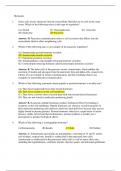
PHYS 506 Anatomy and Physiology Endocrine (Hormones) MCQs Answers 2023/24 Hormones 1. Some cells secrete chemicals into the extracellular fluid that act on cells in the same tissue. Which of the following refers to this type of regulation? (A) Neural (B) Endocrine (C) Neuroendocrine (D) Paracrine (E) Autocrine Answer: D. Paracrine communication refers to cell secretions that diffuse into the extracellular fluid to affect neighboring cells. 2. Which of the following pairs is an example of the paracrine regulation? (A) Somatostatin-growth hormone secretion (B) Somatostatin-insulin secretion (C) Dopamine-prolactin secretion (D) Norepinephrine-corticotrophin-releasing hormone secretion (E) Corticotropin-releasing hormone-adrenocorticotropic hormone secretion Answer: B. The delta cells of the pancreas secrete somatostatin, which inhibits the secretion of insulin and glucagon from the pancreatic beta and alpha cells, respectively. Choice D is an example of neural communication, and the remaining choices are examples of neuroendocrine communication. 3. Which of the following statements about peptide or protein hormones is usually true? (A) They have longer half-lives than steroid hormones (B) They have receptors on the cell membrane (C) They have a slower onset of action than both steroid and thyroid hormones (D) They are not stored in endocrine-producing glands Answer: B. In general, peptide hormones produce biological effects by binding to receptors on the cell membrane. Peptide hormones are stored in secretion granules in their endocrine-producing cells and have relatively short half-lives because they are not highly bound to plasma proteins. Protein hormones often have a rapid onset of action because, unlike steroid and thyroid hormones, protein synthesis is usually not a prerequisite to produce biological effects. 4. Which of the following is a polypeptide hormone? (A)Somatostatin (B) Insulin (C) Both (D)Neither Answer: C. Somatostatin and insulin are polypeptides, consisting of 14 and 51 amino acid residues, respectively. Insulin is synthesized in the pancreatic beta cells; somatostatin is synthesized in the pancreatic delta cells as well as many other sites, including the hypothalamus, cerebrum, thymus, thyroid, gastric and intestinal epithelium, skin, heart, and salivary glands. Insulin inhibits glucagon secretion, and somatostatin inhibits secretion of GH, thyroid-stimulating hormone (TSH), insulin, glucagon, pancreatic polypeptide, gut hormones, gastric acid, and pepsin. 5. All of the following are neuropeptide hormones EXCEPT… (A)Antidiuretic hormone (ADH) (B) β-endorphin (C) Oxytocin (D)Somatomedin (E) Thyrotropin releasing hormone (TRH) Answer: D. The protein anabolic effects of growth hormone (GH) are mediated through a GH-dependent peptide known as somatomedin, which is synthesized in the liver. Important biologic effects of somatomedin include mitogenesis of chondrocytes and bone cells, stimulation of lipogenesis and muscle glycogenesis, and GH-like actions in cartilage (e.g., sulfation of chondroitin). Antidiuretic hormone (ADH) and oxytocin are neuropeptides synthesized mainly in the neurosecretory neurons of the supraoptic and paraventricular nuclei, respectively. Thyrotropin-releasing hormone (TRH) is produced in the neurosecretory neurons of the arcuate nucleus. Endorphins are secretory products of basophils in the adenohypophysis and of brain neurons. Thus, endorphins also can be classified as neuropeptides. Somatomedin is not produced by endocrine neurons called neurosecretory neurons; therefore, it is not a neuropeptide. 6. Release of which of the following hormones is an example of neuroendocrine secretion? (A) Growth hormone (B) Cortisol (C) Oxytocin (D) Prolactin (E) Adrenocorticotropic hormone Answer: C. The secretion of chemical messengers (neurohormones) from neurons into the blood is referred to as neuroendocrine secretion. Thus, in contrast to the local actions of neurotransmitters at nerve endings, neurohormones circulate in the blood before producing biological effects at target tissues. Oxytocin is synthesized from magnocellular neurons whose cell bodies are located in the paraventricular and supraoptic nuclei and whose nerve terminals terminate in the posterior pituitary gland. Target tissues for circulating oxytocin are the breast and uterus, where the hormone plays a role in lactation and parturition, respectively. 7. Which of the following statements that refer to steroid hormones is correct? (A)They have short circulating half-lives (B) They are synthesized at a rate similar to their rate of secretion (C) They are largely bound to plasma albumin (D)They bind to receptors in the cell membrane of target cells (E) They are stored in cytoplasmic lipid droplets Answer: B. The synthesis of steroid hormones is normally due to the activation of the synthetic pathway, which increases commensurately with increased secretion. Steroid hormones are largely bound to plasma globulins, which makes them non-filterable at the glomerulus and accounts for their longer circulating half-lives [e.g., sex hormone-binding globulin and corticosteroid-binding globulin (CBG)]. The lipophilic hormone (steroid) receptors diffuse through the plasma membrane and interact with receptors that are primarily intranuclear. The steroid hormones are stored as prohormones in the form of cholesterol esters in lipid droplets. 8. Which of the following hormones is not stored in its endocrine-producing gland? (A) T4 (B) PTH (C) Aldosterone (D) ACTH (E) Insulin Answer: C. Steroid hormones are not stored to any appreciable extent in their endocrine producing glands. This is true for aldosterone, which is produced in the adrenal cortex. In contrast there are appreciable stores of thyroid hormones and peptide hormones in their endocrine-producing glands. 9. The half-life of a hormone in blood is… (A)Directly proportional to its rate of secretion (B) Directly proportional to the percentage of the hormone that is bound to its plasma carrier protein (C) Directly proportional to the number of hormone receptors present in the target tissue (D)Inversely proportional to the concentration of its plasma binding protein (E) Inversely proportional to the molecular weight of the hormone Answer: B. Hormones bound to plasma protein-carriers, including mainly the lipidsoluble hormones, have longer half-lives. Furthermore, the half-life is proportional to the binding affinity between the hormone and its protein-carrier. The hormone with one of the highest affinities is thyroxine. Water-soluble (hydrophilic) hormones have much shorter half-lives because they circulate usually as unbound (free) hormone. Notable exceptions are growth hormone and insulin-like growth factor-1 (IGF-1). Also, the larger the aqueous soluble hormones, the longer the half-life. It must be appreciated that larger molecules and plasma protein–bound hormones are not filterable by the glomerulus and this prolongs their circulation time. 10. The half-life of a lipid-soluble hormone in blood is: (A) Directly proportional to its rate of secretion (B) Directly proportional to the affinity of the hormone for its plasma protein carrier (C) Directly proportional to the number of hormone receptors present in target tissue (D) Inversely proportional to the concentration of the hormone’s plasma protein carrier (E) Inversely proportional to the molecular weight of the hormone Answer: B. The time for the concentration of a hormone in plasma to decrease by 50% (assuming no further hormone is secreted) is the plasma half-life. For lipid-soluble hormones, the half-life is primarily determined by the affinity of the hormone for its plasma protein carrier, i.e., the higher the affinity, the longer the half-life. Half-life is not related to hormone-secretion rate, the number of hormone receptors, or the molecular weight of the lipid-soluble hormone. 11. An increase in the plasma concentration of a hormone-binding protein would… (A)Decrease the response to the hormone (B) Increase the response to the hormone (C) Decrease the concentration of free hormone (D)Increase the concentration of free hormone (E) Decrease the secretion of the hormone from the endocrine tissue Answer: A. With an increase in binding protein, the response to either exogenous or endogenous hormone is decreased, because more of the hormone becomes bound, and less is dissociated (free). Also, the total concentration (bound plus free) is increased. 12. Which of the following changes would be expected to occur with increased binding of a hormone to plasma proteins? (A) Increase in plasma clearance of the hormone (B) Decrease in half-life of the hormone (C) Increase in hormone activity (D) Increase in degree of negative feedback exerted by the hormone (E) Increase in plasma reservoir for rapid replenishment of free hormone Answer: E. Protein-bound hormones are biologically inactive and cannot be metabolized. Thus, an increase in protein binding would tend to decrease hormone activity and plasma clearance and increase the half-life of the hormone. Free hormone is also responsible for negative feedback inhibition of hormone secretion. Therefore, a sudden increase in hormone binding to plasma proteins would decrease negative feedback. Protein binding of hormones does, however, provide a reservoir for the rapid replacement of free hormone. 13. Levels of transcortin (cortisol binding globulin) are elevated in a pregnant woman. Which of the following laboratory findings would be expected in this patient? (A) Increased total (protein-bound plus free) plasma cortisol concentration (B) Increased free (non-protein-bound) plasma cortisol concentration (C) Decreased total plasma cortisol concentration (D) Decreased free plasma cortisol concentration (E) Little or no change in total plasma cortisol concentration Answer: A. Cortisol is highly bound to plasma proteins, particularly transcortin. Increased plasma levels of transcortin, such as occur during pregnancy, tend to decrease free cortisol concentration, but feedback results in increased adrenocorticotropic hormone secretion, which stimulates cortisol secretion until free plasma levels of the steroid return to normal levels. Thus, in a steady state, total plasma cortisol concentration (bound plus free) is elevated, but free cortisol concentration is normal. 14. A 24-year-old woman presents with a slightly elevated blood pressure. She has high plasma levels of total T4, cortisol, and renin activity, but no symptoms or signs of thyrotoxicosis or Cushing syndrome. Which of the following is the most likely explanation? (A) She has been treated with ACTH and TSH. (B) She has been treated with T3 and cortisol. (C) She has an adrenocortical tumor. (D) She is in the third trimester of pregnancy (E) She has been subjected to chronic stress. Answer: D. Thyroxin-binding globulin (TBG) is increased in estrogen-treated patients and during pregnancy, increasing the total plasma levels of T3 and T4, but with a normal level of the free thyroid hormones, such that the clinical state is euthyroid. Cortisol levels also increase during pregnancy and parturition due to increased production of corticotropin-releasing hormone (CRH) by the placenta (as well as the fetal hypothalamus). Although tissue renin contributes little to the circulating renin pool, pregnancy is associated with increased renin levels that may arise from components of the tissue renin-angiotensin system found in the uterus, the placenta, and the fetal membranes. Amniotic fluid contains large amounts of prorenin. 15. Which of the following hormones is largely unbound to plasma proteins? (A) Cortisol (B) Thyroxine (T4) (C) Antidiuretic hormone (D) Estradiol (E) Progesterone Answer: C. In general, peptide hormones are water soluble and are not highly bound by plasma proteins. Antidiuretic hormone, a neurohypophysial peptide hormone, is virtually unbound by plasma proteins. In contrast, steroid and thyroid hormones are highly bound to plasma proteins. Hormone Receptor Interaction 16. Which of the following hormones acts by an inositol 1,4,5-triphosphate (IP3)-Ca2+ mechanism of action? . . . .. . . . . . .

Geschreven voor
- Instelling
- PHYS 506
- Vak
- PHYS 506
Documentinformatie
- Geüpload op
- 6 december 2023
- Aantal pagina's
- 67
- Geschreven in
- 2023/2024
- Type
- Tentamen (uitwerkingen)
- Bevat
- Vragen en antwoorden
Onderwerpen
-
phys 506 anatomy and physiology
-
anatomy and physiology endocrine hormones mcqs

Ook beschikbaar in voordeelbundel