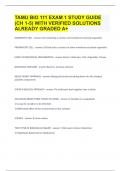
TAMU BIO 111 EXAM 1 STUDY GUIDE (CH 1-5) WITH VERIFIED SOLUTIONS ALREADY GRADED A+
EUKARYOTIC CELL Cell containing a nucleus and membrane-enclosed organelles PROKARYOTIC CELL Cell that lacks a nucleus or other membrane-enclosed organelles Brainpower Read More Previous Play Next Rewind 10 seconds Move forward 10 seconds Unmute 0:00 / 0:00 Full screen LEVELS OF BIOLOGICAL ORGANIZATION Atoms, Molecules, Cells, Organelles, Tissues BIOLOGICAL DOMAINS Bacteria, Archaea, Eukarya REDUCTIONIST APPROACH Biologically break everything down into the simplest possible components SYSTEMS BIOLOGY APPROACH Tie small parts back together into a whole. EVOLUTION NEEDS THREE THINGS TO WORK 1) Variation in a population 2) A way for variation to be inherited 3) Differential effect of the environment on the variation SCIENCE To know nature TWO TYPES OF BIOLOGICAL INQUIRY 1) Discovery Science (Inductive) 2) Hypothesis-Based Science (Deductive) SCIENTIFIC THEORY 1) Well-supported by a large body of evidence with testable ideas and objective data 2) Broad scope, supported by accumulated evidence from many hypotheses, leads to new hypotheses, can be modified or rejected E.g. Cell Theory, Atomic Theory, Evolutionary Theory, Chromosomal Theory HYPOTHESIS A tentative answer to a well-framed question. (Testable, Falsifiable, Verifiable) ELEMENT A substance that cannot be broken down to other substances by chemical means COMPOUND Made of two or more elements held together by chemical bonds and can have very different properties from their constituent elements MOLECULE Two or more atoms held together by a chemical bond ATOM Smallest functional unit of matter that retains the properties of an element SUBATOMIC PARTICLES Protons, Neutrons, Electrons RADIOACTIVE ISOTOPES Nucleus of atom decays spontaneously, giving off particles and energy, thus transforming into an atom of another element VALENCE # of bonds an atom can make VALENCE SHELL Outermost shell VALENCE ELECTRONS Most chemical behavior depend on these electrons 3 TYPES OF CHEMICAL BONDS Covalent, Ionic, Hydrogen 2 TYPES OF COVALENT BONDS Non-polar, Polar NON-POLAR COVALENT BOND Equal sharing of electrons E.g. C-C, C-H POLAR COVALENT BOND Unequal sharing of electrons E.g. Water IONIC BOND Extreme differences in electronegativity resulting in theft of an electron; Strong in a vacuum or air, but weak in an aqueous solution E.g. Salt HYDROGEN BOND Between polar molecules, weak and important VAN DER WAALS INTERACTIONS Weak interactions that derive from momentary attractions between +ve and -ve poles E.g. Gecko on a wall, Hanging from a wall PROPERTIES OF WATER 1) Cohesive and adhesive behavior 2) Moderates temperature (High specific heat) 3) Evaporative cooling (High heat of vaporization) 4) Expands when it freezes 5) Versatile solvent

Geschreven voor
- Instelling
- TAMU Bio 111 Lab
- Vak
- TAMU Bio 111 Lab
Documentinformatie
- Geüpload op
- 4 december 2023
- Aantal pagina's
- 12
- Geschreven in
- 2023/2024
- Type
- Tentamen (uitwerkingen)
- Bevat
- Vragen en antwoorden
Onderwerpen
-
tamu bio 111 exam 1 study guide ch 1 5

Ook beschikbaar in voordeelbundel