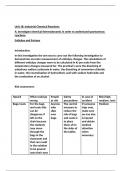
unit 18: Industrial Chemical Reactions
Learning aim A: investigate chemical thermodynamics in order to understand spontaneous reactions
Assignment Title: Enthalpy and Entropy
Experiment 1: Enthalpy of Nutralisation
Hydrochloric acid and sodium hydroxide solution are used in this experiment. The concentration of both
solutions is 0.5 mol dm-3. You must calculate the enthalpy of neutralisation after determining the
temperature rise for the neutralisation of a sample of hydrochloric acid by sodium hydroxide.
Equipment
Hydrochloric acid solution
Sodium hydroxide solution
Polystyrene cup
Thermometer
Distilled/deionised water
Burette
Pipette
Pipette filler
Small funnel
Lab coat
Safety glasses
Health and safety
Hydrochloric acid solution: irritant, it is corrosive to the skin and eyes. Inhalation exposure might cause
nose, eye and respiratory tract irritation and inflammation. To prevent this, wear goggles and a lab coat.
While handing it out be careful.
Sodium hydroxide solution: irritant, if eaten or drunken sodium hydroxide it can cause severe burns and
immediate vomiting, diarrhea, nausea, and chest and stomach pain. To avoid this, wear goggles and a
lab coat. May be gloves and mask to stop it from contacting you.
Method
1. Rinse the burette with hydrochloric acid. Set up the burette and fill it with hydrochloric acid
using a funnel
2. Transfer 25.0 cm3 of the hydrochloric acid in the burette into a dry and clean beaker
3. Measure the temperature of hydrochloric acid, write it down in one decimal place
4. Use distilled/de-ionised water to rinse the thermometer and then dry
5. With the sodium hydroxide solution rinse a pipette. Then using this pipette, transfer 25.0 cm3 of
the sodium hydroxide solution into a polystyrene cup.
6. Put the polystyrene cup in a beaker. Use a clamp stand to mount the thermometer in the cup.
Make sure the bulb does not touch the sides and bottom of the cup, and place a stirring rod in
the cup
, 7. Using a stirring rod stir the sodium hydroxide solution and measure the temperature to one
decimal place. Continue to measure the temperature for up to 3 minutes and record each result
in the drawn table
8. At the 4th minute pour the 25.0 cm3 of hydrochloric acid. Stir but do not record the
temperature.
9. Keep stirring the mixture and measure the temperature for up to 10 minutes and remember to
record the results to 1 decimal place in the table.
Table
Time (in minutes) Temperature
1 25
2 25
3 25
4
5 28
6 28
7 28
8 27
9 27
10 27
Graph
, Calculation
Heat energy change and enthalpy change
q=m x c x ∆t =
∆T = T2 – T1
50 x 4.18 x 3 = 627 j
Moles of sodium hydroxide (NaOH) = 0.5 mols
Moles of hydrochloric acid (HCI) = 0.5 mols
Moles = 0.5 x 25/1000 = 0.0125 mols
∆H = q/mol = 627/0.0125 = 50160 j/mol
50160/1000 = 50.16 kJ/mol
Experiment 2: To find the enthalpy change
Workout the enthalpy changes in KJ per mol from the temperature changes measured for dissolving
ammonium chloride in water.
Equipment
Polystyrene cup
Glass rod
Thermometer
Measuring cylinder
Ammonium chloride
Distilled water
Stopwatch
Weight scale
Health and safety
Ammonium chloride solid: harmful if swallowed. It can cause serious eye irritation. To prevent this,
wear eye protection and lab coats while handing.
Method
1. Measure 100 cm3 of water using measuring cylinder and pour into a polystyrene cup
2. Use a thermometer and record the temperature of the water
3. Use a weight scale to measure 5 grams of ammonium chloride. Add the ammonium chloride into
the water and stir using a stirring rod. Keep recording the temperature every 10 minutes until all
ammonium chloride is dissolved
4. Write down your results on a table
Learning aim A: investigate chemical thermodynamics in order to understand spontaneous reactions
Assignment Title: Enthalpy and Entropy
Experiment 1: Enthalpy of Nutralisation
Hydrochloric acid and sodium hydroxide solution are used in this experiment. The concentration of both
solutions is 0.5 mol dm-3. You must calculate the enthalpy of neutralisation after determining the
temperature rise for the neutralisation of a sample of hydrochloric acid by sodium hydroxide.
Equipment
Hydrochloric acid solution
Sodium hydroxide solution
Polystyrene cup
Thermometer
Distilled/deionised water
Burette
Pipette
Pipette filler
Small funnel
Lab coat
Safety glasses
Health and safety
Hydrochloric acid solution: irritant, it is corrosive to the skin and eyes. Inhalation exposure might cause
nose, eye and respiratory tract irritation and inflammation. To prevent this, wear goggles and a lab coat.
While handing it out be careful.
Sodium hydroxide solution: irritant, if eaten or drunken sodium hydroxide it can cause severe burns and
immediate vomiting, diarrhea, nausea, and chest and stomach pain. To avoid this, wear goggles and a
lab coat. May be gloves and mask to stop it from contacting you.
Method
1. Rinse the burette with hydrochloric acid. Set up the burette and fill it with hydrochloric acid
using a funnel
2. Transfer 25.0 cm3 of the hydrochloric acid in the burette into a dry and clean beaker
3. Measure the temperature of hydrochloric acid, write it down in one decimal place
4. Use distilled/de-ionised water to rinse the thermometer and then dry
5. With the sodium hydroxide solution rinse a pipette. Then using this pipette, transfer 25.0 cm3 of
the sodium hydroxide solution into a polystyrene cup.
6. Put the polystyrene cup in a beaker. Use a clamp stand to mount the thermometer in the cup.
Make sure the bulb does not touch the sides and bottom of the cup, and place a stirring rod in
the cup
, 7. Using a stirring rod stir the sodium hydroxide solution and measure the temperature to one
decimal place. Continue to measure the temperature for up to 3 minutes and record each result
in the drawn table
8. At the 4th minute pour the 25.0 cm3 of hydrochloric acid. Stir but do not record the
temperature.
9. Keep stirring the mixture and measure the temperature for up to 10 minutes and remember to
record the results to 1 decimal place in the table.
Table
Time (in minutes) Temperature
1 25
2 25
3 25
4
5 28
6 28
7 28
8 27
9 27
10 27
Graph
, Calculation
Heat energy change and enthalpy change
q=m x c x ∆t =
∆T = T2 – T1
50 x 4.18 x 3 = 627 j
Moles of sodium hydroxide (NaOH) = 0.5 mols
Moles of hydrochloric acid (HCI) = 0.5 mols
Moles = 0.5 x 25/1000 = 0.0125 mols
∆H = q/mol = 627/0.0125 = 50160 j/mol
50160/1000 = 50.16 kJ/mol
Experiment 2: To find the enthalpy change
Workout the enthalpy changes in KJ per mol from the temperature changes measured for dissolving
ammonium chloride in water.
Equipment
Polystyrene cup
Glass rod
Thermometer
Measuring cylinder
Ammonium chloride
Distilled water
Stopwatch
Weight scale
Health and safety
Ammonium chloride solid: harmful if swallowed. It can cause serious eye irritation. To prevent this,
wear eye protection and lab coats while handing.
Method
1. Measure 100 cm3 of water using measuring cylinder and pour into a polystyrene cup
2. Use a thermometer and record the temperature of the water
3. Use a weight scale to measure 5 grams of ammonium chloride. Add the ammonium chloride into
the water and stir using a stirring rod. Keep recording the temperature every 10 minutes until all
ammonium chloride is dissolved
4. Write down your results on a table