Discovering Statistic Using IBM SPSS Statistics
Chapter 1. Why is my evil lecturer forcing me to learn statistics?
1.2 What the hell am I doing here?
1.2.1 The research process
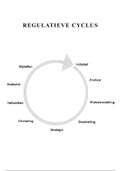
Initial observation (literature study, research problem, research question) generate theory
generate hypothesis collect data to test theory Analyze data.
1.4 Generating theories and testing them
Falsification: the act of disproving a hypothesis or theory.
1.5 Collect data to test your theory
1.5.1 Variables
Most hypotheses can be expressed in terms of two variables: a proposed cause and a proposed
outcome. Both the cause and the outcome are variables.
1.5.1.1 Independent and dependent variables
A variable that we think is a cause is known as an independent variable (predictor variable). A
variable that we think is an effect is called a dependent variable (outcome variable).
1.5.1.2 Levels of measurement
Level of measurement: the relationship between what is being measured and the numbers that
represent what is being measured is known as the level of measurement.
Categorical variables
Binary variable: an entity can be placed into only one of the two categories.
Nominal variable: can be placed into more than two possibilities. The only way that nominal data
can be used is to consider frequencies.
Ordinal variable: when variables are ordered. Does not tell us anything about the differences
between values.
Continuous variables
Interval variable: equal intervals on the scale represent equal differences in the property being
measured.
Ratio variable: meets the requirements of an interval variable, but also the ratios of values along the
scale should be meaningful.
Continuous variables (usually infinite) can be continuous but also discrete. A truly continuous
variable can be measured to any level of precision, whereas a discrete variable (usually finite) can
take on only certain values on the scale (scale from 1 to 5, e.g.). a continuous scale would be
something like age, which can be measured at an infinite level of precision.
1.5.2 Measurement error
Measurement error: a discrepancy between the numbers we use to represent the thing we are
measuring and the actual value of the thing we are measuring.
1
,1.5.3 Validity and reliability
Validity: whether an instrument actually measures what it sets out to measure.
Criterion validity: whether you can establish that an instrument measures what it claims to measure
through comparison to objective criteria (observations e.g.). When data are recorded simultaneously
using the new instrument and existing criteria, then this is said to assess concurrent validity; when
data from the new instrument are used to predict observations at a later point in time, this is said to
asses predictive validity. assessing criterion validity is often impractical because objective criteria
that can be measured easily may not exist.
Reliability: whether an instrument can be interpreted consistently across different situations. To be
valid the instrument must first be reliable.
1.5.4 Correlational research methods
if we simplify things quite a lot then there are two ways to test a hypothesis: either by observing
what naturally happens, or by manipulating some aspect of the environment and observing the
effect it has on the variable.
In correlational or cross-sectional research we observe what naturally goes on in the world without
directly interfering with in, whereas in experimental research we manipulate one variable to see its
effect on another.
1.6 Analyzing data
1.6.1 Frequency distributions
Frequency distribution/ histogram: a graph of how many times each score occurs. Frequency
distributions can be very useful for assessing properties of the distribution scores and can be used
regardless of measurement levels.
Normal distribution: a bell-shaped curve, that implies that the majority of the scores lie around the
center of the distribution. Further away from the center the bars get smaller, implying that the
scores start to deviate from the center their frequency is decreasing.
There are two main ways in which a distribution can deviate from normal:
• Lack of symmetry (skew). Skewed distributions are not symmetrical and instead the most
frequent scores are clustered at one end of the scale. A skewed distribution can be either
positively skewed (the frequent scores are clustered at the lower end) or negatively skewed
(the frequent cores are clustered at the higher end).
• Pointyness (kurtosis). Defers to the degree to which scores cluster at the ends of the
distribution (tails) and this tends to express itself in how pointy a distribution is. A
distribution with positive kurtosis has many scores in the tails (heavy-tailed distribution) and
is pointy. This is known as a leptokurtic distribution. In contrast, a distribution with negative
kurtosis is relatively thin in the tails (light tails) and tends to be flatter than normal. This is
called platykurtic.
In a normal distribution the values of skew and kurtosis are 0.
1.6.2 The center of a distribution
We can measure where the central tendency (center of a frequency distribution) lies. There are
three measures commonly used: the mode, the median and the mean.
2
, 1.6.2.1 The mode
The mode is the score that occurs the most frequently in the data set. One problem with the mode is
that there can be two modes, which is said to be bimodal, and data sets with more than two modes
are multimodal nominal, ordinal, interval, ratio.
1.6.2.2 The median
Median: the middle score when scores are ranked in order of magnitude. When we have an even
number of scores the will not be a middle value. Then the median is calculated by added the two
middle numbers and divide them by 2. The median is relatively unaffected by skewed distributions
and can be used with ordinal, interval and ratio data ordinal, interval, ratio.
1.6.2.3 The mean
The mean is the measure of central tendency containing the average score. To calculate the mean
we add up all of the scores and then divide by the total number of scores. The mean can be
influenced by extreme scores and can be affected by skewed distributions and can only be used with
interval or ratio data. An advantage is that it uses every score compared to the mode and the median
interval, ratio.
1.6.3 The dispersion in a distribution
Range: take the largest score and subtract it from the smallest score. This is affected dramatically by
extreme scores ordinal, interval, ratio.
Interquartile range: cut off the top and bottom 25% of scores and calculate the range of the middle
50%. The advantage of the interquartile range is that it is not affected by extreme scores ordinal,
interval, ratio.
Quartiles are the three values that split the data into four equal parts. First, we calculate the median,
which is called the second quartile. The lower quartile is the median of the lower half of the data and
the upper quartile is the median of the upper half of the data. The median is not include in the two
halves when they are split.
Quantiles: quantiles are values that split a data set into equal portions, and in the case of quartiles
they are quantiles that split the data into four equal parts. You can have other quantiles as
percentiles (100 equal parts) and noniles (nine equal parts).
Deviance: if we use the mean as a measure of the center of a distribution then we can calculate the
difference between each score and the mean.
To get the sum of squared errors (SS), you can add up the squared deviances. We can use this as an
indicator of the total dispersion (total deviance of scores from the mean).
𝑛
𝑠𝑢𝑚 𝑜𝑓 𝑠𝑞𝑢𝑎𝑟𝑒𝑑 𝑒𝑟𝑟𝑜𝑟𝑠 (𝑆𝑆) = ∑𝑖=1(x − x̄ )2
The total dispersion is a bit of a nuisance because we cannot compare it across samples that differ in
size. There it can be useful to work with the average dispersion, which is also known as the variance.
The variance (interval, ratio) is the average error between the mean and the observations made.
SS
𝑣𝑎𝑟𝑖𝑎𝑛𝑐𝑒 =
N−1
3
Chapter 1. Why is my evil lecturer forcing me to learn statistics?
1.2 What the hell am I doing here?
1.2.1 The research process
Initial observation (literature study, research problem, research question) generate theory
generate hypothesis collect data to test theory Analyze data.
1.4 Generating theories and testing them
Falsification: the act of disproving a hypothesis or theory.
1.5 Collect data to test your theory
1.5.1 Variables
Most hypotheses can be expressed in terms of two variables: a proposed cause and a proposed
outcome. Both the cause and the outcome are variables.
1.5.1.1 Independent and dependent variables
A variable that we think is a cause is known as an independent variable (predictor variable). A
variable that we think is an effect is called a dependent variable (outcome variable).
1.5.1.2 Levels of measurement
Level of measurement: the relationship between what is being measured and the numbers that
represent what is being measured is known as the level of measurement.
Categorical variables
Binary variable: an entity can be placed into only one of the two categories.
Nominal variable: can be placed into more than two possibilities. The only way that nominal data
can be used is to consider frequencies.
Ordinal variable: when variables are ordered. Does not tell us anything about the differences
between values.
Continuous variables
Interval variable: equal intervals on the scale represent equal differences in the property being
measured.
Ratio variable: meets the requirements of an interval variable, but also the ratios of values along the
scale should be meaningful.
Continuous variables (usually infinite) can be continuous but also discrete. A truly continuous
variable can be measured to any level of precision, whereas a discrete variable (usually finite) can
take on only certain values on the scale (scale from 1 to 5, e.g.). a continuous scale would be
something like age, which can be measured at an infinite level of precision.
1.5.2 Measurement error
Measurement error: a discrepancy between the numbers we use to represent the thing we are
measuring and the actual value of the thing we are measuring.
1
,1.5.3 Validity and reliability
Validity: whether an instrument actually measures what it sets out to measure.
Criterion validity: whether you can establish that an instrument measures what it claims to measure
through comparison to objective criteria (observations e.g.). When data are recorded simultaneously
using the new instrument and existing criteria, then this is said to assess concurrent validity; when
data from the new instrument are used to predict observations at a later point in time, this is said to
asses predictive validity. assessing criterion validity is often impractical because objective criteria
that can be measured easily may not exist.
Reliability: whether an instrument can be interpreted consistently across different situations. To be
valid the instrument must first be reliable.
1.5.4 Correlational research methods
if we simplify things quite a lot then there are two ways to test a hypothesis: either by observing
what naturally happens, or by manipulating some aspect of the environment and observing the
effect it has on the variable.
In correlational or cross-sectional research we observe what naturally goes on in the world without
directly interfering with in, whereas in experimental research we manipulate one variable to see its
effect on another.
1.6 Analyzing data
1.6.1 Frequency distributions
Frequency distribution/ histogram: a graph of how many times each score occurs. Frequency
distributions can be very useful for assessing properties of the distribution scores and can be used
regardless of measurement levels.
Normal distribution: a bell-shaped curve, that implies that the majority of the scores lie around the
center of the distribution. Further away from the center the bars get smaller, implying that the
scores start to deviate from the center their frequency is decreasing.
There are two main ways in which a distribution can deviate from normal:
• Lack of symmetry (skew). Skewed distributions are not symmetrical and instead the most
frequent scores are clustered at one end of the scale. A skewed distribution can be either
positively skewed (the frequent scores are clustered at the lower end) or negatively skewed
(the frequent cores are clustered at the higher end).
• Pointyness (kurtosis). Defers to the degree to which scores cluster at the ends of the
distribution (tails) and this tends to express itself in how pointy a distribution is. A
distribution with positive kurtosis has many scores in the tails (heavy-tailed distribution) and
is pointy. This is known as a leptokurtic distribution. In contrast, a distribution with negative
kurtosis is relatively thin in the tails (light tails) and tends to be flatter than normal. This is
called platykurtic.
In a normal distribution the values of skew and kurtosis are 0.
1.6.2 The center of a distribution
We can measure where the central tendency (center of a frequency distribution) lies. There are
three measures commonly used: the mode, the median and the mean.
2
, 1.6.2.1 The mode
The mode is the score that occurs the most frequently in the data set. One problem with the mode is
that there can be two modes, which is said to be bimodal, and data sets with more than two modes
are multimodal nominal, ordinal, interval, ratio.
1.6.2.2 The median
Median: the middle score when scores are ranked in order of magnitude. When we have an even
number of scores the will not be a middle value. Then the median is calculated by added the two
middle numbers and divide them by 2. The median is relatively unaffected by skewed distributions
and can be used with ordinal, interval and ratio data ordinal, interval, ratio.
1.6.2.3 The mean
The mean is the measure of central tendency containing the average score. To calculate the mean
we add up all of the scores and then divide by the total number of scores. The mean can be
influenced by extreme scores and can be affected by skewed distributions and can only be used with
interval or ratio data. An advantage is that it uses every score compared to the mode and the median
interval, ratio.
1.6.3 The dispersion in a distribution
Range: take the largest score and subtract it from the smallest score. This is affected dramatically by
extreme scores ordinal, interval, ratio.
Interquartile range: cut off the top and bottom 25% of scores and calculate the range of the middle
50%. The advantage of the interquartile range is that it is not affected by extreme scores ordinal,
interval, ratio.
Quartiles are the three values that split the data into four equal parts. First, we calculate the median,
which is called the second quartile. The lower quartile is the median of the lower half of the data and
the upper quartile is the median of the upper half of the data. The median is not include in the two
halves when they are split.
Quantiles: quantiles are values that split a data set into equal portions, and in the case of quartiles
they are quantiles that split the data into four equal parts. You can have other quantiles as
percentiles (100 equal parts) and noniles (nine equal parts).
Deviance: if we use the mean as a measure of the center of a distribution then we can calculate the
difference between each score and the mean.
To get the sum of squared errors (SS), you can add up the squared deviances. We can use this as an
indicator of the total dispersion (total deviance of scores from the mean).
𝑛
𝑠𝑢𝑚 𝑜𝑓 𝑠𝑞𝑢𝑎𝑟𝑒𝑑 𝑒𝑟𝑟𝑜𝑟𝑠 (𝑆𝑆) = ∑𝑖=1(x − x̄ )2
The total dispersion is a bit of a nuisance because we cannot compare it across samples that differ in
size. There it can be useful to work with the average dispersion, which is also known as the variance.
The variance (interval, ratio) is the average error between the mean and the observations made.
SS
𝑣𝑎𝑟𝑖𝑎𝑛𝑐𝑒 =
N−1
3