Main topics of this course:
1. Motivation
2. Leadership
3. Organisational Culture
4. Power and Politics
5. Conflict and Negotiations
6. Organisational Structure
7. Organisational Change
Chapter 7: Motivation concepts
1. Describe the three key elements of motivation.
We define motivation as the processes that account for an individual’s intensity, direction, and
persistence of effort toward attaining a goal.
- Intensity: describes how hard a person tries
- Direction: the quality of effort
- Persistence: How long a person can maintain effort
2. Evaluate the applicability of early theories of motivation.
Hierarchy of Needs Theory
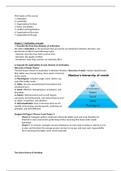
The best-known theory of motivation is Abraham Maslow’s hierarchy of needs. Maslow hypothesized
that within every human being, there exists a hierarchy
of five needs:
1. Physiological. Includes hunger, thirst, shelter, sex,
and other bodily needs.
2. Safety. Security and protection from physical and
emotional harm.
3. Social. Affection, belongingness, acceptance, and
friendship.
4. Esteem. Internal factors such as self-respect,
autonomy, and achievement, and external factors such
as status, recognition, and attention.
5. Self-actualization. Drive to become what we are
capable of becoming; includes growth, achieving our
potential, and self-fulfillment.
Douglas McGregor’s Theory X and Theory Y:
- Theory X: Managers believe employees inherently dislike work and must therefore be
directed or even coerced into performing it (thus assuming that lower-order needs
dominate).
- Theory Y: In contrast, managers assume employees can view work as being as natural as rest
or play, and therefore the average person can learn to accept, and even seek, responsibility
(thus assuming that higher order needs motivate).
Two factor theory of Herzberg
,Mr Herzberg asked people to
describe, in detail, situations in which
they felt exceptionally good or bad
about their jobs. The responses
differed significantly, respondents
who felt good about their work
tended to attribute the intrinsic
factors such as advancement,
recognition, responsibility and
achievement to themselves, while
dissatisfied respondents tended to
cite extrinsic factors such as
supervision, pay, company policies,
and working conditions.
McClelland’s Theory of Needs
The McClelland’s theory of Needs looks at three needs:
- Need for achievement (nAch) is the drive to excel, to achieve in relationship to a set of
standards.
- Need for power (nPow) is the need to make others behave in a way they would not have
otherwise.
- Need for affiliation (nAff) is the desire for friendly and close interpersonal relationships.
3. Contrast the elements of self-determination theory and goalsetting theory.
- The self-determination theory Proposes that people prefer to feel they have control over
their actions, so anything that makes a previously enjoyed task feel more like an obligation
than a freely chosen activity will undermine motivation.
- The goal-setting theory Clear and difficult goals often lead to higher levels of employee
productivity
4. Demonstrate the differences between self-efficacy theory, equity theory, and expectancy theory.
- Self-efficacy theory: refers to an individual’s belief that he is capable of performing a task.
- Equity theory: Employees compare what they get from their job (their “outcomes,” such as
pay, promotions, recognition, or having the corner office) to what they put into it (their
“inputs,” such as effort, experience, and education)
- Expectancy theory: argues that the strength of our tendency to act a certain way depends on
the strength of our expectation of a given outcome and its attractiveness.
The expectancy theory focuses on three relationships:
, 1. Effort–performance relationship. The probability perceived by the individual that exerting a given
amount of effort will lead to performance.
2. Performance–reward relationship. The degree to which the individual believes performing at a
particular level will lead to the attainment of a desired outcome.
3. Rewards–personal goals relationship. The degree to which organizational rewards satisfy an
individual’s personal goals or needs and the attractiveness of those potential rewards for the
individual
5. Identify the implications of employee job engagement for management.
Job engagement: the investment of an employee’s physical, cognitive, and emotional energies into
job performance. Implications of employee job engagement for management:
- Higher level of productivity
- Fewer safety incidents
- Lower turnover
- Higher task performance
Chapter 8: Motivation: From concepts to applications
1. Describe the job characteristics model and the way it motivates by changing the work
environment. The job characteristics model describes jobs by five core dimensions:
1. Skill variety is the degree to which a job requires different activities using specialized skills and
talents.
2. Task identity is the degree to which a job requires completion of a whole and identifiable piece of
work.
3. Task significance is the degree to which a job affects the lives or work of other people.
4. Autonomy is the degree to which a job provides the worker freedom, independence, and
discretion in scheduling work and determining the procedures for carrying it out.
5. Feedback is the degree to which carrying out work activities generates direct and clear information
about your own performance.
This model proposes that individuals obtain internal rewards when they learn (knowledge of results)
that they personally have performed well (experienced responsibility) on a task they care about
(experienced meaningfulness). The more these three psychological states are present, the greater will
be employees’ motivation, performance, and satisfaction, and the lower their absenteeism and
likelihood of leaving.
2. Compare the main ways jobs can be redesigned.
1. Motivation
2. Leadership
3. Organisational Culture
4. Power and Politics
5. Conflict and Negotiations
6. Organisational Structure
7. Organisational Change
Chapter 7: Motivation concepts
1. Describe the three key elements of motivation.
We define motivation as the processes that account for an individual’s intensity, direction, and
persistence of effort toward attaining a goal.
- Intensity: describes how hard a person tries
- Direction: the quality of effort
- Persistence: How long a person can maintain effort
2. Evaluate the applicability of early theories of motivation.
Hierarchy of Needs Theory
The best-known theory of motivation is Abraham Maslow’s hierarchy of needs. Maslow hypothesized
that within every human being, there exists a hierarchy
of five needs:
1. Physiological. Includes hunger, thirst, shelter, sex,
and other bodily needs.
2. Safety. Security and protection from physical and
emotional harm.
3. Social. Affection, belongingness, acceptance, and
friendship.
4. Esteem. Internal factors such as self-respect,
autonomy, and achievement, and external factors such
as status, recognition, and attention.
5. Self-actualization. Drive to become what we are
capable of becoming; includes growth, achieving our
potential, and self-fulfillment.
Douglas McGregor’s Theory X and Theory Y:
- Theory X: Managers believe employees inherently dislike work and must therefore be
directed or even coerced into performing it (thus assuming that lower-order needs
dominate).
- Theory Y: In contrast, managers assume employees can view work as being as natural as rest
or play, and therefore the average person can learn to accept, and even seek, responsibility
(thus assuming that higher order needs motivate).
Two factor theory of Herzberg
,Mr Herzberg asked people to
describe, in detail, situations in which
they felt exceptionally good or bad
about their jobs. The responses
differed significantly, respondents
who felt good about their work
tended to attribute the intrinsic
factors such as advancement,
recognition, responsibility and
achievement to themselves, while
dissatisfied respondents tended to
cite extrinsic factors such as
supervision, pay, company policies,
and working conditions.
McClelland’s Theory of Needs
The McClelland’s theory of Needs looks at three needs:
- Need for achievement (nAch) is the drive to excel, to achieve in relationship to a set of
standards.
- Need for power (nPow) is the need to make others behave in a way they would not have
otherwise.
- Need for affiliation (nAff) is the desire for friendly and close interpersonal relationships.
3. Contrast the elements of self-determination theory and goalsetting theory.
- The self-determination theory Proposes that people prefer to feel they have control over
their actions, so anything that makes a previously enjoyed task feel more like an obligation
than a freely chosen activity will undermine motivation.
- The goal-setting theory Clear and difficult goals often lead to higher levels of employee
productivity
4. Demonstrate the differences between self-efficacy theory, equity theory, and expectancy theory.
- Self-efficacy theory: refers to an individual’s belief that he is capable of performing a task.
- Equity theory: Employees compare what they get from their job (their “outcomes,” such as
pay, promotions, recognition, or having the corner office) to what they put into it (their
“inputs,” such as effort, experience, and education)
- Expectancy theory: argues that the strength of our tendency to act a certain way depends on
the strength of our expectation of a given outcome and its attractiveness.
The expectancy theory focuses on three relationships:
, 1. Effort–performance relationship. The probability perceived by the individual that exerting a given
amount of effort will lead to performance.
2. Performance–reward relationship. The degree to which the individual believes performing at a
particular level will lead to the attainment of a desired outcome.
3. Rewards–personal goals relationship. The degree to which organizational rewards satisfy an
individual’s personal goals or needs and the attractiveness of those potential rewards for the
individual
5. Identify the implications of employee job engagement for management.
Job engagement: the investment of an employee’s physical, cognitive, and emotional energies into
job performance. Implications of employee job engagement for management:
- Higher level of productivity
- Fewer safety incidents
- Lower turnover
- Higher task performance
Chapter 8: Motivation: From concepts to applications
1. Describe the job characteristics model and the way it motivates by changing the work
environment. The job characteristics model describes jobs by five core dimensions:
1. Skill variety is the degree to which a job requires different activities using specialized skills and
talents.
2. Task identity is the degree to which a job requires completion of a whole and identifiable piece of
work.
3. Task significance is the degree to which a job affects the lives or work of other people.
4. Autonomy is the degree to which a job provides the worker freedom, independence, and
discretion in scheduling work and determining the procedures for carrying it out.
5. Feedback is the degree to which carrying out work activities generates direct and clear information
about your own performance.
This model proposes that individuals obtain internal rewards when they learn (knowledge of results)
that they personally have performed well (experienced responsibility) on a task they care about
(experienced meaningfulness). The more these three psychological states are present, the greater will
be employees’ motivation, performance, and satisfaction, and the lower their absenteeism and
likelihood of leaving.
2. Compare the main ways jobs can be redesigned.