Chapter 26: Nursing Care of a Family with a High-Risk Newborn
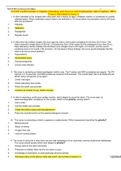
The nurse is weighing a newborn and documents AGA (appropriate for gestational age) on the newborn record. Which weight percentile is anticipated? a. 20th b. 9th c. 5th d. 95th - ha. 20th Appropriate for gestation age infants fall between the 10th and 90th percentile for weight. jWhat is a consequence of hypothermia in a newborn? a. respirations of 46 b. heart rate of 126 c. holds breath 25 seconds d. skin pink and warm - hc. holds breath 25 seconds Apnea is the cessation of breathing for a specific amount of time, and in newborns it usually occurs when the breath is held for 15 seconds. Apnea, cyanosis, respiratory distress, and increased oxygen demand are all consequences of hypothermia. jA nurse is providing care to a large-for-gestational-age newborn. The newborn's blood glucose level was 32 mg/dl one hour ago. Breastfeeding was initiated. The nurse checks the newborn's blood glucose level and finds it to be 23 mg/dl. Which action would the nurse do next? a. Administer intravenous glucose. b. Feed the newborn 2 ounces of formula. c. Initiate blow-by oxygen therapy. d. Place the newborn under a radiant warmer. - ha. Administer intravenous glucose Supervised breastfeeding or formula feeding may be the initial treatment options in asymptomatic hypoglycemia. However, symptomatic hypoglycemia should always be treated with frequent breast or formula feedings or dextrose gel massaged into the buccal mucosa. If hypoglycemia persists, then intravenous dextrose may be needed. Oral feedings would be used to maintain the newborn's glucose level above 40 mg/dl. Blow-by oxygen would have no effect on glucose levels; it may be helpful in promoting oxygenation. Placing the newborn under a radiant warmer would be a more appropriate measure for cold stress. jA nurse is caring for a preterm newborn who has developed rapid, irregular respirations with periods of apnea. Which additional assessment finding should the nurse identify as an indication of respiratory distress syndrome (RDS)? a. Deep inspiration b. Expiratory lag c. Sternal retraction d. Inspiratory grunt - hc. Sternal retraction The nurse should identify sternal retraction as a sign of respiratory distress syndrome in the preterm newborn. Deep inspiration is not seen during respiratory distress; rather, a shallow and rapid respiration is seen. There is an inspiratory lag, instead of an expiratory lag, during respiratory distress. There is a grunting heard when the air is breathed out, which is during expiration and not during inspiration. jA 35-year-old client has just given birth to a healthy newborn during her 43rd week of gestation. What should the nurse expect when assessing the condition of the newborn? a. meconium aspiration in utero or at birth b. seizures, respiratory distress, cyanosis, and shrill cry c. yellow appearance of the newborn's skin d. tremors, irritability, and high-pitched cry - ha. meconium aspiration in utero or at birth Infants born after 42 weeks of pregnancy are post term. These infants are at a higher risk of swallowing or aspirating meconium in utero or after birth. As soon as the infant is born, the nurse usually suctions out the secretions and fluids in the newborn's mouth and throat before the first breath to avoid aspiration of meconium and amniotic fluid into the lungs. Seizures, respiratory distress, cyanosis, and shrill cry are signs and symptoms of infants with intracranial hemorrhage. Intracranial hemorrhage can be a dangerous birth injury that is primarily a problem for preterm newborns, not postterm neonates. Yellow appearance of the newborn's skin is usually seen in infants with jaundice. Tremors, irritability, high-pitched or weak cry, and eye rolling are seen in infants with hypoglycemia. jA client with diabetes gives birth to a full-term neonate who weights 10 lb, 1 oz (4,600 g). While caring for this large-for-gestational-age (LGA) neonate, the nurse palpates the clavicles for which reason? a. Neonates of mothers with diabetes have brittle bones. b. Clavicles are commonly absent in neonates of mothers with diabetes. c. One of the neonate's clavicles may have been broken during birth. d. LGA neonates have glucose deposits on their clavicles. - hc. One of the neonate's clavicles may have been broken during birth. Because of the neonate's large size, clavicular fractures are common during birth. The nurse should assess all LGA neonates for this occurrence. None of the other options are true. jThe nurse observes a neonate born at 28 weeks' gestation. Which finding would the nurse expect to see? a. The skin is pale, and no vessels show through it. b. Creases appear on the interior two-thirds of the sole. c. The pinna of the ear is soft and flat and stays folded. d. The neonate has 7 to 10 mm of breast tissue. - hc. The pinna of the ear is soft and flat and stays folded. The ear has a soft pinna that is flat and stays folded. Pale skin with no vessels showing through and 7 to 10 mm of breast tissue are characteristic of a neonate at 40 weeks' gestation. Creases on the anterior two-thirds of the sole are characteristic of a neonate at 36 weeks' gestation. jA 33-week-gestation infant has just been born. The child's heartbeat is not audible. What is the priority nursing intervention? a. Depression of the sternum with both thumbs 1 to 2 cm at a rate of 100 times per minute b. Administration of IV epinephrine, as prescribed c. Transfer to a transitional or high-risk nursery for continuous cardiac surveillance d. Palpation for a femoral pulse - ha. Depression of the sternum with both thumbs 1 to 2 cm at a rate of 100 times per minute If an infant has no audible heartbeat, or if the cardiac rate is below 60 beats per minute, closed-chest massage should be started. Hold the infant with fingers encircling the chest and wrapped around the back and depress the sternum with both your thumbs, on the lower third of the sternum approximately one third of its depth (1 or 2 cm) at a rate of 100 times per minute. If the pressure and the rate of massage are adequate, it should be possible, in addition, to palpate a femoral pulse. If heart sounds are not resumed above 60 beats per minute after 30 seconds of combined positive-pressure ventilation and cardiac compressions, intravenous epinephrine may be prescribed. Following cardio-resuscitation, newborns need to be transferred to a transitional or high-risk nu

Geschreven voor
- Instelling
- Maternal
- Vak
- Maternal
Documentinformatie
- Geüpload op
- 17 november 2023
- Aantal pagina's
- 16
- Geschreven in
- 2023/2024
- Type
- Tentamen (uitwerkingen)
- Bevat
- Vragen en antwoorden
Onderwerpen
-
chapter 26 nursing care of a family with a high r