Chapter 9 The theory of
distribution of income
9.1 Wage determination under perfect competition
Perfect labour markets
Wage taker An employer or employee who has no power to influence the market wage rate.
The other assumptions of a perfect labour market are:
- Freedom of entry. There are no restrictions on the movement of labour. Workers are
free to move to different jobs or to areas of the country where wages are higher.
- Perfect knowledge. Workers are fully aware of what jobs are available at what wages
and with what conditions of employment.
- Homogeneous labour. It is usually assumed that, in perfect markets, workers of a
given category are identical in terms of productivity.
Wage rates and employment under perfect competition are determined by the interaction
of the market demand and supply of labour.
The supply of labour
We can look at the supply of labour at three levels: the supply of hours by an individual
worker, the supply of workers to an individual employer, and the total market supply of a
given category of labour.
The supply of hours by an individual worker
Work involves two major costs (or ‘disutilities’) to the worker:
- When people work they sacrifice leisure.
- The work itself may be unpleasant or tedious.
Each extra hour worked will involve additional disutility. This marginal disutility of work
(MDU) will tend to increase as people work more hours. There are two reasons for this. First,
the less leisure they have left, the greater is the disutility they experience in sacrificing a
further hour of leisure. Second, any unpleasantness they experience in doing the job tends
to increase due to boredom, tiredness or frustration.
Marginal disutility of work The extra sacrifice/ hardship to a worker of working an extra unit
of time in any given time period (e.g. an extra hour per day).
, The reason is that when wage rates go up, two opposing forces operate on the individual’s
labour supply. On one hand, with higher wage rates people tend to work more hours, since
time taken in leisure now involves a greater sacrifice of income and hence consumption.
Substitution effect of a rise in wage rates Workers will tend to substitute income for leisure
as leisure now has a higher opportunity cost. This effect leads to more hours being worked
as wage rates rise.
On the other hand, people may feel that with higher wage rates they can afford to work less
and have more leisure.
Income effect of a rise in wage rates Workers get a higher income for a given number of
hours worked and may thus feel they need to work fewer hours as wage rates rise.
If the wage rate becomes high enough for the income effect to outweigh the substitution
effect, the supply curve will begin to slope backwards.
These considerations are particularly important for a government when thinking about
policies on income tax. Conservative governments have often argued that cuts in income tax
are the equivalent of giving people a pay rise, and that they provide an incentive for people
to work harder. This analysis is only correct, however, if the substitution effect dominates. If
the income effect dominates, people will work less after the tax cut.
The supply of labour to an individual employer
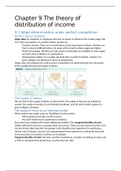
Under perfect competition, the supply of labour to a particular firm will be perfectly elastic,
as in Figure 9.1(b). The firm is a ‘wage taker’ and thus has no power to influence wages.
The market supply of a given type of labour
This will typically be upward sloping, as in Figure 9.1(a). The higher the wage rate offered in
a particular type of job, the more people will want to do that job.
The position of the market supply curve of labour depends on the number of people willing
and able to do the job at each given wage rate. This depends on three things:
distribution of income
9.1 Wage determination under perfect competition
Perfect labour markets
Wage taker An employer or employee who has no power to influence the market wage rate.
The other assumptions of a perfect labour market are:
- Freedom of entry. There are no restrictions on the movement of labour. Workers are
free to move to different jobs or to areas of the country where wages are higher.
- Perfect knowledge. Workers are fully aware of what jobs are available at what wages
and with what conditions of employment.
- Homogeneous labour. It is usually assumed that, in perfect markets, workers of a
given category are identical in terms of productivity.
Wage rates and employment under perfect competition are determined by the interaction
of the market demand and supply of labour.
The supply of labour
We can look at the supply of labour at three levels: the supply of hours by an individual
worker, the supply of workers to an individual employer, and the total market supply of a
given category of labour.
The supply of hours by an individual worker
Work involves two major costs (or ‘disutilities’) to the worker:
- When people work they sacrifice leisure.
- The work itself may be unpleasant or tedious.
Each extra hour worked will involve additional disutility. This marginal disutility of work
(MDU) will tend to increase as people work more hours. There are two reasons for this. First,
the less leisure they have left, the greater is the disutility they experience in sacrificing a
further hour of leisure. Second, any unpleasantness they experience in doing the job tends
to increase due to boredom, tiredness or frustration.
Marginal disutility of work The extra sacrifice/ hardship to a worker of working an extra unit
of time in any given time period (e.g. an extra hour per day).
, The reason is that when wage rates go up, two opposing forces operate on the individual’s
labour supply. On one hand, with higher wage rates people tend to work more hours, since
time taken in leisure now involves a greater sacrifice of income and hence consumption.
Substitution effect of a rise in wage rates Workers will tend to substitute income for leisure
as leisure now has a higher opportunity cost. This effect leads to more hours being worked
as wage rates rise.
On the other hand, people may feel that with higher wage rates they can afford to work less
and have more leisure.
Income effect of a rise in wage rates Workers get a higher income for a given number of
hours worked and may thus feel they need to work fewer hours as wage rates rise.
If the wage rate becomes high enough for the income effect to outweigh the substitution
effect, the supply curve will begin to slope backwards.
These considerations are particularly important for a government when thinking about
policies on income tax. Conservative governments have often argued that cuts in income tax
are the equivalent of giving people a pay rise, and that they provide an incentive for people
to work harder. This analysis is only correct, however, if the substitution effect dominates. If
the income effect dominates, people will work less after the tax cut.
The supply of labour to an individual employer
Under perfect competition, the supply of labour to a particular firm will be perfectly elastic,
as in Figure 9.1(b). The firm is a ‘wage taker’ and thus has no power to influence wages.
The market supply of a given type of labour
This will typically be upward sloping, as in Figure 9.1(a). The higher the wage rate offered in
a particular type of job, the more people will want to do that job.
The position of the market supply curve of labour depends on the number of people willing
and able to do the job at each given wage rate. This depends on three things: