Samenvatting boek Strategic alliance management:
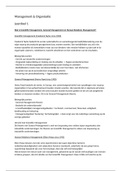
H1: Strategic alliance management.
To develop and maintain competitive advantages, many firms turn increasingly to
alliances; instead of just acquiring resources, they enjoy the benefits of combining their
own resources with resources / assets from others.
Alliances have become cornerstones of the competitive of firms, enabling them to
achieve objectives that otherwise were too difficult. Alliance provides companies to
increase their innovative capacity, improve their market response, achieve efficiency and
share investment risk with partner firms.
Alliance: voluntary, long-term, contractual relationship between two or more
autonomous and independent organizations, designed to achieve mutual and individual
objective by sharing or creating resources.
(JV, purchase partnerships, R&D partnerships ect).
Four important implications:
1. Alliances are an instrument to achieve their objectives, ultimately to develop and
sustain a competitive advantage.
2. Alliance consist of two or more firms, which remain independent org entities but
connect voluntarily through an alliance contract.
3. As critical resources get exchanged, firms engage in alliances grow increasingly
dependent on each other to realize joint goals.
4. Transitional entities, can dissolve them at any time.
Alliance helps firms comply with institutional and market demands for sustainability.
Advantages:
Access to resources
Economies of scale
Risk an cost sharing
Access to a (foreign) market
Learning
Reputation
Blocking competition
Assessing acquisition partner
Flexibility
Disadvantages:
Loss of proprietary information
Management complexity
Financial and org. risk
Risk of becoming dependent
Loss of decision autonomy
Antitrust implication
Learning barriers
, Address three key reasons of potential deal breakers:
Lack of understanding of the potential pitfalls and hazard that pertain to
the different alliance development states.
Unawareness of unique challenges imposed on them by different alliance
objectives.
Alliance failure is more likely when firms neglect the institutionalization of
their alliance know how and know what. Which we refer to alliance
capabilities.
To reap the benefits from alliances firms must deal systematically with these three
issues, which enable them to achieve, efficiently a good design and management
approach to their alliance relationship.
Alliance development stages:
Alliance strategy formulation stage
Partner selection
Negotiation
Design
Launch
Management
Evaluation
Termination
All eight stages remain interlinked through learning and adaption. Alliance failure often
results when organizations skip one or more stages and or managers fail to complete
their decision making task for each development stage. Management plays a critical role
in successful alliances, as org. must be actively managed and guided through various
stages to increase chances for success.
H2: Alliance Strategy Formulation
During the alliance strategy formulation a firm decides which governance mode is
appropriate to realise it’s objective. How it will organize the procurement (inkoop) of its
desired resources.
Make: gather resources internally through inter-unit exchanges or through
mergers and acquisitions. (internal procurement)(merger and acquisition, two
firms agree to integrate their operations because they posses resources that
when combined create synergies).
Buy: procure resources through market transaction organized by simple
contracts.
Ally: alliance arrangements organized through complex contracts with external
parties to procure resources.
Make: increase level of bureaucracy, because the frim has full control over an activity. It
also reduces flexibility, building or integrating resources requires investments, which
may be difficult to recoup if the firm fails.
Buy: conflict buying firms aims low cost, opposite firm high sell, may induce
opportunistic behaviour and increase transaction cost.
,Ally: access to complementary resources, without obtaining property rights. Speed and
flexibility in obtaining access and exploiting desired resources, share risk and
investments.
Seven theoretical perspectives:
Transaction cost economics: transaction cost should be minimized when a
governance mode matches the transaction exchange conditions. (ex ante and ex
post cost)(ex ante cost, drafting, negotiating contracts, ex post, time and
resources invested in repairing misalignments and bonding)
RBV.(appropriate for examining alliances or mergers and acquisitions to access
and obtain resources that they do not own but need to strengthen their
competitive advantage. Alliance are better when not all resources owned by the
target are valuable for the firm, disposing resources induces cost. Alliance enable
the focal firm to obtain only the desired resources and enable firms to protect
their own valuable resources.
RDP: firm cannot generate all resources, so they must enter into transactions and
relationships with external actors that can supply those required resources.
(intangible assets central).
Strategic management theory,
Social network theory
Org learning perspective
Instituation theory (aim for social approval)
Alliance strategy formulation:
1. Formulate business strategy (aim to achieve long term objectives)
2. Develop a governance mode selection framework. Pg. 26
3. Retrieve internal and external information
4. Asses alternative governance modes
5. Formulate alliance strategy
H 3: Alliance partner selection
Partner fit relies on resources complementarity to enhance collaborative effectiveness.
Second type, inter-firm characteristics are compatible. Incompatibility has a negative
effect.
Partner fit: resource complementarity, the effect of the joint use of resources yields
higher total return than used individually.
Complementary resources create synergy.
Supplementary resources, supply similar resources to obtain economies of scale.
Resource complementarity may stimulate inter-firm learning which increases the
likelihood of involuntary transfers of critical resources. RBV motive could undermine a
firm competitive position over time.
Partner fit compatibility:
Share of similar characteristics, Strategic, org, operational, cultural and human.
, Strategic: compatible strategic mission an vision
Alliance partner selection:
Develop a partner profile
Long and short list of potential partners
Partner fit framework
Partner fit analysis
Risk assessment
H4: Alliance negotiation
Which negotiation outcomes would will enable the alliance partners to obtain the
greatest possible level of synergy, and what negotiation outcomes would proved the best
deal for the partner firm.
- outcome that maximize value
- protect individual interest
Negotiation strategies
Integrative (address underlying interest of both) Distributive (individual gain)
5 strategies:
- collaborating
- competing
- avoiding
- accommodating
- compromising
valuation partners resources contributions
negotiations in alliances must achieve win-win outcomes, because the partners
ultimately seek a long term relationship.
Decision steps:
- assemble alliance negotiation team
- set up agenda and strategy
- share information
- assess compatibility and chemistry
- balance interest and consider traide offs
- document outcomes
- decision to proceed
H1: Strategic alliance management.
To develop and maintain competitive advantages, many firms turn increasingly to
alliances; instead of just acquiring resources, they enjoy the benefits of combining their
own resources with resources / assets from others.
Alliances have become cornerstones of the competitive of firms, enabling them to
achieve objectives that otherwise were too difficult. Alliance provides companies to
increase their innovative capacity, improve their market response, achieve efficiency and
share investment risk with partner firms.
Alliance: voluntary, long-term, contractual relationship between two or more
autonomous and independent organizations, designed to achieve mutual and individual
objective by sharing or creating resources.
(JV, purchase partnerships, R&D partnerships ect).
Four important implications:
1. Alliances are an instrument to achieve their objectives, ultimately to develop and
sustain a competitive advantage.
2. Alliance consist of two or more firms, which remain independent org entities but
connect voluntarily through an alliance contract.
3. As critical resources get exchanged, firms engage in alliances grow increasingly
dependent on each other to realize joint goals.
4. Transitional entities, can dissolve them at any time.
Alliance helps firms comply with institutional and market demands for sustainability.
Advantages:
Access to resources
Economies of scale
Risk an cost sharing
Access to a (foreign) market
Learning
Reputation
Blocking competition
Assessing acquisition partner
Flexibility
Disadvantages:
Loss of proprietary information
Management complexity
Financial and org. risk
Risk of becoming dependent
Loss of decision autonomy
Antitrust implication
Learning barriers
, Address three key reasons of potential deal breakers:
Lack of understanding of the potential pitfalls and hazard that pertain to
the different alliance development states.
Unawareness of unique challenges imposed on them by different alliance
objectives.
Alliance failure is more likely when firms neglect the institutionalization of
their alliance know how and know what. Which we refer to alliance
capabilities.
To reap the benefits from alliances firms must deal systematically with these three
issues, which enable them to achieve, efficiently a good design and management
approach to their alliance relationship.
Alliance development stages:
Alliance strategy formulation stage
Partner selection
Negotiation
Design
Launch
Management
Evaluation
Termination
All eight stages remain interlinked through learning and adaption. Alliance failure often
results when organizations skip one or more stages and or managers fail to complete
their decision making task for each development stage. Management plays a critical role
in successful alliances, as org. must be actively managed and guided through various
stages to increase chances for success.
H2: Alliance Strategy Formulation
During the alliance strategy formulation a firm decides which governance mode is
appropriate to realise it’s objective. How it will organize the procurement (inkoop) of its
desired resources.
Make: gather resources internally through inter-unit exchanges or through
mergers and acquisitions. (internal procurement)(merger and acquisition, two
firms agree to integrate their operations because they posses resources that
when combined create synergies).
Buy: procure resources through market transaction organized by simple
contracts.
Ally: alliance arrangements organized through complex contracts with external
parties to procure resources.
Make: increase level of bureaucracy, because the frim has full control over an activity. It
also reduces flexibility, building or integrating resources requires investments, which
may be difficult to recoup if the firm fails.
Buy: conflict buying firms aims low cost, opposite firm high sell, may induce
opportunistic behaviour and increase transaction cost.
,Ally: access to complementary resources, without obtaining property rights. Speed and
flexibility in obtaining access and exploiting desired resources, share risk and
investments.
Seven theoretical perspectives:
Transaction cost economics: transaction cost should be minimized when a
governance mode matches the transaction exchange conditions. (ex ante and ex
post cost)(ex ante cost, drafting, negotiating contracts, ex post, time and
resources invested in repairing misalignments and bonding)
RBV.(appropriate for examining alliances or mergers and acquisitions to access
and obtain resources that they do not own but need to strengthen their
competitive advantage. Alliance are better when not all resources owned by the
target are valuable for the firm, disposing resources induces cost. Alliance enable
the focal firm to obtain only the desired resources and enable firms to protect
their own valuable resources.
RDP: firm cannot generate all resources, so they must enter into transactions and
relationships with external actors that can supply those required resources.
(intangible assets central).
Strategic management theory,
Social network theory
Org learning perspective
Instituation theory (aim for social approval)
Alliance strategy formulation:
1. Formulate business strategy (aim to achieve long term objectives)
2. Develop a governance mode selection framework. Pg. 26
3. Retrieve internal and external information
4. Asses alternative governance modes
5. Formulate alliance strategy
H 3: Alliance partner selection
Partner fit relies on resources complementarity to enhance collaborative effectiveness.
Second type, inter-firm characteristics are compatible. Incompatibility has a negative
effect.
Partner fit: resource complementarity, the effect of the joint use of resources yields
higher total return than used individually.
Complementary resources create synergy.
Supplementary resources, supply similar resources to obtain economies of scale.
Resource complementarity may stimulate inter-firm learning which increases the
likelihood of involuntary transfers of critical resources. RBV motive could undermine a
firm competitive position over time.
Partner fit compatibility:
Share of similar characteristics, Strategic, org, operational, cultural and human.
, Strategic: compatible strategic mission an vision
Alliance partner selection:
Develop a partner profile
Long and short list of potential partners
Partner fit framework
Partner fit analysis
Risk assessment
H4: Alliance negotiation
Which negotiation outcomes would will enable the alliance partners to obtain the
greatest possible level of synergy, and what negotiation outcomes would proved the best
deal for the partner firm.
- outcome that maximize value
- protect individual interest
Negotiation strategies
Integrative (address underlying interest of both) Distributive (individual gain)
5 strategies:
- collaborating
- competing
- avoiding
- accommodating
- compromising
valuation partners resources contributions
negotiations in alliances must achieve win-win outcomes, because the partners
ultimately seek a long term relationship.
Decision steps:
- assemble alliance negotiation team
- set up agenda and strategy
- share information
- assess compatibility and chemistry
- balance interest and consider traide offs
- document outcomes
- decision to proceed