SUMMARY
INTRODUCTION TO THE SUPPLY CHAIN
- What is a supply chain?
“a set of three or more companies directly linked by one or more of the upstream and
downstream flows of products, services, finance and information from a source to a
customer” Mentzer
“all organizations and activities associated with the flow and transformation of goods
from raw materials, through to the end user, as well as the associated information and
monetary flows” Handfield and Nichols
Three components of the supply chain:
1. activities: deals with the level of linkages/integration – management components
2. organizations: members – network structure
3. processes and operations: linkages between members – business structure
- What is supply chain management?
planning and management of all activities involved in sourcing and procurement,
conversion and all logistics management activities includes coordination and
collaboration with channel partners including suppliers, intermediaries, third party service
providers, customers etc.
Perspective: focus on inter‐organizational relations and processes between actors in the
supply chain
Vertical integration is an individual organization in the supply chain integrating (for
instance by taking over) its own upstream parts
Horizontal integration is integration with other equal parts in the supply chain (for
instance by taking over more production facilities)
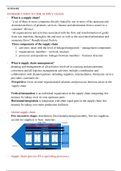
- Global supply chain
Five successive stages: distribution, final manufacturing/assembly, first tier suppliers,
second tier suppliers to basic materials.
- Supply chain process (Five operating processes)
, 1. Demand management: several related activities related to the market: forecasting,
customer service, customer order processing, market coordination, and sales support
activities.
2. Distribution: provides the link between production and the market. It influences
logistics through market requirements for service and efficiency.
3. Production: provides the link between production and the market. It influences
logistics through market requirements for service and efficiency.
4. Procurement: links stages of manufacturing together. In effect, purchasing
departments become managers of outside production.
5. Returns: Close the supply loop by remanufacturing products and components, and
reuse or recycle resources in the production process. How returns are organized
influence value creation, transport, and waste in the reverse supply chain.
LAMBERT CONTROL MODEL
Relationship of three components: the key supply chain members with whom to link
process need to be selected based on the strategic important of process that should be linked
with each of the key supply chain members. Each of these process links has management
components defined that the level of integration and management should be applied to each
process link
❖ Why monitoring trade partner’s activity with competitors?
1. Influence the supply chain’s effectiveness and competiveness
2. suppliers sell to competitors to avoid captive and to remain competitive and
innovative
- Supply chain network structure
• Members of the chain
➢ Identify critical members of the chain (4 principal P 60)
➢ Distinguish between key/primary players (those who add value to process to
fulfil customer needs) and supporting members (provide resources, knowledge,
utilities to primary members
• Structural dimensions of the network
, ➢ Horizontal Structure: Number of tiers across the chain
➢ Vertical Structure: Number of tiers across the chain
➢ Horizontal Position: Nearer supply, nearer the customer (demand)
• Types of process links across the supply chain
- Supply chain business process: a structured and measured set of activities designed to
produce a specific output for a particular customer or market
4 Types of business process:
➢ Order-to-Cash: activities of fulfilling customer orders. This measure the time
between customer order placement and receive
➢ Customer Service: a number of services before, during and after the actual sale
transaction. (Advising, track and trace, customer support)
➢ Time-to-Market: activities among a product development. This measure the speed
of transferring a product idea into actual/saleable product
➢ Procure-to-Pay: includes activities of procurement of materials, receiving invoice
and paying to suppliers
Four types of business process links:
➢ Managed business process links: focal company finds important to manage and
integrate
➢ Monitored process links: not as critical, but important to manage and integrate
➢ Not-managed process links: focal company not involved
➢ Non-member process links: activities of suppliers common to competitors
Key points for process links:
• Integrating and managing all business process links throughout the chain is not
likely to be appropriate
• Drivers for integration situational
• Levels of integration should vary from link to link, and over time
- Supply chain management components: 2 managerial components
Physical and technical systems Operational and behavioural systems
1. Planning and control systems 1. Management principles
2. Process structure 2. Power structure
3. Organizational structure 3. Incentives
4. Information distribution
5. Production flow
POSTPONEMENT: Activities in supply chain delayed until receipt of a customer order
(JIT)
The logic behind postponement is that risk and uncertainty costs are tied to differentiating
products by form, place, and time during manufacturing and logistics operations.
• Manufacturing postponement:
INTRODUCTION TO THE SUPPLY CHAIN
- What is a supply chain?
“a set of three or more companies directly linked by one or more of the upstream and
downstream flows of products, services, finance and information from a source to a
customer” Mentzer
“all organizations and activities associated with the flow and transformation of goods
from raw materials, through to the end user, as well as the associated information and
monetary flows” Handfield and Nichols
Three components of the supply chain:
1. activities: deals with the level of linkages/integration – management components
2. organizations: members – network structure
3. processes and operations: linkages between members – business structure
- What is supply chain management?
planning and management of all activities involved in sourcing and procurement,
conversion and all logistics management activities includes coordination and
collaboration with channel partners including suppliers, intermediaries, third party service
providers, customers etc.
Perspective: focus on inter‐organizational relations and processes between actors in the
supply chain
Vertical integration is an individual organization in the supply chain integrating (for
instance by taking over) its own upstream parts
Horizontal integration is integration with other equal parts in the supply chain (for
instance by taking over more production facilities)
- Global supply chain
Five successive stages: distribution, final manufacturing/assembly, first tier suppliers,
second tier suppliers to basic materials.
- Supply chain process (Five operating processes)
, 1. Demand management: several related activities related to the market: forecasting,
customer service, customer order processing, market coordination, and sales support
activities.
2. Distribution: provides the link between production and the market. It influences
logistics through market requirements for service and efficiency.
3. Production: provides the link between production and the market. It influences
logistics through market requirements for service and efficiency.
4. Procurement: links stages of manufacturing together. In effect, purchasing
departments become managers of outside production.
5. Returns: Close the supply loop by remanufacturing products and components, and
reuse or recycle resources in the production process. How returns are organized
influence value creation, transport, and waste in the reverse supply chain.
LAMBERT CONTROL MODEL
Relationship of three components: the key supply chain members with whom to link
process need to be selected based on the strategic important of process that should be linked
with each of the key supply chain members. Each of these process links has management
components defined that the level of integration and management should be applied to each
process link
❖ Why monitoring trade partner’s activity with competitors?
1. Influence the supply chain’s effectiveness and competiveness
2. suppliers sell to competitors to avoid captive and to remain competitive and
innovative
- Supply chain network structure
• Members of the chain
➢ Identify critical members of the chain (4 principal P 60)
➢ Distinguish between key/primary players (those who add value to process to
fulfil customer needs) and supporting members (provide resources, knowledge,
utilities to primary members
• Structural dimensions of the network
, ➢ Horizontal Structure: Number of tiers across the chain
➢ Vertical Structure: Number of tiers across the chain
➢ Horizontal Position: Nearer supply, nearer the customer (demand)
• Types of process links across the supply chain
- Supply chain business process: a structured and measured set of activities designed to
produce a specific output for a particular customer or market
4 Types of business process:
➢ Order-to-Cash: activities of fulfilling customer orders. This measure the time
between customer order placement and receive
➢ Customer Service: a number of services before, during and after the actual sale
transaction. (Advising, track and trace, customer support)
➢ Time-to-Market: activities among a product development. This measure the speed
of transferring a product idea into actual/saleable product
➢ Procure-to-Pay: includes activities of procurement of materials, receiving invoice
and paying to suppliers
Four types of business process links:
➢ Managed business process links: focal company finds important to manage and
integrate
➢ Monitored process links: not as critical, but important to manage and integrate
➢ Not-managed process links: focal company not involved
➢ Non-member process links: activities of suppliers common to competitors
Key points for process links:
• Integrating and managing all business process links throughout the chain is not
likely to be appropriate
• Drivers for integration situational
• Levels of integration should vary from link to link, and over time
- Supply chain management components: 2 managerial components
Physical and technical systems Operational and behavioural systems
1. Planning and control systems 1. Management principles
2. Process structure 2. Power structure
3. Organizational structure 3. Incentives
4. Information distribution
5. Production flow
POSTPONEMENT: Activities in supply chain delayed until receipt of a customer order
(JIT)
The logic behind postponement is that risk and uncertainty costs are tied to differentiating
products by form, place, and time during manufacturing and logistics operations.
• Manufacturing postponement: