Excitable Cells verified to pass 2023
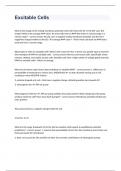
Excitable CellsWhat is the charge of the resting membrane potential of all cells? Does the ICF or the ECF carry this charge? What is the average RMP value? Do most cells have an RMP that exists in a broad range or a narrow range? - correct answer All cells carry a negative resting membrane potential, and the ICF is negatively charged relative to the ECF. The average RMP value = -70mV. Most cells have an RMP that is small and w/in a narrow range. What types of cells are excitable cells? What is the reason for this, in terms of a specific type of channel? Give examples of RMP for excitable cells. - correct answer Nervous and muscle cells. Specifically, motor neurons, skeletal, and cardiac muscle cells. Excitable cells have a high number of voltage-gated channels. RMP for excitable cells= -90mV, on average. What are the three major factors that contribute or establish RMP? - correct answer 1. differences in permeability of membrane to various ions, SPECIFICALLY K+ via leak channels moving out of cell, resulting in more NEGATIVE interior 2. proteins trapped w/in cell---that have a negative charge, attracting positive ions towards ICF 3. electrogenic Na+-K+ ATP-ase pump What happens if the Na+-K+ ATP-ase pump exhibits decreased activity? What charge does this pump produce inside the cell? How many Na/K pumped? - correct answer Membrane potential will become more positive. The pump produces a negative charge inside the cell. 3 Na Out, 2 K in What are the major drawbacks (2) of the Nernst equation with regards to equilibirium potential predictions? - correct answer 1. assumes free premeability of ions thru the membrane (not all ions can freely permeate the membrane) 2. does not account for the activities of other ions and the contributions of electrogenic pumps Assuming that an ion cannot cross the membrane by itself, what two factors influence the permeability of individual ions across the membrane? - correct answer 1. number of channels 2. type of channels What effect on the membrane potential does an ion yield if it is more permeant across the membrane? - correct answer The more permeant an ion is across the membrane, the more the ion will pull the membrane potential towards its Eion (equilibrium pot) What is the Chord Conductance (Goldman's) Equation for membrane potential? - correct answer It is a weighted average of the equilibrium potentials of all PERMEANT ions, especially Na+, K+, Cl-. The weighting factor accounts for the relative permeability of each ion, and the weighting factors must add to 1. What happens in the Chord conductance equation if one ion's permeability score increases? - correct answer The permeability scores/weighting factors of the other ions must decrease. Why does K+ have the largest influence on RMP? - correct answer K+ conductance is 10 x greater than Na+'s under resting membrane conditions. K+ has leak channels and has the greatest permeability Changes in ECF K+ alter RMP of all cells What is the result of Goldman's equation not accounting for the contribution of the electrogenic pump to RMP? - correct answer The RMP is more negative than Goldman's calculation. What is the definition of an Action Potential? In what cells does this occur? What specific transmembrane integral proteins are responsible? - correct answer AP=rapid and large change in membrane potential, followed by return to RMP. Occurs in excitable cells (muscle/neurons) Voltage-gated channels in plasma membrane. What kinds of stimuli can alter the RMP, resulting in an AP? - correct answer Electrical chemical Mechanical What is a hyperpolarizing stimulus? What effect does this type of stimulus have on the production of an AP? - correct answer A stimulus that makes the cell more negative, moving the membrane potential more negatively. This type of stimulus will make it less likely to generate an AP than at RMP. What is a depolarizing stimulus? Do all depolarizing stimuli result in APs? - correct answer Causes the RMP to become less negative/more positive/reduction in membrane potential. It is due to the mvmt of positive ions into the cell. Not all depolarizing stimuli result in APs. If there is sufficient reduction in membrane potential, there will be an AP What happens if a depolarizing stimulus is not sufficient enough to produce an AP? - correct answer The stimulus is called a "sub-threshold, local response, non-propagated potential." The membrane becomes depolarized over a small distance, but no AP occurs. What is the relationship between the magnitude of the membrane potential change and distance from the initiation site? - correct answer Size of pot change decreases exponentially with increasing distance from initiation site. What is the threshold point? - correct answer The minimum amt of membrane depolarization required to produce an AP. What is the equilibrium pot of Na+? - correct answer +60mv What is the equilibrium pot of Cl-? - correct answer -70mV

Geschreven voor
- Instelling
- RMP
- Vak
- RMP
Documentinformatie
- Geüpload op
- 24 oktober 2023
- Aantal pagina's
- 10
- Geschreven in
- 2023/2024
- Type
- Tentamen (uitwerkingen)
- Bevat
- Vragen en antwoorden
Onderwerpen
-
excitable cells

Ook beschikbaar in voordeelbundel