

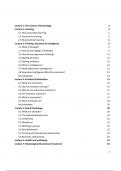
Lecture 1: The Science of Psychology 2
Lecture 2: Learning 4
2.1 Non-associative learning 5
2.2 Associative learning 5
2.3 Observational learning 8
Lecture 3: Thinking, Decisions & Intelligence 9
3.1 What is thought? 9
3.2 How do we engage in thinking? 9
3.3 How do we experience thinking? 11
3.4 Making decisions 11
3.5 Solving problems 13
3.6 What is intelligence? 13
3.7 What determines intelligence? 13
3.8 How does intelligence affect life outcomes? 14
Key takeaways 14
Lecture 4: Emotion & Motivation 15
4.1 What are emotions? 15
4.2 How do emotions emerge? 15
4.3 Why do we experience emotions? 17
4.4 Are emotions universal? 17
4.4 What is motivation? 17
4.5 What motivates us? 18
Key takeaways 20
Lecture 5: Social Psychology 20
5.1 What are attitudes? 20
5.2 The attitude-behavior link 22
5.3 Conformity 22
5.4 Obedience 22
5.5 Working in groups 23
5.6 Deindividuation 23
5.7 Forming and maintaining relationships 23
5.8 Romantic relationships 24
Lecture 6: Health and well-being 25
Lecture 7: Psychological Disorders & Treatment 33
1
,Lecture 1: The Science of Psychology
What is psychology? → study of the soul
Humans are intuitive psychologists
Psychology is a science, it is the study, through research of mind, brain and behavior
→ aimed at understanding and predicting
- Behaviour (actions)
- Mind (mental activity)
What is mind?
- Stuff of thought
- Mental activity
- Perceptual experiences (sights, smells, tastes, sounds and touches)
- Memories, thoughts and feelings
→ Not directly observable, the observable is the tip of the iceberg
Psychological science
Levels at which you can study psychology:
● Groups vs individuals
● Behavior vs brain activity
● Nature vs nurture
Journey through the history of psychology
- Dualism (Descartes, separation of mind and body)
- Nature/nurture debate
Structuralism: complex mental processes can be reduced to simpler processes (reaction times,
introspection)
Functionalism: concerned with the adaptive purpose/function of mind and behavior (the mind
is more complex than its elements)
2
,Evolution
● Genetic diversity
○ Mutation = variation
○ The benefits of sexual reproduction
● Environmental pressures
○ Evolution has no foresight
● Sexual selection
○ Traits that aid in reproduction
→ Evolution can provide answers to the ‘why’ questions
Schools of thought
● Psychoanalytical approach
○ Mental processes operate below the level of conscious awareness
○ Unconscious drives
● Behaviorism
○ Building on work of pavlov
○ Only observable behavior can be subject of scientific investigation
● Gestalt
○ A few basic principles guide visual perception
○ These explain how visual input is grouped into a coherent whole
○ ‘’The whole is bigger than the sum of its parts’’
● Humanistic psychology
○ An approach focusing on basic goodness in people, achieving goals and finding
fulfillment
○ Positive psychology
○ Values, creativity, quality of relationships, gratitude, faith
● Cognitivism
○ The cognitive revolution
■ Exploring mental process
■ Influences by the progress in computer science
○ Cognitive neuroscience
■ We can infer how the mind works by looking at behavior
■ Neuroimaging has even made the mind observable
3
,The Scientific Method
Based on the experience, observation, existing theories etc., come up with a question and a
prediction → test that prediction against real measurement from the physical world → make
conclusion with regard to your questions, show support or lack of if for your prediction
- The SM is important because our intuitions and even perceptions can be biased. SM can
help overcome these problems.
Optimism bias: we tend to think we are better than others
Availability heuristic: If something is easier to bring to mind/image or if we hear about
something more often → we judge it as more probable
Contemporary psychology: what’s new in psychology?
➢ Biology (evolution)
➢ Big data, computational modeling
➢ Çulture
➢ Interdisciplinary influences
Lecture 2: Learning
Overview
● How do we learn
● How do we learn predictive associations?
● How do consequences of actions shape behavior?
● What do different types of associative learning have in common?
● How do we learn from others?
Learning goals
- Define classical conditioning and give examples of how it works
- Define operant conditioning and give examples of how it works
- Describe how learning takes place through observation
Learning: Environment is never constant, individuals must adapt to ever-changing conditions of
the specific environments they live in
- Behaviourism
- Ecological perspective
- Learning is an enduring change in behavior that results from experience
4
,2.1 Non-associative learning
Imagine a stimulus that triggers behavior, like airplane noise annoys you
Repeated exposure to his stimulation can either:
- Decrease behavior: habituation, you get used to it
- Increase behavior: sensitization, you get even more annoyed
2.2 Associative learning
We learn connections between things
- Things that happen close in time
- Behavior that has a predictable outcome
Reflexes: stimulus (S) → response ( R)
Types of learning
● Classical conditioning
○ Responding to stimuli
○ Learning process that creates new reflexes from existing reflexes
A reflex is a simple, automatic, stimulus response sequence mediated by the nervous system
=unconditioned stimulus
=unconditioned response
5
, ‘Food’ reflex:
-Stimulus: image of delicious food
-Response: hunger sensation, salivation
Creating new reflexes
- Pair a new (neutral stimulus) with the unconditioned stimulus triggering an
unconditioned response
- The neutral stimulus becomes the conditioned stimulus and the unconditioned response
becomes a conditioned response
For a stimulus to be conditioned it must have a predictive value
- Precede the unconditioned stimulus
- Signal increased probability
- Repeated pairings
- There must not already be a better predictor
How long does it last?
Extinction
- Repeated exposure to the conditioned stimulus without the Unconditioned stimulus
may make the conditioned response disappear
Conditioning and evolution
- Classic behaviorist view: humans and animals start as a blank slate, a tabula rasa
- Any stimulus pair leads to conditioning equally easy
- The contemporary view
- Conditioning occurs most easily for stimulus pairs that are relevant for survival
- You easily associate a taste with sickness, a conditioned taste aversion
- You less easily associate a sound with sickness
A phobia is an acquired fear that is out of proportion to the real threat of an object/situation
Addiction and conditioned drug effects
- Relapsing: environmental cues trigger cravings
6
Lecture 2: Learning 4
2.1 Non-associative learning 5
2.2 Associative learning 5
2.3 Observational learning 8
Lecture 3: Thinking, Decisions & Intelligence 9
3.1 What is thought? 9
3.2 How do we engage in thinking? 9
3.3 How do we experience thinking? 11
3.4 Making decisions 11
3.5 Solving problems 13
3.6 What is intelligence? 13
3.7 What determines intelligence? 13
3.8 How does intelligence affect life outcomes? 14
Key takeaways 14
Lecture 4: Emotion & Motivation 15
4.1 What are emotions? 15
4.2 How do emotions emerge? 15
4.3 Why do we experience emotions? 17
4.4 Are emotions universal? 17
4.4 What is motivation? 17
4.5 What motivates us? 18
Key takeaways 20
Lecture 5: Social Psychology 20
5.1 What are attitudes? 20
5.2 The attitude-behavior link 22
5.3 Conformity 22
5.4 Obedience 22
5.5 Working in groups 23
5.6 Deindividuation 23
5.7 Forming and maintaining relationships 23
5.8 Romantic relationships 24
Lecture 6: Health and well-being 25
Lecture 7: Psychological Disorders & Treatment 33
1
,Lecture 1: The Science of Psychology
What is psychology? → study of the soul
Humans are intuitive psychologists
Psychology is a science, it is the study, through research of mind, brain and behavior
→ aimed at understanding and predicting
- Behaviour (actions)
- Mind (mental activity)
What is mind?
- Stuff of thought
- Mental activity
- Perceptual experiences (sights, smells, tastes, sounds and touches)
- Memories, thoughts and feelings
→ Not directly observable, the observable is the tip of the iceberg
Psychological science
Levels at which you can study psychology:
● Groups vs individuals
● Behavior vs brain activity
● Nature vs nurture
Journey through the history of psychology
- Dualism (Descartes, separation of mind and body)
- Nature/nurture debate
Structuralism: complex mental processes can be reduced to simpler processes (reaction times,
introspection)
Functionalism: concerned with the adaptive purpose/function of mind and behavior (the mind
is more complex than its elements)
2
,Evolution
● Genetic diversity
○ Mutation = variation
○ The benefits of sexual reproduction
● Environmental pressures
○ Evolution has no foresight
● Sexual selection
○ Traits that aid in reproduction
→ Evolution can provide answers to the ‘why’ questions
Schools of thought
● Psychoanalytical approach
○ Mental processes operate below the level of conscious awareness
○ Unconscious drives
● Behaviorism
○ Building on work of pavlov
○ Only observable behavior can be subject of scientific investigation
● Gestalt
○ A few basic principles guide visual perception
○ These explain how visual input is grouped into a coherent whole
○ ‘’The whole is bigger than the sum of its parts’’
● Humanistic psychology
○ An approach focusing on basic goodness in people, achieving goals and finding
fulfillment
○ Positive psychology
○ Values, creativity, quality of relationships, gratitude, faith
● Cognitivism
○ The cognitive revolution
■ Exploring mental process
■ Influences by the progress in computer science
○ Cognitive neuroscience
■ We can infer how the mind works by looking at behavior
■ Neuroimaging has even made the mind observable
3
,The Scientific Method
Based on the experience, observation, existing theories etc., come up with a question and a
prediction → test that prediction against real measurement from the physical world → make
conclusion with regard to your questions, show support or lack of if for your prediction
- The SM is important because our intuitions and even perceptions can be biased. SM can
help overcome these problems.
Optimism bias: we tend to think we are better than others
Availability heuristic: If something is easier to bring to mind/image or if we hear about
something more often → we judge it as more probable
Contemporary psychology: what’s new in psychology?
➢ Biology (evolution)
➢ Big data, computational modeling
➢ Çulture
➢ Interdisciplinary influences
Lecture 2: Learning
Overview
● How do we learn
● How do we learn predictive associations?
● How do consequences of actions shape behavior?
● What do different types of associative learning have in common?
● How do we learn from others?
Learning goals
- Define classical conditioning and give examples of how it works
- Define operant conditioning and give examples of how it works
- Describe how learning takes place through observation
Learning: Environment is never constant, individuals must adapt to ever-changing conditions of
the specific environments they live in
- Behaviourism
- Ecological perspective
- Learning is an enduring change in behavior that results from experience
4
,2.1 Non-associative learning
Imagine a stimulus that triggers behavior, like airplane noise annoys you
Repeated exposure to his stimulation can either:
- Decrease behavior: habituation, you get used to it
- Increase behavior: sensitization, you get even more annoyed
2.2 Associative learning
We learn connections between things
- Things that happen close in time
- Behavior that has a predictable outcome
Reflexes: stimulus (S) → response ( R)
Types of learning
● Classical conditioning
○ Responding to stimuli
○ Learning process that creates new reflexes from existing reflexes
A reflex is a simple, automatic, stimulus response sequence mediated by the nervous system
=unconditioned stimulus
=unconditioned response
5
, ‘Food’ reflex:
-Stimulus: image of delicious food
-Response: hunger sensation, salivation
Creating new reflexes
- Pair a new (neutral stimulus) with the unconditioned stimulus triggering an
unconditioned response
- The neutral stimulus becomes the conditioned stimulus and the unconditioned response
becomes a conditioned response
For a stimulus to be conditioned it must have a predictive value
- Precede the unconditioned stimulus
- Signal increased probability
- Repeated pairings
- There must not already be a better predictor
How long does it last?
Extinction
- Repeated exposure to the conditioned stimulus without the Unconditioned stimulus
may make the conditioned response disappear
Conditioning and evolution
- Classic behaviorist view: humans and animals start as a blank slate, a tabula rasa
- Any stimulus pair leads to conditioning equally easy
- The contemporary view
- Conditioning occurs most easily for stimulus pairs that are relevant for survival
- You easily associate a taste with sickness, a conditioned taste aversion
- You less easily associate a sound with sickness
A phobia is an acquired fear that is out of proportion to the real threat of an object/situation
Addiction and conditioned drug effects
- Relapsing: environmental cues trigger cravings
6




