Lifespan Development Final Exam Questions With Complete Solutions
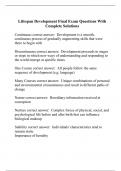
Continuous correct answer: Development is a smooth, continuous process of gradually augmenting skills that were there to begin with Discontinuous correct answer: Development proceeds in stages or steps in which new ways of understanding and responding to the world emerge at specific times One Course correct answer: All people follow the same sequence of development (e.g. language) Many Courses correct answer: Unique combinations of personal and environmental circumstances and result in different paths of change Nature correct answer: Hereditary information received at conception Nurture correct answer: Complex forces of physical, social, and psychological life before and after birth that can influence biological makeup Stability correct answer: Individuals' characteristics tend to remain static Importance of heredity Plasticity correct answer: Change can happen throughout the lifespan in response to influential experiences Importance of nurture Behaviorism (who, what, experiment, cont/discont, one/many, nature/nurture?) correct answer: Watson All development is a series of conditioning experiences Little Albert: bang on pipe with the emergence of animal leads to fear of animal (conditioned fear) CONTINUOUS, MANY, NURTURE Social Learning Theory (who, what, experiment, cont/discont, one/many, nature/nurture?) correct answer: Bandura Imitation or observational learning (MODELLING) is a powerful source of development Bobo Doll: kids exposed to violent behaviour begin to behave aggressively as well CONTINUOUS, MANY, NURTURE Psychosexual Theory (who, what, stages (5), cont/discont, one/many, nature/nurture?) correct answer: Freud Development proceeds in stages that are defined by biological drives (LIBIDO) and social expectations 1. Oral (birth-1 year): sucking 2. Anal (1-3 years): potty training 3. Phallic (3-6 years): genital stimulation - oedipal conflict 4. Latency (6-11 years): Superego strengthens 5. Genital (Adolescence): Sexual impulses DISCONTINUOUS, ONE, BOTH (inborn drives and society) Psychosocial Theory (who, what, stages (8), cont/discont, one/many, nature/nurture?) Similarities/Differences from Freud correct answer: Erikson Lifespan perspective divided into conflicts 1. Basic trust vs. mistrust (birth-1 year): hope 2. Autonomy vs. shame/doubt (1-3 years): will 3. Initiation vs. guilt (3-6 years): purpose 4. Industry vs. Inferiority (6-11 years): competence 5. Identity vs. Role Confusion (Adolescence): fidelity 6. Intimacy v. Isolation (Early adulthood): love 7. Generativity vs. Stagnation (Middle adulthood): caring 8. Ego Integrity vs. Despair (Late adulthood): wisdom DISCONTINUOUS, ONE, BOTH (inborn drives and society) - Similarities: focuses on inborn drives vs. social expectations, progression through stages that all individuals share - Differences: Lifespan approach covers all periods of life Cognitive-Developmental Theory (who, what, sta

Geschreven voor
- Instelling
- Lifespan Development
- Vak
- Lifespan Development
Documentinformatie
- Geüpload op
- 19 oktober 2023
- Aantal pagina's
- 64
- Geschreven in
- 2023/2024
- Type
- Tentamen (uitwerkingen)
- Bevat
- Vragen en antwoorden
Onderwerpen
-
lifespan development final exam questions with com

Ook beschikbaar in voordeelbundel