Research Methods in Communication Science
Master Communication Science
Tutorials and interpretation
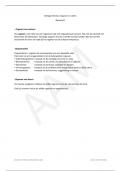
Course outline
• ‘Traditional’ way of teaching
o 2 lectures, 1 (plenary) tutorial per week
o Tutorial bring your own device
• Plus ‘blended’-learning elements
o Online assignments with R (compulsory)
o Homework theory questions (at your choice)
General information:
• Pass with Grade > 5.5.
• Grade
o 65% → Exam (theory and R output)
o 35% → 5 best scores of the weekly tests
• The resit is for 100% of the mark
• Only R → NO SPSS!
Week topics
1. Introduction to regression
2. Multiple regression
3. Mediation
4. Moderation
5. Repeated measures & Mixed-Designs ANOVA
6. MANOVA
1
,Table of Content
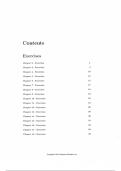
Tutorial Assignment: Week 1.................................................................................................................. 3
Tutorial Assignment: Week 2................................................................................................................ 17
Tutorial Assignment: Week 3................................................................................................................ 29
Tutorial Assignment: Week 4................................................................................................................ 41
Tutorial Assignment: Week 5................................................................................................................ 50
Tutorial Assignment: Week 6................................................................................................................ 63
2
,Tutorial Assignment: Week 1
# Loading libraries
library(ggplot2)
library(QuantPsyc)
library(car)
library(lm.beta)
library(haven)
library(psych)
library(gmodels)
library(tidyverse)
library(sjPlot)
# Loading data
ong2011 <- read_sav("YOUR_FOLDER/YOUR_FILE")
Question 1
For the first question, we start by looking at the number of cases and the number of variables in the
dataset. How many are there of both?
You can find the answer simply by viewing the dataset, or by calling nrow(ong1) (to get the
number of rows, i.e., observations/cases) and ncol(ong1) (to get the number of columns, i.e.,
variables).
# introduction - loading data
ong2011 <- read_sav("YOUR_FOLDER/YOUR_FILE")
View(ong2011)
view_df(ong2011)
table(ong2011$Age)
table(ong2011$FB_Status)
# number of rows and colums
nrow(ong2011)
ncol(ong2011)
There are 275 observations (cases) and 8 variables.
3
, Question 2
For which variable(s) makes it more sense to produce frequencies than produce the mean and the
standard deviation?
Gender, grade
Frequencies are appropriate for categorical variables. The two categorical variables are Gender and
Grade. Gender is a nominal variable: a categorical variable without ordering. Grade is an ordinal
variable: a categorical variable with ordering.
Question 3
Before we proceed to any analysis, let's get to know our data a bit.
Calculate the means of all variables using the functions describe() or mean().
The describe() function works on entire data frames. The mean() function only works on
specific variables.
HINT: Remember that you can use the dollar sign ($) operator to index the data set, i.e., to specify a
column within a data frame.
NOTE: The mean() functions only accepts columns (variables) that contain no missing values. If you
want R to disregard missing values when running this function, you need to pass the argument na.rm
= TRUE to remove NA-values (i.e., missing values, NA stands for 'not applicable').
So, obtaining the mean for the variable Age may look like this: mean(ong1$Age, na.rm =
TRUE)
describe(ong2011)
mean(ong2011$Age, na.rm = TRUE)
Question 4
Calculate the mode of all variables, i.e. the value for the variable that occurs most frequently in a given
set of data.
For this, check the frequencies of values that can be taken on by each variable using table().
table(ong2011$FB_Status)
4
Master Communication Science
Tutorials and interpretation
Course outline
• ‘Traditional’ way of teaching
o 2 lectures, 1 (plenary) tutorial per week
o Tutorial bring your own device
• Plus ‘blended’-learning elements
o Online assignments with R (compulsory)
o Homework theory questions (at your choice)
General information:
• Pass with Grade > 5.5.
• Grade
o 65% → Exam (theory and R output)
o 35% → 5 best scores of the weekly tests
• The resit is for 100% of the mark
• Only R → NO SPSS!
Week topics
1. Introduction to regression
2. Multiple regression
3. Mediation
4. Moderation
5. Repeated measures & Mixed-Designs ANOVA
6. MANOVA
1
,Table of Content
Tutorial Assignment: Week 1.................................................................................................................. 3
Tutorial Assignment: Week 2................................................................................................................ 17
Tutorial Assignment: Week 3................................................................................................................ 29
Tutorial Assignment: Week 4................................................................................................................ 41
Tutorial Assignment: Week 5................................................................................................................ 50
Tutorial Assignment: Week 6................................................................................................................ 63
2
,Tutorial Assignment: Week 1
# Loading libraries
library(ggplot2)
library(QuantPsyc)
library(car)
library(lm.beta)
library(haven)
library(psych)
library(gmodels)
library(tidyverse)
library(sjPlot)
# Loading data
ong2011 <- read_sav("YOUR_FOLDER/YOUR_FILE")
Question 1
For the first question, we start by looking at the number of cases and the number of variables in the
dataset. How many are there of both?
You can find the answer simply by viewing the dataset, or by calling nrow(ong1) (to get the
number of rows, i.e., observations/cases) and ncol(ong1) (to get the number of columns, i.e.,
variables).
# introduction - loading data
ong2011 <- read_sav("YOUR_FOLDER/YOUR_FILE")
View(ong2011)
view_df(ong2011)
table(ong2011$Age)
table(ong2011$FB_Status)
# number of rows and colums
nrow(ong2011)
ncol(ong2011)
There are 275 observations (cases) and 8 variables.
3
, Question 2
For which variable(s) makes it more sense to produce frequencies than produce the mean and the
standard deviation?
Gender, grade
Frequencies are appropriate for categorical variables. The two categorical variables are Gender and
Grade. Gender is a nominal variable: a categorical variable without ordering. Grade is an ordinal
variable: a categorical variable with ordering.
Question 3
Before we proceed to any analysis, let's get to know our data a bit.
Calculate the means of all variables using the functions describe() or mean().
The describe() function works on entire data frames. The mean() function only works on
specific variables.
HINT: Remember that you can use the dollar sign ($) operator to index the data set, i.e., to specify a
column within a data frame.
NOTE: The mean() functions only accepts columns (variables) that contain no missing values. If you
want R to disregard missing values when running this function, you need to pass the argument na.rm
= TRUE to remove NA-values (i.e., missing values, NA stands for 'not applicable').
So, obtaining the mean for the variable Age may look like this: mean(ong1$Age, na.rm =
TRUE)
describe(ong2011)
mean(ong2011$Age, na.rm = TRUE)
Question 4
Calculate the mode of all variables, i.e. the value for the variable that occurs most frequently in a given
set of data.
For this, check the frequencies of values that can be taken on by each variable using table().
table(ong2011$FB_Status)
4