Introduction to psychology
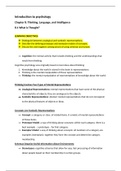
Chapter 8: Thinking, Language, and Intelligence
8.1 What is Thought?
LEARNING OBJECTIVES:
Distinguish between analogical and symbolic representations.
Describe the defining prototype and exemplar models of concepts.
Discuss the and negative consequences of using schemas and scripts.
Cognition: the mental activity that includes thinking and the understandings that
result from thinking.
Cognitive psychology was originally based on two ideas about thinking:
1. Knowledge about the world is stored in the brain in representations.
2. Thinking is the mental manipulation of these representations
Thinking: the mental manipulation of representations of knowledge about the world.
Thinking Involves Two Types of Mental Representations
Analogical Representations: mental representations that have some of the physical
characteristics of objects; they are analogous to the objects.
Symbolic Representations: abstract mental representations that do not correspond
to the physical features of objects or ideas.
Concepts Are Symbolic Representations
Concept: a category, or class, of related items; it consists of mental representations
of those items.
Prototype Model: a way of thinking about concepts: within each category, there is a
best example – a prototype – for that category.
Exemplar Model: a way of thinking about concepts: all members of a category are
examples (exemplars); together they form the concept and determine category
membership.
Schemas Organize Useful Information About Environments
Stereotypes: cognitive schemas that allow for easy, fast processing of information
about people based on their membership in certain groups.
, Script: a schema that directs behavior over time within a situation.
Schemas and scripts are adaptive because they minimize attentional requirements and help
people avoid dangerous situations. A negative consequence of schemas and scripts is that
they may reinforce stereotypes and biases.
8.2 How Do We Make Decisions and Solve Problems?
LEARNING OBJECTIVES:
Distinguish between normative and descriptive models of decision making.
Explain how heuristics influence decision making.
Review strategies that facilitate insight and problem solving.
Decision Making: attempting to select the best alternative from among several
options.
Problem Solving: finding a way around an obstacle to reach a goal.
Decision Making Often Involves Heuristics
Normative Decision Theories: attempts to refine how people should make decisions.
Expected Utility Theory: people make decisions by considering the possible
alternatives and choosing the most desirable one.
Descriptive Decision Theories: attempts to predict how people actually make
choices, not to define ideal choices.
Heuristics: shortcuts (rules of thumb or informal guidelines) used to reduce the
amount of thinking that is needed to make decisions.
Relative Comparisons (Anchoring and Framing)
Anchoring: the tendency, in making judgements, to rely on the first piece of
information encountered or information that comes most quickly to mind.
Framing: in decision making, the tendency to emphasize the potential losses or
potential gains from at least one alternative.
Chapter 8: Thinking, Language, and Intelligence
8.1 What is Thought?
LEARNING OBJECTIVES:
Distinguish between analogical and symbolic representations.
Describe the defining prototype and exemplar models of concepts.
Discuss the and negative consequences of using schemas and scripts.
Cognition: the mental activity that includes thinking and the understandings that
result from thinking.
Cognitive psychology was originally based on two ideas about thinking:
1. Knowledge about the world is stored in the brain in representations.
2. Thinking is the mental manipulation of these representations
Thinking: the mental manipulation of representations of knowledge about the world.
Thinking Involves Two Types of Mental Representations
Analogical Representations: mental representations that have some of the physical
characteristics of objects; they are analogous to the objects.
Symbolic Representations: abstract mental representations that do not correspond
to the physical features of objects or ideas.
Concepts Are Symbolic Representations
Concept: a category, or class, of related items; it consists of mental representations
of those items.
Prototype Model: a way of thinking about concepts: within each category, there is a
best example – a prototype – for that category.
Exemplar Model: a way of thinking about concepts: all members of a category are
examples (exemplars); together they form the concept and determine category
membership.
Schemas Organize Useful Information About Environments
Stereotypes: cognitive schemas that allow for easy, fast processing of information
about people based on their membership in certain groups.
, Script: a schema that directs behavior over time within a situation.
Schemas and scripts are adaptive because they minimize attentional requirements and help
people avoid dangerous situations. A negative consequence of schemas and scripts is that
they may reinforce stereotypes and biases.
8.2 How Do We Make Decisions and Solve Problems?
LEARNING OBJECTIVES:
Distinguish between normative and descriptive models of decision making.
Explain how heuristics influence decision making.
Review strategies that facilitate insight and problem solving.
Decision Making: attempting to select the best alternative from among several
options.
Problem Solving: finding a way around an obstacle to reach a goal.
Decision Making Often Involves Heuristics
Normative Decision Theories: attempts to refine how people should make decisions.
Expected Utility Theory: people make decisions by considering the possible
alternatives and choosing the most desirable one.
Descriptive Decision Theories: attempts to predict how people actually make
choices, not to define ideal choices.
Heuristics: shortcuts (rules of thumb or informal guidelines) used to reduce the
amount of thinking that is needed to make decisions.
Relative Comparisons (Anchoring and Framing)
Anchoring: the tendency, in making judgements, to rely on the first piece of
information encountered or information that comes most quickly to mind.
Framing: in decision making, the tendency to emphasize the potential losses or
potential gains from at least one alternative.