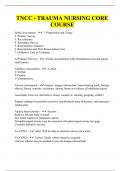
TNCC - TRAUMA NURSING CORE COURSE
Initial Assessment - 1. Preparation and Triage 2. Primary Survey 3. Reevaluation 4. Secondary Survey 5. Reevaluation Adjuncts 6. Reevaluation and Post Resuscitation Care 7. Definitive Care or Transport A (Primary Survey) - Airway and alertness with simultaneous cervical spinal stabilization. Alertness Assessment - A-Alert V-Verbal P-Painful U-Unresponsive Airway Assessment - Inspect: tongue obstruction, loose/missing teeth, foreign objects, blood, vomitus, secretions, edema, burns or evidence of inhalation injury Auscultate: listen for obstructive airway sounds (ie. snoring, gurgling, stridor) Palpate: palpate for possible occlusive maxillofacial bony deformity, subcutaneous emphysema Airway Interventions: - Suction Remove foreign body if noted Jaw thrust maneuver (maintain cspine) Nasopharyngeal airway (can be conscious) Oropharyngeal airway (no gag) Consider definitive airway A (AVPU) - Alert. Will be able to maintain airway once clear. V (AVPU) - Verbal. Needs verbal stimuli to respond. (Airway adjunct may be needed to prevent tongue obstruction) P (AVPU) - Painful. Responds only to painful stimuli. (Airway adjunct may be needed while determining need for intubation) U (AVPU) - Unresponsive. Does not respond to any stimuli. B (Primary Survey) - Breathing and Ventilation Breathing and Ventilation Assessment - Inspect: spontaneous breathing, symmetrical rise and fall, depth/pattern/rate of respirations, accessory muscle use, diaphragmatic breathing, skin color (normal, pale, flushed, cyanotic), contusions/abrasions/deformities (signs of underlying injury), open pneumothoraces (sucking chest wound), JVD, tracheal position, signs of inhalation injury Auscultate: presence, absence and equality of breath sounds at 2nd intercostal space midclavicular line and bases at the fifth intercostal space anterior axillary line Palpate: bony structures, possible rib fractures, SQ emphysema, soft tissue injury, JV pulsations at suprasternal notch or supraclavicular area Life-threatening pulmonary injuries requiring immediate intervention: open pneumothorax, tension pneumothorax, flail chest, hemothorax. Breathing and Ventilation Intervention - Breathing absent: jaw-thrust maneuver, oral airway adjunct, assist ventilation with bag-mask device, prepare for definitive airway Breathing present: NRB. Determine if ventilation effective: etCO2 35-45, SpO2 94% or higher. If ineffective: assist with bag-mask and determine need for definitive airway C (Primary Survey) - Circulation and Control of Hemorrhage Circulation and Control of Hemorrhage Assessment - Inspect: Uncontrolled external bleeding, skin color Auscultate: Muffled heart sounds - may indicate pericardial tamponade Palpate: carotid and/or femoral pulses for rate, rhythm, strength Circulation and Control of Hemorrhage Interventions - Control and treat external bleeding: apply direct pressure, elevate bleeding extremity, apply pressure over arterial sites, consider use of a tourniquet. 2 large bore IVs, if unable consider IO, obtain labs and crossmatch. Initiate IVF of warmed isotonic crystalloid solution. Consider blood products after 2L. **Large volumes of fluid lead to dilution coagulopathy which worsens metabolic acidosis and may cause hypothermia. Component therapy, including administering RBC, plasma and platelets is a balanced approach so that O2 delivery is optimized, acidosis corrected and coagulopathy prevented. D (Primary Survey) - Disability (Neurologic Status) Disability Assessment - Assess GCS on arrival and repeat per policy. Assess pupils for equality, shape and reactivity (PERRL) Disability interventions - Evaluate for need for CT. Assume AMS to be the result of CNS injury until proven otherwise. Consider ABGs - AMS may be indicator of decreased cerebral perfusion, hypoventilation or acid-base imbalance. Consider bedside glucose. GCS - GCS EYES 1: Does not open eyes 2: Opens eyes in response to pain 3: Opens eyes in response to voice 4: Opens eyes spontaneously

Geschreven voor
- Instelling
- TNCC
- Vak
- TNCC
Documentinformatie
- Geüpload op
- 8 oktober 2023
- Aantal pagina's
- 10
- Geschreven in
- 2023/2024
- Type
- Tentamen (uitwerkingen)
- Bevat
- Vragen en antwoorden
Onderwerpen
-
tncc
-
tncc trauma nursing core course

Ook beschikbaar in voordeelbundel