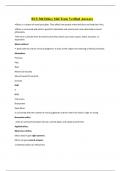
EMT-Basic-Test 1 Questions with 100% Correct Answers| Graded A+
Levels of EMS Training - First Responder EMT-Basic EMT-Intermediate EMT-Paramedic Roles and Responsibilities of the EMT Basic - Personal Safety Safety of the crew, patient & bystanders Patient care based on assessment findings Lifting and moving patient safely Transport/Transfer of Patient Record Keeping-Data Collecting Patient Advocacy Quality Improvement - A system of internal & external reviews and audits of all aspects of the EMS system so as to identify those aspects needing improvement to ensure that the public receives the highest quality of prehospital care. Medical Direction - A physician responsible for the clinical and patient care aspects of an EMS System. Every ambulance/rescue squad must have physician medical direction BSI (Body Substance Isolation) - Assumes that all substances are infectious, procedures are set by OSHA and local policy. Critical Stress Incident Debriefing - Open discussion about thought, feelings & reactions following a traumatic event. Held within 24-72 hours post incident. 5 Stages of Grief - Denial Anger Bargaining Depression Acceptance Scene Safety - Only do what you are trained to do. Know how to recognize situations and call for proper help. DOT Emergency Response Guidebook (Haz Mat Reference) is required on all ambulances. Scope of Practice - A collective set of rules and duties that define your roles as an EMT-N Ethical Responsibilities - Makes patient's needs a priority. Maintain skills & knowledge. Critically review performance. Prepare honest reports. Expressed Consent - Must be obtained from a conscious, competent adult before treatment. Parent must be legal age and rational. Patient must be informed. Implied Consent - Based on the assumption that a patient would consent if conscious. Assault/Battery - Unlawful touching of a patient without consent can be batter. Providing care without consent. Patient Refusal - Patients (of legal age that are competent and informed of the consequences of not receiving treatment) have the right to refuse treatment. Patients can revoke consent at any time. Must sign a release form. Most common reason for EMS lawsuits. Advance Directive - DNR- Patient has the right to refuse resuscitative efforts. Must be signed by a physician and patient. Paperwork must be with patient. Abandonment - Termination of care of a patient without assuring continuation of care at the same level or higher Negligence - Deviation from accepted standard of care, resulting in injury to a patient. Components include: Duty to Act, Breach of Duty, Injury or Damages inflicted, actions or omissions by EMT-B caused damages. Duty to Act - A legal or contractual requirement to provide care. Confidential Information - Patient history, assessment finding, care rendered, written release required to give out information. Exceptions to a written release include: other treating healthcare professionals, subpoena, mandatory reporting, and insurance. Crime Scenes - Do not enter until scene safe. Patient care is a priority. Remain alert for evidence and signs of repeated violence. Be observant & remember what you touch and minimize your impact at the scene, communicate with police. Special Reporting Situations - Abuse, Sexual Assault Gunshot Wound Infectious Disease Exposure Treating a Patient you Suspect has Committed a Crime Anatomical Position - This position is the basis for the description of the anatomy. Person is standing facing forward, palms fating forward (hands down), feet on floor. Anatomical Planes - Divide the body into right and left halves Midline - Imaginary plane dividing the body into right and left halves Mid-Clavicular - Imaginary line from head to toe just inside the nipples or in the middle of the clavicle or collar bone. Mid-Axillary Line - Imaginary plane dividing the body front and back (From armpits down to feet) Proximal - A directional term used for comparison. Means closer to the main body or trunk Distal - A directional term used for comparison. Means further away from the body or trunk. Lateral - A directional term used for comparison. Means away from the midline. Medial - A directional term used for comparison. Means toward the midline Ventral or Anterior - Front of the body Dorsal or Posterior - Back of the Body Superior - Toward the head Inferior - Toward the feet Supine - Lying on one's back (face up) Prone - Lying on one's stomach (face down) Autonomic Nervous System - Parallels spinal code but is separately involved in control of endocrine glands, blood vessels, viscera and external genitalia. Skin - Protects the body from the environment and organisms. Helps regulate body temperature. Senses heat, cold, touch, pressure and pain. Epidermis - Top layer of skin Dermis - Second layer of skin. Holds nerve endings, capillary network, hair follicles, pores, etc Subcutaneous - Third layer of skin. Fatty tissue Endocrine System - Secretes chemicals that regulate body activities and functions. Includes glands of the body. Lifting (of Patient) considerations - Patient's weight Communication with lifting partners identify need for assistance before lifting Leading injury for EMTs - Back injuries. Emergency Moves - Used when the scene is dangerous, life threatening conditions requires the move, or a patient must be moved to reach a critical patient. Clothes drag, incline drag, firefighter's drag, firefighter's carry, one rescuer assist and tow rescuer are all emergency moves. Urgent Moves - Treatment of a patient's condition requires a move or factors at the scent cause the patient's decline. Non-Urgent Moves - Used when there is no threat to life and when the patient's condition allows for assessment and care. Baseline Vital Signs - Respirations, Pulse, Skin, Blood Pressure, Pupils Left Lateral Recumbent - Also known as the recovery position. Lying on one's left side. Allows for drainage and keeps tongue off back of throat. Prevent hypotension in pregnant women Fowler's Position - Patient on cot with head slightly raised, almost a sitting position Trendelenburg Position - Feet raised 10-12 inches. Also known as the shock position Musculoskeletal System -

Geschreven voor
- Instelling
- EMT-
- Vak
- EMT-
Documentinformatie
- Geüpload op
- 28 september 2023
- Aantal pagina's
- 18
- Geschreven in
- 2023/2024
- Type
- Tentamen (uitwerkingen)
- Bevat
- Vragen en antwoorden
Onderwerpen
-
emt basic test 1
-
emt

Ook beschikbaar in voordeelbundel