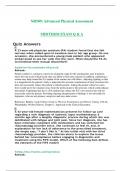
NR509: Advanced Physical Assessment MIDTERM EXAM Q & A
A 23-year-old physician assistant (PA) student found that she felt nervous when called upon to examine men in her age group. On one occasion, she encountered a young male patient who appeared embarrassed to see her walk into the room. What should the PA do to minimize their mutual discomfort? Explain how the examination will proceed. Rationale: Patient comfort is a primary concern in setting the stage for the examination, and, if patients know how the exam will proceed, they are likely to feel more relaxed. In addition, explaining a routine may help remind the PA student of the routine she will follow. Adjusting lighting so that it is tangential to the patient’s body is important for accurate visualization of body structures but does not necessarily reduce the patient’s embarrassment. Asking the patient where he comes from would move the situation away from the professional to the personal, which could enhance discomfort. Explaining that she is a PA student may reduce the PA’s own anxiety but will not necessarily calm the patient. Providing ongoing interpretation of findings is not advisable for beginners, who are not primary caregivers and may make errors. Reference: Bickley, Lynn S.Bates’Guide to Physical Examination and History Taking, 13th ed., Philadelphia: Wolters Kluwer, Chapter 1: Approach to the Clinical Encounter. 2 A 42-year-old female mathematician presents for follow-up care regarding a new diagnosis of systemic lupus erythematosus 6 months ago after a lengthy diagnostic process during which she was debilitated with fatigue and joint pain. Since her diagnosis, she has been minimally compliant with medications and has switched her rheumatology provider twice. She continues to feel ill, and, in explanation for her lack of adherence to the prescribed treatment, she simply says, “I don’t like it.” At this initial visit with her third rheumatology provider, the clinician elects to explore the issues behind her noncompliance before engaging in diagnostics and treatment using the FIFE model. Which of the following best defines the elements of the FIFE model? Feelings, Ideas, Function, and Expectations Rationale: This model captures the patient’s emotional landscape, intellectual landscape, current situation (function), and thoughts about future conditions. This breadth is important as aspects of a patient’s illness experience may be missed without a wide exploration. For example, a clinician may deeply engage with a patient’s emotional experience, but the lack of attention to a patient’s ideas surrounding their care and treatment may be perceived as condescending—especially to a very well-educated patient. Focus, intensity, function, and evaluation and facts, intensity, focus, and evidence are incorrect because these elements are very concrete in nature and may miss the emotional aspects of the patient’s illness. Feelings, impression, fantasy, and emotion is incorrect because, in contrary to the above two answers, these elements are almost entirely rooted in the emotional landscape with little attention paid to the intellectual side of a patient’s experience. Facts, intelligence, fortuity, and eventuality are incorrect because this group of elements (especially the latter two) does not clearly specify the topics that the clinician should explore. Reference: Bickley, Lynn S.Bates’Guide to Physical Examination and History Taking,13th ed., Philadelphia: Wolters Kluwer, Chapter 1: Approach to the Clinical Encounter. 3 A 34-year-old male with a history of complex social and medical needs (including current substance abuse) presents to a primary care teaching clinic. The patient has experienced a number of adversarial relationships with prior clinicians, including voluntarily leaving two practices within the previous year and being asked to leave care at a third clinic due to misbehavior. The attending physician desires to utilize the approaches to this patient that are most likely lead to comprehensive care and patient compliance. Which of the following is the most appropriate interview style for the attending physician to use? Following The Patient’s Lead to Understand Their Thoughts, Ideas, Concerns, And Requests Rationale: Following the patient’s lead is the key concept of patient-centered medical care. This approach helps to identify the personal context and address concerns as well as concrete maladies. Current evidence suggests that this technique is not only very satisfying to the patient and the clinician, but also leads to optimal outcomes. Focusing on the need for immediate diagnostic certainty over personal connection and taking charge of the interaction to meet the clinician’s desire to acquire diagnostic information are incorrect because diagnostic certainty may be required in emergent conditions, whereas establishing personal connection with patients first may lead to improved long-term care. Ignoring the personal connection with patients can lead to alienation and missed diagnoses as the patient is less likely to engage in care. Deferring respect, empathy, humility, and sensitivity in favor of the acquisition of concrete details about the patient’s condition is incorrect because deferring respect for the patient in favor of concrete details is unlikely to engage the patient in his or her care. Taking a symptom-focused approach to reduce the involvement of the patient’s emotional difficulties is incorrect because emotional issues may be at the forefront of a patient’s issues (such as a diabetic who is unmotivated to control his diabetes due to concurrent depression), and sidelining the emotional needs may sabotage progress on medical issues. Reference: Bickley, Lynn S.Bates’Guide to Physical Examination and History Taking, 13th ed., Philadelphia: Wolters Kluwer, Chapter 1: Approach to the Clinical Encounter. 4 A 17-year-old male presents to a sexually transmitted disease clinic at the behest of his brother, who convinced the patient to attend the clinic after he disclosed that he prefers homosexual partners but is afraid that his last partner may have given him an infection. The patient expresses to the intake nurse that he is unashamed of his sexual orientation and will not stay through the visit if he feels that he is dismissed or discriminated against because of it. The nurse practitioner receives this communication prior to entering the examination room and decides to employ active listening to best connect with the patient at this critical juncture in his care with the clinic. Which of the following is an example of an active listening technique? Using nonverbal communication to encourage the patient to expand their narrative Rationale: Active listening is the core of the interview technique and demands such skills as setting aside diagnostic priorities in favor of open discussion; using verbal and non-verbal skills to encourage the patient to engage fully with their own narrative, and being aware of the patient’s emotional state. Ignoring visual cues to focus on the patient’s exact words is incorrect because focusing on the patient’s words is important, and other cues to concerns and discomforts may be gleaned from nonverbal cues such as posture and facial expression. Setting aside the patient’s emotional state to focus on his medical needs is incorrect because except in emergent circumstances, laying a foundation of trust and emotional connection is critical prior to engaging in specific medical needs. Paring down the patient’s concerns to concrete medical needs is incorrect because addressing the concrete medical needs at hand is a vital part of medical visits, without a greater understanding of the patient’s concerns, fears, and anxieties, the patient is unlikely to feel satisfied on the end of the visit. Considering a differential diagnosis while the patient is speaking to maximize the patient’s time with the provider is incorrect because this may save time for the provider, but it is unlikely to serve the patient best if the provider is distracted with complex thoughts and conjectures. Reference: Bickley, Lynn S.Bates’Guide to Physical Examination and History Taking, 13th ed., Philadelphia: Wolters Kluwer, Chapter 1: Approach to the Clinical Encounter. Quiz Answers 1 A 36-year-old female air traffic controller presents to her primary care provider for a routine visit 3 months after losing her spouse to a lengthy battle with a neurodegenerative disease. The patient denies any psychiatric symptoms on review of systems and, in fact, states that she has slept better in the last month than she had in the previous years. She endorses a healthy support system, including the extended family of her deceased spouse, with whom she is still close. She becomes wistful and briefly tearful when speaking of the plans that they had when they first married that were never fulfilled; she then changes the subject rapidly to whether her Pap smear is due. Which of the following is an example of an empathetic response to this patient? Recognizing the patient’s emotions by asking or confirming how she feels about the event Rationale: This patient expresses notable ambiguity about her experience of her husband’s death and her desire to speak openly of those events. Empathizing with her emotions without understanding them better may lead to alienation from the clinician; for example, she may be more relieved than being sad about his death after a lengthy illness, and may feel guilty if she feels the clinician seems to prefer the expression of sadness. Assuming that the event caused her to become depressed and expressing the same feeling on behalf of the patient and presuming that the patient’s emotions meet social expectations, such as being depressed and even traumatized by her spouse’s death are incorrect because assumptions about a patient’s emotional landscape may not be correct and, as above, may lead to alienation if the patient feels she must play a role to be accepted by the clinician. By allowing the crying patient to look around the room for tissues to permit her an excuse to hide her face and defer her emotions is incorrect because a patient who is obvious in attempting to hide or maintain privacy may well be given the latitude and respect to do so, a more compassionate gesture may be to find the tissue and hand it to her. Narrowing the understanding of the patient’s emotional response to only thoughts and feelings that have been verbalized is incorrect because this patient’s emotional landscape is likely rich and nuanced with grief, relief, regret, and many other emotions—little of which is verbalized in the few lines she shares. Undisclosed responses may be even more significant to her than those few she shared. Reference: Bickley, Lynn S.Bates’Guide to Physical Examination and History Taking, 13th ed.,

Geschreven voor
- Instelling
- NR509: Advanced Physical Assessment
- Vak
- NR509: Advanced Physical Assessment
Documentinformatie
- Geüpload op
- 25 september 2023
- Aantal pagina's
- 26
- Geschreven in
- 2023/2024
- Type
- Tentamen (uitwerkingen)
- Bevat
- Vragen en antwoorden
Onderwerpen
-
nr509 advanced physical assessment midterm exam

Ook beschikbaar in voordeelbundel