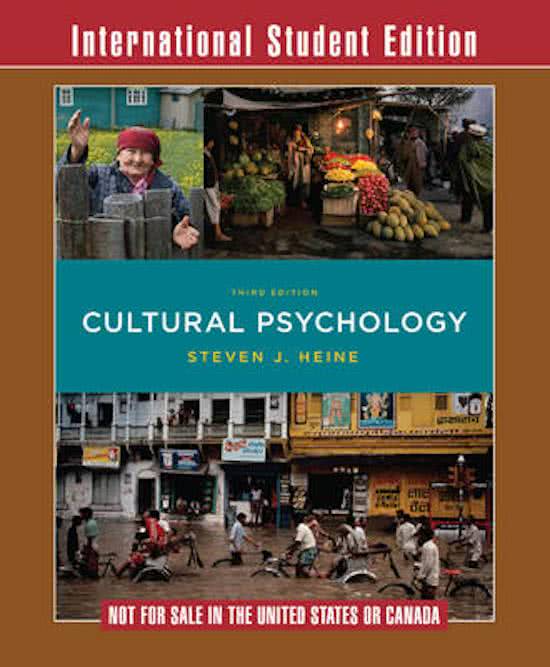
Cultural Psychology (Slides Milena Juana Feldkamp)
Chapter 2: Culture and Human Nature, Chapter 3: Cultural
Evolution and Chapter 5: Development and Socialization
- Cultural norms are adaptive responses to features of ecology
For example: Living in close proximity to animals created long-term resistance to
diseases transmitted by animals.
- Situational demands trigger appropriate responses out of a biologically encoded
repertoire
For example: The availability of food defines the foraging behaviour; if resources are
scarce and a lot of hunting is required, being masculine becomes more important.
- Adaptations can become functionally autonomous (Like the code of honor)
- Cultural variation due to proximal and distal causes
Proximal cause
= Cause a direct immediate effect. (Having swords directly caused Pizarro to beat
Atahualpa.)
Distal cause
= Indirect delayed effects.(A diverse environment with nutritious plants and big
animals indirectly caused agriculture and creating tools that are more sophisticated,
eventually creating more complex societies.)
More adaptation to environmental demands:
- Visual stimulation & perception
Differences in spatial awareness (strong special awareness if you can see far out),
the sophistication of geometrical spatial systems and the importance of geometrical
shapes in artefacts, lots of carving ornaments to make up for minimum visual stimuli
- Food availability, values and socialization practices
Low food accumulation & individualism (hunting) Assertiveness, venturesome
High food accumulation & conscientious (agriculture) Compliant, conservative,
higher severity of discipline
Ecological demands Part of culture it influences
Activity interdependence Need for collaboration related to
collectivism
Climate and temperature Collectivism/ Individualism
Availability of domesticable animals Population density and tightness, disease
immunities, innovativeness
Resource mobility Culture of honor (=aggressive reactions to
insults to prevent stealing) is related to
moveable cattle
Unpredictability of environment Spontaneity (especially if there is low
resource availability) and strong short-lived
motivations vs. long-term planning
Terrain fragmentation Development of distinct cultures
Cultural isolation Limited outgroup contact, and high ingroup
= Separation of groups by mountains, rivers homogeneity leads to tightness, the opposite
and other obstacles. to looseness
Dangerous activity (fishing vs. plucking Appreciation of bravery and masculinity
mangos)
Chapter 2: Culture and Human Nature, Chapter 3: Cultural
Evolution and Chapter 5: Development and Socialization
- Cultural norms are adaptive responses to features of ecology
For example: Living in close proximity to animals created long-term resistance to
diseases transmitted by animals.
- Situational demands trigger appropriate responses out of a biologically encoded
repertoire
For example: The availability of food defines the foraging behaviour; if resources are
scarce and a lot of hunting is required, being masculine becomes more important.
- Adaptations can become functionally autonomous (Like the code of honor)
- Cultural variation due to proximal and distal causes
Proximal cause
= Cause a direct immediate effect. (Having swords directly caused Pizarro to beat
Atahualpa.)
Distal cause
= Indirect delayed effects.(A diverse environment with nutritious plants and big
animals indirectly caused agriculture and creating tools that are more sophisticated,
eventually creating more complex societies.)
More adaptation to environmental demands:
- Visual stimulation & perception
Differences in spatial awareness (strong special awareness if you can see far out),
the sophistication of geometrical spatial systems and the importance of geometrical
shapes in artefacts, lots of carving ornaments to make up for minimum visual stimuli
- Food availability, values and socialization practices
Low food accumulation & individualism (hunting) Assertiveness, venturesome
High food accumulation & conscientious (agriculture) Compliant, conservative,
higher severity of discipline
Ecological demands Part of culture it influences
Activity interdependence Need for collaboration related to
collectivism
Climate and temperature Collectivism/ Individualism
Availability of domesticable animals Population density and tightness, disease
immunities, innovativeness
Resource mobility Culture of honor (=aggressive reactions to
insults to prevent stealing) is related to
moveable cattle
Unpredictability of environment Spontaneity (especially if there is low
resource availability) and strong short-lived
motivations vs. long-term planning
Terrain fragmentation Development of distinct cultures
Cultural isolation Limited outgroup contact, and high ingroup
= Separation of groups by mountains, rivers homogeneity leads to tightness, the opposite
and other obstacles. to looseness
Dangerous activity (fishing vs. plucking Appreciation of bravery and masculinity
mangos)