Biology Spec Led Revision
Chapter 8 - Transport in Animals
(a) the need for transport systems in multicellular animals. To include an appreciation of size,
metabolic rate and surface area to volume ratio (SA:V).
Circulatory Systems
Multicellular organisms need transport systems
1) Single celled organisms can get substances via diffusion, multicellular cannot
2) Multicellular have low surface area to volume ratios, and a higher metabolic rates
3) A lot of multicellular organisms are also very active, which means there is a large number of
cells respiring very quickly that need a constant rapid supply of glucose and oxygen
4) A transport system ensures that every cell can get the nutrients which it needs
5) In mammals, the circulatory system uses blood to carry glucose and oxygen around the body.
Also carries hormones, antibodies and waste products.
(b) the different types of circulatory systems
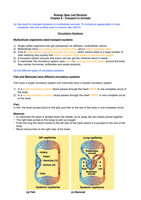
Fish and Mammals have different circulatory systems
Fish have a single circulatory system and mammals have a double circulatory system
1) In a single circulatory system, blood passes through the heart ONCE in one complete circuit of
the body
2) In a double circulatory system, blood passes through the heart TWICE in one complete circuit
of the body
Fish:
In fish, the heart pumps blood to the gills and then to the rest of the body in one complete circuit
Mammal:
- In mammals the heart is divided down the middle, so its really like two hearts joined together.
- The right side pumps to the lungs to pick up oxygen.
- From the lung the blood travels to the left side of the heart where it is pumped to the rest of the
body.
- Blood returns then to the right side of the heart.
,Pulmonary System - Takes blood to the lungs
Systemic System - Takes blood around the body
An advantage of having double circulatory system is that it can give blood the extra push to get
around the body faster, which means cells can get oxygen replenishment faster.
Circulatory Systems can be open or closed
Closed circulatory systems
All vertebrates have CLOSED CIRCULATORY SYSTEMS - the blood is enCLOSED within blood
vessels
1) The heart pumps blood into the ARTERIES, these branch out into millions of CAPILLARIES
2) Substances such as oxygen and glucose diffuse from the blood out of the capillaries into the
body cells, but blood itself does not diffuse, only nutrients
3) Veins take blood back into the heart
ARTERIES = AWAY VEINS = IN TO THE HEART
, Open circulatory systems
Some invertebrates have an OPEN CIRCULATORY SYSTEM - blood isn't enclosed within blood
vessels all the time, instead it flows freely through the body cavity.
1) The heart is segmented. It contracts in a wave, starting from the back pumping blood into a
single artery.
2) The artery opens up into the main body cavity
3) The blood flows around the insects organs, gradually making its way back into the heart via
several valves
The circulatory system in insects only transport nutrients and hormones to cells, it doesn't supply
the cells with oxygen. This is done via the tracheal system.
(c) the structure and functions of arteries, arterioles, capillaries, venules and veins. To include the
distribution of different tissues within the vessel walls.
Blood Vessels
Blood vessels transport substances around the body
5 types of blood vessel:
1) Arteries -
- Carry blood from heart to the rest of the body.
- Thick muscular walls that have elastic tissue to stretch and recoil with heart beats (helps
maintain pressure)
- Folded ENDOTHELIUM (inner lining), allowing the artery to expand
- All arteries carry OXYGENATED BLOOD, apart from the pulmonary arteries, which take
deoxygenated blood to the lungs.
2) Arterioles
- Arteries branch into arterioles which are smaller than arteries.
- Arterioles have a layer of smooth muscle but less elastic tissue
- The smooth muscle allows them to expand or contract, controlling the amount of blood going
to tissues
3) Capillaries
- Arterioles branch into capillaries
- Are the smallest blood vessels in the body
- Substances like glucose and oxygen diffuse out from capillaries to the cells
- They adapted for efficient diffusion (by them having thin one cell thick walls)
4) Venules
- Capillaries branch into venules
- They have very thin walls that contain some muscle cells
- Venules join together to form veins
5) Veins
- Take blood back from the body to the heart under low pressure
- They have a wider lumen compared to arteries
- Little muscle or elastic tissues
- Contains valves to stop back flow of blood
- Blood flows through veins is helped by muscle contractions from body around them
- All veins carry deoxygenated blood apart from the pulmonary veins which carry oxygenated
blood from the lungs into the heart.
Chapter 8 - Transport in Animals
(a) the need for transport systems in multicellular animals. To include an appreciation of size,
metabolic rate and surface area to volume ratio (SA:V).
Circulatory Systems
Multicellular organisms need transport systems
1) Single celled organisms can get substances via diffusion, multicellular cannot
2) Multicellular have low surface area to volume ratios, and a higher metabolic rates
3) A lot of multicellular organisms are also very active, which means there is a large number of
cells respiring very quickly that need a constant rapid supply of glucose and oxygen
4) A transport system ensures that every cell can get the nutrients which it needs
5) In mammals, the circulatory system uses blood to carry glucose and oxygen around the body.
Also carries hormones, antibodies and waste products.
(b) the different types of circulatory systems
Fish and Mammals have different circulatory systems
Fish have a single circulatory system and mammals have a double circulatory system
1) In a single circulatory system, blood passes through the heart ONCE in one complete circuit of
the body
2) In a double circulatory system, blood passes through the heart TWICE in one complete circuit
of the body
Fish:
In fish, the heart pumps blood to the gills and then to the rest of the body in one complete circuit
Mammal:
- In mammals the heart is divided down the middle, so its really like two hearts joined together.
- The right side pumps to the lungs to pick up oxygen.
- From the lung the blood travels to the left side of the heart where it is pumped to the rest of the
body.
- Blood returns then to the right side of the heart.
,Pulmonary System - Takes blood to the lungs
Systemic System - Takes blood around the body
An advantage of having double circulatory system is that it can give blood the extra push to get
around the body faster, which means cells can get oxygen replenishment faster.
Circulatory Systems can be open or closed
Closed circulatory systems
All vertebrates have CLOSED CIRCULATORY SYSTEMS - the blood is enCLOSED within blood
vessels
1) The heart pumps blood into the ARTERIES, these branch out into millions of CAPILLARIES
2) Substances such as oxygen and glucose diffuse from the blood out of the capillaries into the
body cells, but blood itself does not diffuse, only nutrients
3) Veins take blood back into the heart
ARTERIES = AWAY VEINS = IN TO THE HEART
, Open circulatory systems
Some invertebrates have an OPEN CIRCULATORY SYSTEM - blood isn't enclosed within blood
vessels all the time, instead it flows freely through the body cavity.
1) The heart is segmented. It contracts in a wave, starting from the back pumping blood into a
single artery.
2) The artery opens up into the main body cavity
3) The blood flows around the insects organs, gradually making its way back into the heart via
several valves
The circulatory system in insects only transport nutrients and hormones to cells, it doesn't supply
the cells with oxygen. This is done via the tracheal system.
(c) the structure and functions of arteries, arterioles, capillaries, venules and veins. To include the
distribution of different tissues within the vessel walls.
Blood Vessels
Blood vessels transport substances around the body
5 types of blood vessel:
1) Arteries -
- Carry blood from heart to the rest of the body.
- Thick muscular walls that have elastic tissue to stretch and recoil with heart beats (helps
maintain pressure)
- Folded ENDOTHELIUM (inner lining), allowing the artery to expand
- All arteries carry OXYGENATED BLOOD, apart from the pulmonary arteries, which take
deoxygenated blood to the lungs.
2) Arterioles
- Arteries branch into arterioles which are smaller than arteries.
- Arterioles have a layer of smooth muscle but less elastic tissue
- The smooth muscle allows them to expand or contract, controlling the amount of blood going
to tissues
3) Capillaries
- Arterioles branch into capillaries
- Are the smallest blood vessels in the body
- Substances like glucose and oxygen diffuse out from capillaries to the cells
- They adapted for efficient diffusion (by them having thin one cell thick walls)
4) Venules
- Capillaries branch into venules
- They have very thin walls that contain some muscle cells
- Venules join together to form veins
5) Veins
- Take blood back from the body to the heart under low pressure
- They have a wider lumen compared to arteries
- Little muscle or elastic tissues
- Contains valves to stop back flow of blood
- Blood flows through veins is helped by muscle contractions from body around them
- All veins carry deoxygenated blood apart from the pulmonary veins which carry oxygenated
blood from the lungs into the heart.