Biology spec led revision
Chapter 6 - Cell division, Cell diversity and cellular organisation
(a) the cell cycle. To include the processes taking place during interphase (G1, S and G2), mitosis
and cytokinesis, leading to genetically identical cells.
The cell cycle and Mitosis
The cell cycle:
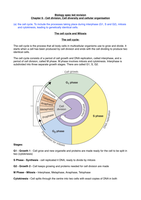
The cell cycle is the process that all body cells in multicellular organisms use to grow and divide. It
starts when a cell has been produced by cell division and ends with the cell dividing to produce two
identical cells.
The cell cycle consists of a period of cell growth and DNA replication, called interphase, and a
period of cell division, called M phase. M phase involves mitosis and cytokinesis. Interphase is
subdivided into three separate growth stages. There are called G1, S, G2.
Stages:
G1 - Growth 1 - Cell grow and new organelle and proteins are made ready for the cell to be split in
two (cytokinesis)
S Phase - Synthesis - cell replicated it DNA, ready to divide by mitosis
G2 - Growth 2 - Cell keeps growing and proteins needed for cell division are made
M Phase - Mitosis - Interphase, Metaphase, Anaphase, Telophase
Cytokinesis - Cell splits through the centre into two cells with exact copies of DNA in both
,(b) how the cell cycle is regulated. To include an outline of the use of checkpoints to control the
cycle.
The cell cycle is regulated by checkpoints. Checkpoints occur at key points during the cycle to
make sure its OK for the process to continue.
G1 Checkpoint - The cell checks that the chemicals needed for replication are present and for any
damage to the DNA before entering S-phase
G2 Checkpoint - The cell checks whether all the DNA has been replicated without any damage. If
it has, the can enter mitosis.
Metaphase Checkpoint - The cell checks that all the chromosomes are attached to the spindle
before mitosis can continue
(c) the main stages of mitosis. To include the changes in the nuclear envelope, chromosomes,
chromatids, centromere, centrioles, spindle fibres and cell membrane.
Interphase:
During interphase the cell carries out normal functions, but also prepares to divide. The cells DNA
is unravelled and replicated, to double its genetic content. The organelles are also replicated so it
has spare ones, and its ATP content is increased (ATP provides the energy needs for cell division.
Mitosis:
There are two types of cell division, mitosis and meiosis. Mitosis is the form of cell division that
occurs during yah cell cycle. It’s needed for the growth of multicellular organisms and for repairing
damaged tissues. Some animals, plants and fungi also use this to reproduce asexually. Mitosis is
really one continuous process but is described as a series of division stages - Prophase,
Metaphase, Anaphase, Telophase
Structure of chromosomes
As mitosis begins, the chromosomes are made of two strands joined in the middle by a
centromere. The spared strands are called chromatids. Two strands on the same chromosomes
are called sister chromatids. There are two strands because each chromosomes has already made
an identical copy of itself during interphase. When mitosis is over, the chromatids end up as one
strand chromosomes in the new daughter cells.
Prophase - Chromosomes condense, getting shorter and fatter. Tiny bundles of protein called
centrioles start moving to opposite ends of the cell, forming a network of protein fibres across it
called the spindle. The nuclear envelope (the membrane around the nucleus) breaks down and
chromosomes lie free in the cytoplasm.
Metaphase - The chromosomes line up along the middle of the cell and become attached to the
spindle by the centromere. At the metaphase checkpoint the cell checks that all the chromosomes
are attached to spindles before mitosis occurs.
Anaphase - The centromeres divide, separating each pair of sister chromatids. The spindle
contact pilling the chromatids to each side of the cell, centromere first.
Telophase - The chromatids reach the opposite poles on the spindle. They uncoil and become
long and thin again. They're not called chromosomes again. A nucleus envelope forms around
each group of chromosomes, so there now are two nuclei.
Cytokinesis - The cytoplasm divides. IN animal cells, a cleavage furrow forms to divide the cell
membranes. There are now two daughter cells that are genetically identical to the original cell and
, each other. Cytokinesis usually begins in anaphase and ends in telophase. Its a separate process
to mitosis.
(d) sections of plant tissue showing the cell cycle and stages of mitosis.
Anaphase in stained onion cell.
Chapter 6 - Cell division, Cell diversity and cellular organisation
(a) the cell cycle. To include the processes taking place during interphase (G1, S and G2), mitosis
and cytokinesis, leading to genetically identical cells.
The cell cycle and Mitosis
The cell cycle:
The cell cycle is the process that all body cells in multicellular organisms use to grow and divide. It
starts when a cell has been produced by cell division and ends with the cell dividing to produce two
identical cells.
The cell cycle consists of a period of cell growth and DNA replication, called interphase, and a
period of cell division, called M phase. M phase involves mitosis and cytokinesis. Interphase is
subdivided into three separate growth stages. There are called G1, S, G2.
Stages:
G1 - Growth 1 - Cell grow and new organelle and proteins are made ready for the cell to be split in
two (cytokinesis)
S Phase - Synthesis - cell replicated it DNA, ready to divide by mitosis
G2 - Growth 2 - Cell keeps growing and proteins needed for cell division are made
M Phase - Mitosis - Interphase, Metaphase, Anaphase, Telophase
Cytokinesis - Cell splits through the centre into two cells with exact copies of DNA in both
,(b) how the cell cycle is regulated. To include an outline of the use of checkpoints to control the
cycle.
The cell cycle is regulated by checkpoints. Checkpoints occur at key points during the cycle to
make sure its OK for the process to continue.
G1 Checkpoint - The cell checks that the chemicals needed for replication are present and for any
damage to the DNA before entering S-phase
G2 Checkpoint - The cell checks whether all the DNA has been replicated without any damage. If
it has, the can enter mitosis.
Metaphase Checkpoint - The cell checks that all the chromosomes are attached to the spindle
before mitosis can continue
(c) the main stages of mitosis. To include the changes in the nuclear envelope, chromosomes,
chromatids, centromere, centrioles, spindle fibres and cell membrane.
Interphase:
During interphase the cell carries out normal functions, but also prepares to divide. The cells DNA
is unravelled and replicated, to double its genetic content. The organelles are also replicated so it
has spare ones, and its ATP content is increased (ATP provides the energy needs for cell division.
Mitosis:
There are two types of cell division, mitosis and meiosis. Mitosis is the form of cell division that
occurs during yah cell cycle. It’s needed for the growth of multicellular organisms and for repairing
damaged tissues. Some animals, plants and fungi also use this to reproduce asexually. Mitosis is
really one continuous process but is described as a series of division stages - Prophase,
Metaphase, Anaphase, Telophase
Structure of chromosomes
As mitosis begins, the chromosomes are made of two strands joined in the middle by a
centromere. The spared strands are called chromatids. Two strands on the same chromosomes
are called sister chromatids. There are two strands because each chromosomes has already made
an identical copy of itself during interphase. When mitosis is over, the chromatids end up as one
strand chromosomes in the new daughter cells.
Prophase - Chromosomes condense, getting shorter and fatter. Tiny bundles of protein called
centrioles start moving to opposite ends of the cell, forming a network of protein fibres across it
called the spindle. The nuclear envelope (the membrane around the nucleus) breaks down and
chromosomes lie free in the cytoplasm.
Metaphase - The chromosomes line up along the middle of the cell and become attached to the
spindle by the centromere. At the metaphase checkpoint the cell checks that all the chromosomes
are attached to spindles before mitosis occurs.
Anaphase - The centromeres divide, separating each pair of sister chromatids. The spindle
contact pilling the chromatids to each side of the cell, centromere first.
Telophase - The chromatids reach the opposite poles on the spindle. They uncoil and become
long and thin again. They're not called chromosomes again. A nucleus envelope forms around
each group of chromosomes, so there now are two nuclei.
Cytokinesis - The cytoplasm divides. IN animal cells, a cleavage furrow forms to divide the cell
membranes. There are now two daughter cells that are genetically identical to the original cell and
, each other. Cytokinesis usually begins in anaphase and ends in telophase. Its a separate process
to mitosis.
(d) sections of plant tissue showing the cell cycle and stages of mitosis.
Anaphase in stained onion cell.