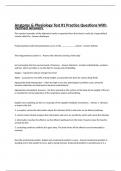
Anatomy & Physiology Test #1 Practice Questions With Verified Answers
The superior boundary of the abdominal cavity is separated from the thoracic cavity by a large skeletal muscle called the - Answer diaphragm Producing blood cells (hematopoiesis) occurs in the ____________ system - Answer skeletal The integumentary system is: - Answer the external covering of the body List and explain the five survival needs of humans: - Answer Nutrients - include carbohydrates, proteins, and fats, which are taken in via the diet for energy and cell building. Oxygen - required to release energy from food Water - accounts for over 60% of body weight, and provides the basis for various body fluids Appropriate body temperature - when too high or too low, physiological activities cease, primarily because molecules are destroyed or become nonfunctional. Appropriate atmospheric pressure - the force exerted on the surface of the body by the weight of the air; is essential for normal operation of the respiratory system and breathing Explain how scratching an itch is an example of the negative feedback mechanism. - Answer 1. stimulus or input is the itch 2. a receptor carries the information about the stimulus (itch) to the brain via an afferent pathway 3. control center (brain) analyzes this information and turns on an effector which will cancel the stimulus 4. information reaches the effector via the efferent pathway from the brain. Muscles move the hand to scratch the itch 5. scratching continues until the itch goes away. The brain shuts off the effector once homeostatis is restored. Describe anatomical position. Explain why anatomical position is used. - Answer Anatomical position is - standing erect, feet parallel to arms, palms facing forward. Anatomical position is used because it is a standard position; it also helps us to avoid confusion. Additionally, anatomical position is a reference point that helps us accurately describe body parts and postion. The fundamental unit of life in the body starts at the ________________level - Answer cellular A patient undergoing an appendectomy has his/her incision in the right hypogastric region. True or false. - Answer false The wrist is ____________ to the elbow, but ______________ to the fingers. - Answer distal, proximal List and briefly define, the human body's living organization levels from the smallest to the largest. - Answer 1. Cellular level - cells are the smallest living unit in living organisms 2. Tissue level - tissues are groupings of cells performing a common function 3. Organ level - an organ is a structure consisting of two or more tissue types 4. Organ system - an organ system describes a group of organs functioning cooperatively for a common purpose 5. Organism level - a human organism consists of all the organ systems of the body working together to promote healthy functioning The baby finger is medial to the thumb. True or false. - Answer True

Geschreven voor
- Instelling
- Anatomy & Physiology
- Vak
- Anatomy & Physiology
Documentinformatie
- Geüpload op
- 15 september 2023
- Aantal pagina's
- 6
- Geschreven in
- 2023/2024
- Type
- Tentamen (uitwerkingen)
- Bevat
- Vragen en antwoorden
Onderwerpen
-
anatomy physiology stuvia
-
anatomy physiology test 1 practice questions wi
-
the superior boundary of the abdominal cavity is s
-
producing blood cells hematopoiesis occurs in th

Ook beschikbaar in voordeelbundel