Meta-Ethics
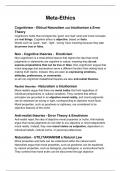
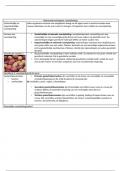
Cognitivism - Ethical Naturalism and Intuitionism & Error
Theory
Cognitivism holds that concepts like ‘good’ and ‘bad’ exist and moral concepts
are real things. Cognitive ethics is objective; based on facts.
Words such as ‘good’, ‘bad’, ‘right’, ‘wrong’ have meaning because they can
be proven true or false.
Non - Cognitive theories - Emotivism
Non-cognitivism is a meta-ethical stance that rejects the idea that moral
judgments or statements are cognitive in nature, meaning they do not
express propositions that can be true or false. Non-cognitivism argues that
moral language and expressions serve a different function than stating facts or
making truth claims. Instead, they are seen as expressing emotions,
attitudes, preferences, or commands.
so all non-cognitivist metaethical theories are also anti-realist theories.
Realist theories - Naturalism & Intuitionism
Moral realists argue that there are moral truths that hold regardless of
individual perspectives or cultural variations. They contend that ethical
principles are grounded in an objective moral reality, and moral judgments
can be assessed as wrong or right, corresponding to objective moral facts.
Moral properties, such as goodness or rightness, are considered to be
objective features of the world.
Anti-realist theories - Error Theory & Emotivism
Anti-realist reject the idea of objective moral properties or truths. Anti-realists
argue that moral judgments do not refer to any objective or mind-independent
moral reality. Instead, they view moral claims as subjective, dependent on
individual beliefs, cultural norms, or personal preferences.
Naturalism - UTILITARIANISM & Natural Law
Moral properties and facts can be understood within the natural world.
Naturalists argue that moral properties, such as goodness can be explained
by natural properties, such as biological, psychological, or sociocultural facts.
They contend that moral truths can be discovered through objective
, investigation of the natural world. Eg Murder is wrong by looking at how it
occurs and what happens as a result.
Non-naturalism - Error Theory & Emotivism & Intuitionism
Moral properties and truths cannot be fully explained by natural properties
or facts. Non-naturalists argue that moral properties are distinct and non-
reducible, and they cannot be defined or reduced to naturalistic terms. Eg
"murder is wrong" reflects a cognitive opinion that murder is bad, whereas
"wrong" refers to a non-natural feature.
Naturalism (realist & cognitivist).
According to naturalism, ethical judgements are considered to be true or
false beliefs, and moral attributes are real and exist as natural qualities.
According to a naturalist perspective on ethics, moral claims are objectively
valid after they have been verified by nature. So, in accordance with ethical
naturalism, it is possible for one to determine that murder is wrong by looking
at how it occurs and what happens as a result.
UTILITARIANISM AS NATURALISM
Bentham's conclusion is that it is in our human nature to seek pleasure and
avoid suffering. Because this is a fact of our nature, it follows that goodness
equals pleasure. According to utilitarianism, "good" may be reduced to
pleasure and "bad" to suffering because the mind and brain naturally
experience both pleasure and pain.
If utilitarian naturalism is valid, it means that there exist objectively correct
and incorrect moral solutions. According to a utilitarian, murder is immoral
because it harms the victim and prevents their pleasure, which can be
proven by evidence through observation. When someone is killed, we can
see that people are unhappy/afraid, and therefore it is bad as it causes pain.
For example, Hitler was objectively wrong; it was not a matter of opinion,
because his acts caused more Pain than pleasure.
Natural Law and Naturalism
Natural law argues that morality derives from both human nature and the
natural order of things, both of which may be discovered via reason and
Cognitivism - Ethical Naturalism and Intuitionism & Error
Theory
Cognitivism holds that concepts like ‘good’ and ‘bad’ exist and moral concepts
are real things. Cognitive ethics is objective; based on facts.
Words such as ‘good’, ‘bad’, ‘right’, ‘wrong’ have meaning because they can
be proven true or false.
Non - Cognitive theories - Emotivism
Non-cognitivism is a meta-ethical stance that rejects the idea that moral
judgments or statements are cognitive in nature, meaning they do not
express propositions that can be true or false. Non-cognitivism argues that
moral language and expressions serve a different function than stating facts or
making truth claims. Instead, they are seen as expressing emotions,
attitudes, preferences, or commands.
so all non-cognitivist metaethical theories are also anti-realist theories.
Realist theories - Naturalism & Intuitionism
Moral realists argue that there are moral truths that hold regardless of
individual perspectives or cultural variations. They contend that ethical
principles are grounded in an objective moral reality, and moral judgments
can be assessed as wrong or right, corresponding to objective moral facts.
Moral properties, such as goodness or rightness, are considered to be
objective features of the world.
Anti-realist theories - Error Theory & Emotivism
Anti-realist reject the idea of objective moral properties or truths. Anti-realists
argue that moral judgments do not refer to any objective or mind-independent
moral reality. Instead, they view moral claims as subjective, dependent on
individual beliefs, cultural norms, or personal preferences.
Naturalism - UTILITARIANISM & Natural Law
Moral properties and facts can be understood within the natural world.
Naturalists argue that moral properties, such as goodness can be explained
by natural properties, such as biological, psychological, or sociocultural facts.
They contend that moral truths can be discovered through objective
, investigation of the natural world. Eg Murder is wrong by looking at how it
occurs and what happens as a result.
Non-naturalism - Error Theory & Emotivism & Intuitionism
Moral properties and truths cannot be fully explained by natural properties
or facts. Non-naturalists argue that moral properties are distinct and non-
reducible, and they cannot be defined or reduced to naturalistic terms. Eg
"murder is wrong" reflects a cognitive opinion that murder is bad, whereas
"wrong" refers to a non-natural feature.
Naturalism (realist & cognitivist).
According to naturalism, ethical judgements are considered to be true or
false beliefs, and moral attributes are real and exist as natural qualities.
According to a naturalist perspective on ethics, moral claims are objectively
valid after they have been verified by nature. So, in accordance with ethical
naturalism, it is possible for one to determine that murder is wrong by looking
at how it occurs and what happens as a result.
UTILITARIANISM AS NATURALISM
Bentham's conclusion is that it is in our human nature to seek pleasure and
avoid suffering. Because this is a fact of our nature, it follows that goodness
equals pleasure. According to utilitarianism, "good" may be reduced to
pleasure and "bad" to suffering because the mind and brain naturally
experience both pleasure and pain.
If utilitarian naturalism is valid, it means that there exist objectively correct
and incorrect moral solutions. According to a utilitarian, murder is immoral
because it harms the victim and prevents their pleasure, which can be
proven by evidence through observation. When someone is killed, we can
see that people are unhappy/afraid, and therefore it is bad as it causes pain.
For example, Hitler was objectively wrong; it was not a matter of opinion,
because his acts caused more Pain than pleasure.
Natural Law and Naturalism
Natural law argues that morality derives from both human nature and the
natural order of things, both of which may be discovered via reason and