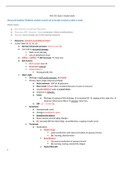
, Genome Projects
A genome works by collecting DNA samples from many individuals of species These DNA samples then sequenced
project a . are
and compared to cre ate a reference genome .
More than one individual i s used a s on e organism may have anomalies or
mutations that a re
atypical for the species .
A reference genome represents an average genome for a species based on a
genome project comparing the genome of many
individuals of the same species .
9 Shorter
>
easy to determine
genome of simpler
proteome (prokaryotes)
organisms
a l l DNA is part of a
gene r
snot associated with histones
coding for a protein
no non -
coking regions Corley exons )
The Human Genome
International research program which aimed to complete mapping and understanding of all the
genes of human beings .
Began in 1990 and completed in 2003 .
3 billion base pairs long ,
so 25000
genes .
Bsenefits : cures for genetic diseases , cheaper and beneficial medicine , genes linked to breast cancer and Alzheimers .
Recombinant DNA and Isolating Genes .
Genetic code is universal .
So scientists a re able to
artificially change an organism's DNA by combining lengths of nucleotides
from different sources .
Altered DNA i s called recombinant DNA .
If an organism contains nucleotide sequences from a different species it is called a transgenic organism Any organism that.
has introduced genetic material is a
genetically modified organism (GMO] Transcription and
. translation a re also universal .
Three main ways to obtain desired gene
:
① gene can be identified using a
gene probe and then c u t from the DNA fragment using an
enzyme called a restriction enzyme .
② a
copy of the gene can be produced from mRNA strands
using the enzyme reverse transcriptase .
③ the gene can be also synthesised using an automated polynucleartide sequencer (gene machine ) .
, ① The gene is identified using a gene probe and then cut from the DNA fragment using a restric tion
enzyme .
DNA
probe a shor t single-stranded piece of DNA (50 80 nucleotides long) complimentary to a sec tion of DNA
being
-
investigated .
Restriction enzyme an
enzyme t h a t cuts DNA at a specific base sequence .
Most restriction enzymes m a ke a
staggered art to form sticky ends .
Sticky ends exposed bases a t the ends of cut DNA .
② A
copy of the gene can be produced from mRNA strands .
$ IN / $
'
*
isolate reverse
from cells
transcriptase PCR
purity
original mRNA with mRNA in cDNA many copies .
(n o introns
gene no introns
testy
(many , much
(2 copies) shor ter)
copies)
③ the gene can be synthesised using an automated polynucleotide sequencer . This i s a machine that can synthesise a
length of DNA froma base sequence t h at i s typed into i t Calla a gene machine )
The base sequence of genes is required for this .
In Vitro Gene Cloning Polymerase Chain Reaction )
CPCR
3 stages :
① Denaturation
② Annealing
③ Extension
A genome works by collecting DNA samples from many individuals of species These DNA samples then sequenced
project a . are
and compared to cre ate a reference genome .
More than one individual i s used a s on e organism may have anomalies or
mutations that a re
atypical for the species .
A reference genome represents an average genome for a species based on a
genome project comparing the genome of many
individuals of the same species .
9 Shorter
>
easy to determine
genome of simpler
proteome (prokaryotes)
organisms
a l l DNA is part of a
gene r
snot associated with histones
coding for a protein
no non -
coking regions Corley exons )
The Human Genome
International research program which aimed to complete mapping and understanding of all the
genes of human beings .
Began in 1990 and completed in 2003 .
3 billion base pairs long ,
so 25000
genes .
Bsenefits : cures for genetic diseases , cheaper and beneficial medicine , genes linked to breast cancer and Alzheimers .
Recombinant DNA and Isolating Genes .
Genetic code is universal .
So scientists a re able to
artificially change an organism's DNA by combining lengths of nucleotides
from different sources .
Altered DNA i s called recombinant DNA .
If an organism contains nucleotide sequences from a different species it is called a transgenic organism Any organism that.
has introduced genetic material is a
genetically modified organism (GMO] Transcription and
. translation a re also universal .
Three main ways to obtain desired gene
:
① gene can be identified using a
gene probe and then c u t from the DNA fragment using an
enzyme called a restriction enzyme .
② a
copy of the gene can be produced from mRNA strands
using the enzyme reverse transcriptase .
③ the gene can be also synthesised using an automated polynucleartide sequencer (gene machine ) .
, ① The gene is identified using a gene probe and then cut from the DNA fragment using a restric tion
enzyme .
DNA
probe a shor t single-stranded piece of DNA (50 80 nucleotides long) complimentary to a sec tion of DNA
being
-
investigated .
Restriction enzyme an
enzyme t h a t cuts DNA at a specific base sequence .
Most restriction enzymes m a ke a
staggered art to form sticky ends .
Sticky ends exposed bases a t the ends of cut DNA .
② A
copy of the gene can be produced from mRNA strands .
$ IN / $
'
*
isolate reverse
from cells
transcriptase PCR
purity
original mRNA with mRNA in cDNA many copies .
(n o introns
gene no introns
testy
(many , much
(2 copies) shor ter)
copies)
③ the gene can be synthesised using an automated polynucleotide sequencer . This i s a machine that can synthesise a
length of DNA froma base sequence t h at i s typed into i t Calla a gene machine )
The base sequence of genes is required for this .
In Vitro Gene Cloning Polymerase Chain Reaction )
CPCR
3 stages :
① Denaturation
② Annealing
③ Extension