Shadow Health Abdominal Questions and Answers 100% Solved
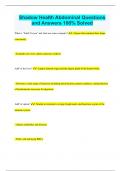
Shadow Health Abdominal Questions and Answers 100% Solved What is "Solid Viscera" and what are some examples? - Organs that maintain their shape consistently - Examples are: liver, spleen, pancreas, kidneys A&P of the liver? - Largest internal organ and the largest gland in the human body. - Performs a wide range of functions including detoxification, protein synthesis, and production of biochemicals necessary for digestion. A&P of spleen? - Similar in structure to a large lymph node, and functions as part of the immune system. - Attacks antibodies and diseases - Filters old and dying RBC's - Holds a reserve of blood, and recycles iron A&P of pancreas? - Produces important hormones including insulin, somatostatin, and pancreatic polypeptide which circulate in the blood. - Secretes pancreatic juice containing digestive enzymes that assist in the breakdown of nutrients in the small intestine. A&P of kidneys? - Function as an essential part of the urinary system by sifting out waste and extra water from the blood. - These are excreted by the kidneys as urine, which flows through the ureter and empties into the urinary bladder. What is a "hollow viscera", and what are examples? - Organs whose shape depends on their contents - Stomach, gallbladder, small intestine, colon, bladder A&P of stomach? - A rounded and highly elastic organ - Churn food with muscular contractions - Secretes digestive enzymes and hydrochloric acid to assist in the breakdown of food A&P of gallbladder? - Stores and concentrates bile produced by the liver - When food enters the digestive tract, the gallbladder releases bile into the small intestine where it aid in the digestion of lipids A&P of small intestine? - Majority of digestion and absorption occurs in the small intestine, where bile and pancreatic juices work to break down the food. - Small intestine is divided into the duodenum, jejunum, and ileum A&P of Colon? - Also known a the large intestine - Has four parts: ascending, descending, transverse, and sigmoid. - Throughout the colon, water, salt, and some nutrients are removed from digested food. - Results in the formation of stool, which is removed through the colon by strong muscle contractions A&P of bladder? - Elastic, muscular sac that stores urine excreted by the kidneys. When the muscles of the bladder contract, the urine is passed into the urethra and before exiting the body. A&P of aorta? - Both solid and hollow viscera rely heavily on oxygenated blood supplied by the abdominal aorta, which descends through the abdominal cavity, just left the midline along the posterior abdominal wall. Right lower quadrant contains ________? - Kidneys - Small intestine - Colon Right upper quadrant contains ________? - Liver - Pancreas - Kidneys - Stomach - Gallbladder - Colon Left lower quadrant contains ________? - Kidneys - Small intestine - Colon Left upper quadrant contains ________? - Liver - Spleen - Pancreas - Kidneys - Stomach - Colon Abdominal exam preparations? - Make sure that your patient has an empty bladder - Ask your patient to assume a comfortable, supine position. You patient's head may rest on a pillow, and the arms should be relaxed alongside the abdomen. - Ask your patient to point to any painful areas. During the palpation portion of the examination, these areas should be examined last. - Conduct the abdominal examination while standing at your patient's right-hand side. - Visualize the organs in each region you are examining. - Monitor your patient's facial expression for any sign of discomfort. In what order does the nurse do the physical examination for the abdomen? 1) Inspection 2) Auscultation 3) Percussion 4) Palpation What is the nurse looking for during abdominal inspection? Signs of pathology - Discoloration - Rashes - Dilated veins Contour - Distention - Asymmetry - Abnormal pulsations - Protuberances Why is it important to ask about scars? Asking about scars noted during inspection may uncover important facts about your patient's medical history. It can provide information about past surgeries or injuries. What is a hernia? A bulging of an organ or tissue through an abnormal opening. What is being assessed during abdominal auscultation? - Quality and frequency of sounds made by digestive processes and air moving through the bowels. - Listen for gurgling, cascading, rushing, and tinkling. What part of the stethoscope should be used when auscultating the abdomen? - The diaphragm - Listen to all quadrants clockwise: - RLQ > RUQ >LUQ >LLQ What are the three type of bowel sounds? 1) Normoactive 2) Hyperactive 3) Hypoactive What are Normoactive bowel sounds? - Occur irregularly, every 5 to 10 seconds. - Encompass a wide range of sounds including gurgling and cascading, and indicate a healthy level of intestinal activity. What are hyperactive bowel sounds? - Occur with increased frequency, and are often louder than normoactive bowel sounds. - Indicate increased intestinal activity. What are hypoactive bowel sounds? - Quiet and infrequent sounds that indicate reduced intestinal activity. - Absent bowel sounds, the most severe form of hypoactivity, can only be determined after 3-5 minutes of continuous listening in each quadrant. What is the nurse assessing during percussion of the abdomen? - Assess organs and screen for masses. - Occur over areas that are distended, fluid-filled, or dense, such as the liver. When percussing the abdomen, tympany should predominate. - A third percussion sound, resonance, is normally heard over the lungs. What 2 basic sounds are produced during percussion of the abdomen? - Tympanic - Dull *Resonance is normally heard over the lungs What is indicated by scattered dullness in the lower quadrants? - Fecal matter in the colon. During palpation of the abdomen what is the nurse looking for? - Assess organs, find masses, and locate tender areas. - Two types of palpation: light and deep. How is light palpation performed? - Done at a depth of 1 cm and is used to check for large mases, pulses, involuntary muscle guarding, and tenderness. - Light palpation is always performed before deep palpation because it may help your patient relax, and will help your patient relax, and will alert you to areas that should be treated with caution later in the exam. - It's also important to check your patient for signs of discomfort and body language. How is deep palpation performed? - Done at a depth of 5-8 cm to determine size and location of organs, and to check more thoroughly for masses and rebound tenderness. - In a healthy patient, deep palpation will enable you to feel the liver edge, aorta, and the sigmoid section of the colon. - The bladder is normally palpable only when full. What is rebound tenderness? - Also known as Blumberg's sign. - Is a clinical sign that is elicited during physical examination of a patient's abdomen. - It is indicative of peritonitis. - It refers to pain upon removal of pressure rather than application of pressure to the abdomen. What is peritonitis? Inflammation of the membrane lining the abdominal wall and covering the abdominal organs. Is the spleen normally palpable? Nah bruh Are the kidneys normally palpable? Nah bruh What is he width of the abdominal aorta in a normal adult? 3 cm What is an aneurysm? - A ballooning and weakened area in an artery. - Aneurysms often occur in the aorta, brain, back of the knee, intestine, or spleen. A ruptured aneurysm can result in internal bleeding, stroke, and can sometimes be fatal. - Aneurysms often have no symptoms until they rupture. - Treatment varies from watchful waiting to emergency surgery. The choice depends on the location, size, and condition of the aneurysm. A 2-month-old male child comes into the Shadow General Hospital Emergency Department with dehydration due to projectile vomiting since birth. On physical exam you note marked peristalsis (waves visible on inspection of the abdomen). This is a sign of what pathologic process? Pyloric stenosis A 76-year-old is admitted to the Shadow General Hospital ICU with severe abdominal pain and nausea. On physical exam you find rebound tenderness, guarding on palpation and abdominal wall rigidity. These are common findings with what problem? Peritonitis The Left Upper Quadrant (LUQ) contains the: Spleen Suppose that Tina reported pain when you assessed for costovertebral angle (CVA) tenderness. Which of the following would be true? CVA tenderness may indicate kidney infection Suppose that you suspected ascites because Tina's abdomen is large. Which of the following assessment findings would confirm ascites? Shifting dullness What is ascites? The accumulation of fluid in the peritoneal cavity, causing abdominal swelling.

Geschreven voor
- Instelling
- Shadow Health
- Vak
- Shadow Health
Documentinformatie
- Geüpload op
- 1 september 2023
- Aantal pagina's
- 14
- Geschreven in
- 2023/2024
- Type
- Tentamen (uitwerkingen)
- Bevat
- Vragen en antwoorden
Onderwerpen
-
shadow health abdominal questions and answers 100

Ook beschikbaar in voordeelbundel