Evaluate the extent to which alternatives to fossil fuel energy sources
provide an energy secure future (20 marks).
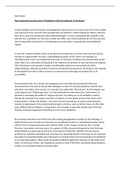
A fossil fuel is a hydrocarbon-based energy source that forms from the decomposition of dead
animals and plants. Fossil fuel usage is decreasing, in 1996 they accounted for 94% of energy
sources, but today they provide 84.3% of the world’s energy, with one third from oil, 27% from coal,
and 24.2% from gas. This is partially due to renewable energy sources becoming more eco-friendly,
and technological advances making these resources more accessible. They are also sometimes
cheaper; the International Renewable Energy Agency stated in June 2021 that renewables were now
significantly undercutting fossil fuels as the world’s cheapest source of power. Fossil fuels are of
varying importance to a country’s energy mix; 41% of the UKs energy comes from fossil fuels, in
Iceland 70% of energy came from hydroelectric power and 30% from geothermal power, and in
China 86% of its energy comes from fossil fuels. Newly industrialised countries like China use non-
renewable energy resources such as coal plants because they are more efficient than wind and solar.
This is critical for them because their demand for energy is rapidly growing, with an increase of 4
percent each year of factories and a growing middle class as 163 million Chinese people have
become middle class with an annual compound growth rate of 15% per year. Despite China having
over 150 billion tonnes of coal in its’ reserves, this does not make it energy secure even in the
foreseeable future. China uses 5.2 billion tonnes each year at a compound growth rate of 5.2% each
year, which means that at this rate China could use Up all of its’ internal coal reserves within the
next 35 years and the average coal plant lasts less than 30 years. This means that China must - and
has plans to - swich to renewable energy resources and become carbon neutral by before 2060 and
limit the production of coal plants by 2025.
In some countries, a future reliant on renewable energy resources is already achieved. This is the
case with Iceland, which has a 100% renewable energy 70% of which comes from hydropower and
30% comes from geothermal energy. Hydropower is created by the kinetic energy of groundwater
flow and glacial flow, whereas Iceland’s 32 active volcanoes provide thermal energy which is
converted into electricity through the rising of hot water and steam which can run turbines.
However, Iceland’s’ reliance on Glacial hydropower could be seen as a weakness in the modern era
as its glaciers retreat (750km2 of glacial retreat in Iceland since 2000). This shows how despite this is
a form of renewable energy, it does not necessarily provide an energy secure future due to the
environment’s instability from climate change. Furthermore Iceland supports a small population of
375,000 people, therefore it is criticisable as to whether its’ success is scalable to country with a
much larger population such as China with a population of over 1.4 billion. It is also likely that
Iceland’s’ lesser developed population uses less energy on average than a country where there is a
much higher demand per person, such as the UK.
A crucial factor as to how efficient energy can be is storage of electricity. Currently, produced
technology runs directly onto the mains to be used. If excess electricity could be stored, then this
might reduce the amount of energy production infrastructure that needs to be built. Currently, there
is limited technology for storage, and it is usually more expensive than building electricity generating
infrastructure. One successful company at this for mass electrical storage is ETC which created
STORNETIC which stores electricity as mechanical energy and then outputs it as kinetic energy to be
provide an energy secure future (20 marks).
A fossil fuel is a hydrocarbon-based energy source that forms from the decomposition of dead
animals and plants. Fossil fuel usage is decreasing, in 1996 they accounted for 94% of energy
sources, but today they provide 84.3% of the world’s energy, with one third from oil, 27% from coal,
and 24.2% from gas. This is partially due to renewable energy sources becoming more eco-friendly,
and technological advances making these resources more accessible. They are also sometimes
cheaper; the International Renewable Energy Agency stated in June 2021 that renewables were now
significantly undercutting fossil fuels as the world’s cheapest source of power. Fossil fuels are of
varying importance to a country’s energy mix; 41% of the UKs energy comes from fossil fuels, in
Iceland 70% of energy came from hydroelectric power and 30% from geothermal power, and in
China 86% of its energy comes from fossil fuels. Newly industrialised countries like China use non-
renewable energy resources such as coal plants because they are more efficient than wind and solar.
This is critical for them because their demand for energy is rapidly growing, with an increase of 4
percent each year of factories and a growing middle class as 163 million Chinese people have
become middle class with an annual compound growth rate of 15% per year. Despite China having
over 150 billion tonnes of coal in its’ reserves, this does not make it energy secure even in the
foreseeable future. China uses 5.2 billion tonnes each year at a compound growth rate of 5.2% each
year, which means that at this rate China could use Up all of its’ internal coal reserves within the
next 35 years and the average coal plant lasts less than 30 years. This means that China must - and
has plans to - swich to renewable energy resources and become carbon neutral by before 2060 and
limit the production of coal plants by 2025.
In some countries, a future reliant on renewable energy resources is already achieved. This is the
case with Iceland, which has a 100% renewable energy 70% of which comes from hydropower and
30% comes from geothermal energy. Hydropower is created by the kinetic energy of groundwater
flow and glacial flow, whereas Iceland’s 32 active volcanoes provide thermal energy which is
converted into electricity through the rising of hot water and steam which can run turbines.
However, Iceland’s’ reliance on Glacial hydropower could be seen as a weakness in the modern era
as its glaciers retreat (750km2 of glacial retreat in Iceland since 2000). This shows how despite this is
a form of renewable energy, it does not necessarily provide an energy secure future due to the
environment’s instability from climate change. Furthermore Iceland supports a small population of
375,000 people, therefore it is criticisable as to whether its’ success is scalable to country with a
much larger population such as China with a population of over 1.4 billion. It is also likely that
Iceland’s’ lesser developed population uses less energy on average than a country where there is a
much higher demand per person, such as the UK.
A crucial factor as to how efficient energy can be is storage of electricity. Currently, produced
technology runs directly onto the mains to be used. If excess electricity could be stored, then this
might reduce the amount of energy production infrastructure that needs to be built. Currently, there
is limited technology for storage, and it is usually more expensive than building electricity generating
infrastructure. One successful company at this for mass electrical storage is ETC which created
STORNETIC which stores electricity as mechanical energy and then outputs it as kinetic energy to be