PAPER 1: ENERGY FOR LIFE
Year 2 Chapter 1: Importance of ATP
What is chemiosmosis?
The flow of protons down an electrochemical gradient, through ATP synthetase coupled with the synthesis of
ATP from ADP and a phosphate ion
What enzyme generates ATP?
ATP Synthetase/ ATP Synthase
List the reasons why ATP is suitable for its role
It is inert, can pass out of mitochondria into cytoplasm, releases energy efficiently, releases energy in useable
quantities, easily hydrolysed for energy, readily reformed by phosphorylation
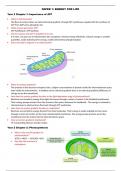
Draw and label a diagram of a mitochondrion
What are proton gradients?
The product of the electron transport chain, a higher concentration of protons inside the intermembrane space
than inside the mitochondria . In addition to the chemical gradient there is an electrical gradient (Difference in
charge across the membrane)
How does the proton gradient function in the light-dependent stage of photosynthesis?
Electrons are excited by energy from light and mover through a series of carrier in the thylakoid membranes.
Their energy pumps protons from the stroma to the spaces between the thylakoids . The energy is released in
chemiosmosis in which protons flow back through ATP synthetase.
How does the proton gradient function in respiration?
Electrons are excited by energy derived from food molecules. Their energy is made available as they move
through a series of carriers on the inner mitochondrial membrane. The energy pumps protons across the
membrane form the matrix into the intermembrane space.
How are proton gradients maintained?
H+ transporting electron transfer chains
Year 2 Chapter 2: Photosynthesis
What is the overall equation for
photosynthesis?
6CO2 + 6H2O C6H12O6 +6O2
Describe the structure of
chloroplasts
, Describe the absorption spectrum and the action spectrum
Absorption spectrum – how much light is absorbed at different wavelengths
Action spectrum – A graph showing the rate of photosynthesis at different wavelengths
What are the four types of photosynthetic pigment?
- Chlorophyll a, chlorophyll b
- B-carotene, xanthophyll
Describe the basic features of photosystems I and II
- An Antenna complex – contains the photosynthetic pigments (allows a range of wavelengths to be
absorbed)
- A reaction centre (within the antenna complex) contains two molecules of the primary pigment
chlorophyll a
o Photosystem I is arranged around a chlorophyll a molecule with an absorption peak of 700nm
o Photosystem II is arranged around a chlorophyll a molecule with an absorption peak of 680nm
Explain the light dependent stage of photosynthesis step by step
The light reactions take place fast in the grana of the chloroplast
1. In PSII an antenna pigments absorbs a photon’s energy; this energy will resonate to the reaction centre
of PSII
2. The chlorophyll a P680 becomes excited then rapidly emits an electron that is gained by the electron
transport chain
3. This reaction takes place time after time, leaving ‘electron holes’ behind
4. The P680 must replace the electrons that escaped, so water from the mesophyll gives its electrons to
chlorophyll
a. The water gets split (photolysis) which enzymatically provides protons, electrons, and oxygen
b. The electrons one by one refill the holes that were left in chlorophyll
c. The protons take a place in the thylakoid lumen/space
d. The oxygen atoms form oxygen gas as they combine – released into the air
5. The electrons lost from PSII move down the electron transport chain, losing energy which is gained by
cytochromes along the chain
, 6. Cytochrome b6f complex uses energy to pump protons which translocate from the stroma to the
thylakoid space (enhances proton motive force)
7. Photophosphorylation occurs at ATP synthase (ATP used in Calvin cycle)
8. IN THE ELECTRON CHAIN – the electrons are deenergised so they must gain energy from the sun which
they get at PSI from P700 chlorophyll a.
9. An excited electron leaves PSI (but is immediately replaced). The excited electron then takes a place on
NADP+ which gets reduced to NADPH
Explain the light independent stage of photosynthesis step by step
The Calvin cycle takes place in the stroma of the chloroplast.
1. The cycle begins with RuBP (5C)
2. Rubisco and anabolic enzyme help CO2 and RuBP bind, this is known as carbon fixation (forms 6C)
3. Unstable 6C compound splits to produce two glycerate-3-phosphate (3C)A
4. ATP molecules give phosphate to the phosphoglycerates to produce bisphosphoglycerates
5. NADP reduces bisphosphoglycerates to triose phosphate
6. Some of the TP goes from a series of reactions which form glucose phosphate and then starch, but most
of it is used to regenerate 5C RuBP so the cycle can continue – ATP from the light dependent reaction
makes this possible
Compare cyclic and non-cyclic photophosphorylation
Cyclic photophosphorylation: ATP can be produced by electrons that take a cyclical pathway and are
recycled back into chlorophyll a in PSI
Non-cyclic photophosphorylation: ATP can be produced by electrons that take a linear pathway from water,
through PSII and PSI to NADP, which they produce.
Explain how three different products may be made from photosynthesis
Carbohydrates: the first hexose made is fructose phosphate. This can be converted to glucose and combined
with the glucose to make sucrose for transport around the plant.
Fats: acetyl CoA can be synthesised from glycerate-3-phosphate and converted to fatty acids. Triose
phosphate can be converted directly into glycerol. Fatty acids and glycerol combine to form triglycerides
Proteins: glycerate-3-phosphate can be converted into amin acids. Amino group is derived from ammonium
ions derived from nitrate ions taken in at the roots.
Describe how carbon dioxide limits photosynthesis
As carbon dioxide increases from zero the rate of the light-
dependent reaction increases and so the rate of
photosynthesis increases. If concentration increases above
about 0.5% the rate of photosynthesis remains constant
implying that carbon dioxide is not the limiting factor. When
above 1% the rate decreases as the stomata close preventing
carbon dioxide uptake (because CO2 dissolves forming carbonic
acid denaturing enzymes)
Describe how light intensity limits photosynthesis
As light intensity increase the light dependent reaction occur
with increasing efficiency. Light intensity is the limiting factor. At
about 10,000 lux reaction are at their maximum rate and light is
Year 2 Chapter 1: Importance of ATP
What is chemiosmosis?
The flow of protons down an electrochemical gradient, through ATP synthetase coupled with the synthesis of
ATP from ADP and a phosphate ion
What enzyme generates ATP?
ATP Synthetase/ ATP Synthase
List the reasons why ATP is suitable for its role
It is inert, can pass out of mitochondria into cytoplasm, releases energy efficiently, releases energy in useable
quantities, easily hydrolysed for energy, readily reformed by phosphorylation
Draw and label a diagram of a mitochondrion
What are proton gradients?
The product of the electron transport chain, a higher concentration of protons inside the intermembrane space
than inside the mitochondria . In addition to the chemical gradient there is an electrical gradient (Difference in
charge across the membrane)
How does the proton gradient function in the light-dependent stage of photosynthesis?
Electrons are excited by energy from light and mover through a series of carrier in the thylakoid membranes.
Their energy pumps protons from the stroma to the spaces between the thylakoids . The energy is released in
chemiosmosis in which protons flow back through ATP synthetase.
How does the proton gradient function in respiration?
Electrons are excited by energy derived from food molecules. Their energy is made available as they move
through a series of carriers on the inner mitochondrial membrane. The energy pumps protons across the
membrane form the matrix into the intermembrane space.
How are proton gradients maintained?
H+ transporting electron transfer chains
Year 2 Chapter 2: Photosynthesis
What is the overall equation for
photosynthesis?
6CO2 + 6H2O C6H12O6 +6O2
Describe the structure of
chloroplasts
, Describe the absorption spectrum and the action spectrum
Absorption spectrum – how much light is absorbed at different wavelengths
Action spectrum – A graph showing the rate of photosynthesis at different wavelengths
What are the four types of photosynthetic pigment?
- Chlorophyll a, chlorophyll b
- B-carotene, xanthophyll
Describe the basic features of photosystems I and II
- An Antenna complex – contains the photosynthetic pigments (allows a range of wavelengths to be
absorbed)
- A reaction centre (within the antenna complex) contains two molecules of the primary pigment
chlorophyll a
o Photosystem I is arranged around a chlorophyll a molecule with an absorption peak of 700nm
o Photosystem II is arranged around a chlorophyll a molecule with an absorption peak of 680nm
Explain the light dependent stage of photosynthesis step by step
The light reactions take place fast in the grana of the chloroplast
1. In PSII an antenna pigments absorbs a photon’s energy; this energy will resonate to the reaction centre
of PSII
2. The chlorophyll a P680 becomes excited then rapidly emits an electron that is gained by the electron
transport chain
3. This reaction takes place time after time, leaving ‘electron holes’ behind
4. The P680 must replace the electrons that escaped, so water from the mesophyll gives its electrons to
chlorophyll
a. The water gets split (photolysis) which enzymatically provides protons, electrons, and oxygen
b. The electrons one by one refill the holes that were left in chlorophyll
c. The protons take a place in the thylakoid lumen/space
d. The oxygen atoms form oxygen gas as they combine – released into the air
5. The electrons lost from PSII move down the electron transport chain, losing energy which is gained by
cytochromes along the chain
, 6. Cytochrome b6f complex uses energy to pump protons which translocate from the stroma to the
thylakoid space (enhances proton motive force)
7. Photophosphorylation occurs at ATP synthase (ATP used in Calvin cycle)
8. IN THE ELECTRON CHAIN – the electrons are deenergised so they must gain energy from the sun which
they get at PSI from P700 chlorophyll a.
9. An excited electron leaves PSI (but is immediately replaced). The excited electron then takes a place on
NADP+ which gets reduced to NADPH
Explain the light independent stage of photosynthesis step by step
The Calvin cycle takes place in the stroma of the chloroplast.
1. The cycle begins with RuBP (5C)
2. Rubisco and anabolic enzyme help CO2 and RuBP bind, this is known as carbon fixation (forms 6C)
3. Unstable 6C compound splits to produce two glycerate-3-phosphate (3C)A
4. ATP molecules give phosphate to the phosphoglycerates to produce bisphosphoglycerates
5. NADP reduces bisphosphoglycerates to triose phosphate
6. Some of the TP goes from a series of reactions which form glucose phosphate and then starch, but most
of it is used to regenerate 5C RuBP so the cycle can continue – ATP from the light dependent reaction
makes this possible
Compare cyclic and non-cyclic photophosphorylation
Cyclic photophosphorylation: ATP can be produced by electrons that take a cyclical pathway and are
recycled back into chlorophyll a in PSI
Non-cyclic photophosphorylation: ATP can be produced by electrons that take a linear pathway from water,
through PSII and PSI to NADP, which they produce.
Explain how three different products may be made from photosynthesis
Carbohydrates: the first hexose made is fructose phosphate. This can be converted to glucose and combined
with the glucose to make sucrose for transport around the plant.
Fats: acetyl CoA can be synthesised from glycerate-3-phosphate and converted to fatty acids. Triose
phosphate can be converted directly into glycerol. Fatty acids and glycerol combine to form triglycerides
Proteins: glycerate-3-phosphate can be converted into amin acids. Amino group is derived from ammonium
ions derived from nitrate ions taken in at the roots.
Describe how carbon dioxide limits photosynthesis
As carbon dioxide increases from zero the rate of the light-
dependent reaction increases and so the rate of
photosynthesis increases. If concentration increases above
about 0.5% the rate of photosynthesis remains constant
implying that carbon dioxide is not the limiting factor. When
above 1% the rate decreases as the stomata close preventing
carbon dioxide uptake (because CO2 dissolves forming carbonic
acid denaturing enzymes)
Describe how light intensity limits photosynthesis
As light intensity increase the light dependent reaction occur
with increasing efficiency. Light intensity is the limiting factor. At
about 10,000 lux reaction are at their maximum rate and light is