Data
M2 Lecture 1 Data-ecologies (Maaike Kleinsman)
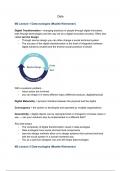
Digital Transformation = changing practices of people through digital innovation,
both through technologies and the way we do a digital innovation process. Often also
called service design
- Through service design you can often change a social technical system
- The success of the digital transformation is the level of integration between
digital solutions created and the diverse social practices involved
With a systemic problem…
- many actors are involved
- you can shape it in many different ways (different products, digital/physical)
Digital Materiality = dynamic interface between the physical and the digital
Convergence = the system is developed and operated by multiple organisations
Generativity = digital objects can be reprogrammed or changed to increase value in
use → can your solutions also be implemented in a different field?
Key take-aways
- The complexity of digital transformation result in data-ecologies
- Data ecologies have social and technical components
- (service) design methods allow us to design systems that connect technical
with the social system in a human-centered way
- You as a (service) designer can and will shape data-ecologies
M2 Lecture 2 Data-ecologies (Maaike Kleinsman)
,Data enabled design = 2 loops: the everyday life loop→ people are doing their
practices (we as designers observe those people) + design research loop→ because
of data through observation there is a constant loop
Steps:
1. Collection of data → how are we getting knowledge about
the everyday life of people→ through prototypes
2. Design Synthesis→ moment in time where there is big
learning taking place: from here we want to go forward
3. Designly Explorations
Each step can be executed through a different way
M3 Lecture 1 Data Modeling (Alessandro Bozzon)
Data Model = an abstraction of the mini-world (also called universe of discourse)
captured by the data
A mini world is a restricted view of the real world relevant to a design goal
(Tree-hunt game mini world: only trees in parks in amsterdam - only tourists)
, Abstraction = the process of filtering out - ignoring - the characteristics of the
mini-world that we don’t need in order to concentrate on those that we do.
- Filter out of specific details to create a representation (idea) of what we are
trying to understand, or design.
- Purpose: “is not to be vague, but to create a new semantic level in which one
can be absolutely precise”
Data Model = an abstract representation of the data relevant to a design goal
- To capture the semantics (the meaning) of data:
- What is described?
- What values are reasonable?
- What data belongs together?
- Purpose: can be used as a design tool, to help us:
- Better understand the design problem at hand
- Think about the structure and properties of data
- Communicate with relevant stakeholders
- Data model is the starting point for the construction of databases and
information systems required to make data-enabled products or services work
(link to DPD)
M3 Lecture 2 Data Modeling (Alessandro Bozzon)
The Entity-Relationship (E-R) Model = the most used conceptual data model
- It provides a series of constructs capable of describing the data of a mini
world:
- in a way that is easy to understand
- using a graphical formalisms
- independently of the data management system used for storage and
retrieval of data (not bound to a particular tech. environment)
- For every construct, there is a corresponding graphical representation→
define an E-R schema diagrammatically
Entity
- Classes of objects (e.g. facts, things, people) having..
- common properties
- autonomous existence
- An instance of an entity is an object of the class the entity represents
- Examples: Tree, park, tourist, picture
M2 Lecture 1 Data-ecologies (Maaike Kleinsman)
Digital Transformation = changing practices of people through digital innovation,
both through technologies and the way we do a digital innovation process. Often also
called service design
- Through service design you can often change a social technical system
- The success of the digital transformation is the level of integration between
digital solutions created and the diverse social practices involved
With a systemic problem…
- many actors are involved
- you can shape it in many different ways (different products, digital/physical)
Digital Materiality = dynamic interface between the physical and the digital
Convergence = the system is developed and operated by multiple organisations
Generativity = digital objects can be reprogrammed or changed to increase value in
use → can your solutions also be implemented in a different field?
Key take-aways
- The complexity of digital transformation result in data-ecologies
- Data ecologies have social and technical components
- (service) design methods allow us to design systems that connect technical
with the social system in a human-centered way
- You as a (service) designer can and will shape data-ecologies
M2 Lecture 2 Data-ecologies (Maaike Kleinsman)
,Data enabled design = 2 loops: the everyday life loop→ people are doing their
practices (we as designers observe those people) + design research loop→ because
of data through observation there is a constant loop
Steps:
1. Collection of data → how are we getting knowledge about
the everyday life of people→ through prototypes
2. Design Synthesis→ moment in time where there is big
learning taking place: from here we want to go forward
3. Designly Explorations
Each step can be executed through a different way
M3 Lecture 1 Data Modeling (Alessandro Bozzon)
Data Model = an abstraction of the mini-world (also called universe of discourse)
captured by the data
A mini world is a restricted view of the real world relevant to a design goal
(Tree-hunt game mini world: only trees in parks in amsterdam - only tourists)
, Abstraction = the process of filtering out - ignoring - the characteristics of the
mini-world that we don’t need in order to concentrate on those that we do.
- Filter out of specific details to create a representation (idea) of what we are
trying to understand, or design.
- Purpose: “is not to be vague, but to create a new semantic level in which one
can be absolutely precise”
Data Model = an abstract representation of the data relevant to a design goal
- To capture the semantics (the meaning) of data:
- What is described?
- What values are reasonable?
- What data belongs together?
- Purpose: can be used as a design tool, to help us:
- Better understand the design problem at hand
- Think about the structure and properties of data
- Communicate with relevant stakeholders
- Data model is the starting point for the construction of databases and
information systems required to make data-enabled products or services work
(link to DPD)
M3 Lecture 2 Data Modeling (Alessandro Bozzon)
The Entity-Relationship (E-R) Model = the most used conceptual data model
- It provides a series of constructs capable of describing the data of a mini
world:
- in a way that is easy to understand
- using a graphical formalisms
- independently of the data management system used for storage and
retrieval of data (not bound to a particular tech. environment)
- For every construct, there is a corresponding graphical representation→
define an E-R schema diagrammatically
Entity
- Classes of objects (e.g. facts, things, people) having..
- common properties
- autonomous existence
- An instance of an entity is an object of the class the entity represents
- Examples: Tree, park, tourist, picture