2. Developmental Dyslexia
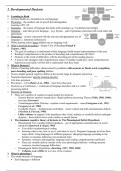
1. Learning to Read
o Literacy builds on a foundation of oral language.
o Phonology –the smallest unit of speech that distinguishes
meaning. GPC AP
o Semantics – the aspect of language that deals with meaning (e.g. Vocabulary knowledge)
o Grammar – rules that govern language – (e.g. Syntax – part of grammar concerned with word order and
agreement)
o Pragmatics – system concerned with the relevant and appropriate use of
language i.e. intentions (inferences)
o When entering school most children can us language well
o What’s involved in reading? - Simple View of Reading (Gough &
Tunmer, 1985)
The goal of reading is to understand written language (build mental representations of the text).
Reading Comprehension is the product of decoding and comprehension (R+DxC)
Dyslexia is the result of difficulties with the decoding part of the reading process
A person who struggles with comprehension aspect of reading would have ‘poor comprehension’ –
hyperlexia (read really well but fail to understand what they read)
2. What is Dyslexia?
o Pattern of learning difficulties characterized by problems with accurate or fluent word recognition,
poor decoding, and poor spelling abilities.
o Occurs despite general cognitive ability in the normal range & adequate instruction
o Neurodevelopmental ‘specific learning disorder’
o Life-time persistent
o Prevalence ~3-6% (Rutter et al., 2004) – more boys than girls
o Dyslexia as a Continuum -> continuum of language disorders and is a verbal
processing deficit
o Theories of Dyslexia
There are a number of cognitive/causal models for dyslexia:
- Sensory theories (process sounds fast) - Rapid auditory processing Theory (Talla, 1980; 2000);
rise time (Goswami)
- Visual/magnocellular Theories - explains visual impairments – stein (Livingston et al., 1991;
Lovegrove et al., 1980)
- Cerebellar Theory – dysfunctional cerebellum – motor control and skill automatisation deficits
(Nicolson & Fawcett, 1990)
- Little evidence in support of the hypotheses that visual, auditory or cerebella deficits underpin
dyslexia – these deficits have weak validity as causal factors
The dominant cognitive theory of dyslexia is: The Phonological Deficit Hypothesis
- Phonological Core variable deficit hypothesis – use of appropriate communication in social
situations (Stanovich & Siegel, 1994)
Core deficit in phonological coding
knowing what to say, how to say it, and when to say it). Pragmatic language involves three
major skills: Using language for different purposes, changing language according to the
listener or situation, following conversational rules
Semantic, syntactic and pragmatic language (and reading comprehension) unaffected
There are variable deficits outside of the core phonological deficits: working memory
resources, broader language difficulties.
- Phonological Deficit Hypothesis (Snowling, 1987; 1998; 2000)
Vellutino et al. (2004) for a review of the evidence
3. What is phonology?
o The sound structure of language
Each language is different
1. Learning to Read
o Literacy builds on a foundation of oral language.
o Phonology –the smallest unit of speech that distinguishes
meaning. GPC AP
o Semantics – the aspect of language that deals with meaning (e.g. Vocabulary knowledge)
o Grammar – rules that govern language – (e.g. Syntax – part of grammar concerned with word order and
agreement)
o Pragmatics – system concerned with the relevant and appropriate use of
language i.e. intentions (inferences)
o When entering school most children can us language well
o What’s involved in reading? - Simple View of Reading (Gough &
Tunmer, 1985)
The goal of reading is to understand written language (build mental representations of the text).
Reading Comprehension is the product of decoding and comprehension (R+DxC)
Dyslexia is the result of difficulties with the decoding part of the reading process
A person who struggles with comprehension aspect of reading would have ‘poor comprehension’ –
hyperlexia (read really well but fail to understand what they read)
2. What is Dyslexia?
o Pattern of learning difficulties characterized by problems with accurate or fluent word recognition,
poor decoding, and poor spelling abilities.
o Occurs despite general cognitive ability in the normal range & adequate instruction
o Neurodevelopmental ‘specific learning disorder’
o Life-time persistent
o Prevalence ~3-6% (Rutter et al., 2004) – more boys than girls
o Dyslexia as a Continuum -> continuum of language disorders and is a verbal
processing deficit
o Theories of Dyslexia
There are a number of cognitive/causal models for dyslexia:
- Sensory theories (process sounds fast) - Rapid auditory processing Theory (Talla, 1980; 2000);
rise time (Goswami)
- Visual/magnocellular Theories - explains visual impairments – stein (Livingston et al., 1991;
Lovegrove et al., 1980)
- Cerebellar Theory – dysfunctional cerebellum – motor control and skill automatisation deficits
(Nicolson & Fawcett, 1990)
- Little evidence in support of the hypotheses that visual, auditory or cerebella deficits underpin
dyslexia – these deficits have weak validity as causal factors
The dominant cognitive theory of dyslexia is: The Phonological Deficit Hypothesis
- Phonological Core variable deficit hypothesis – use of appropriate communication in social
situations (Stanovich & Siegel, 1994)
Core deficit in phonological coding
knowing what to say, how to say it, and when to say it). Pragmatic language involves three
major skills: Using language for different purposes, changing language according to the
listener or situation, following conversational rules
Semantic, syntactic and pragmatic language (and reading comprehension) unaffected
There are variable deficits outside of the core phonological deficits: working memory
resources, broader language difficulties.
- Phonological Deficit Hypothesis (Snowling, 1987; 1998; 2000)
Vellutino et al. (2004) for a review of the evidence
3. What is phonology?
o The sound structure of language
Each language is different