Topic 1.1-Carbohydrates
i Know the difference between monosaccharides, disaccharides and polysaccharides
Monosaccharides- These are simple sugar monomers e.g glucose C6H12O6
Disaccharides- Are double sugars formed from two monosaccharides e.g maltose
Polysaccharides- large sugar molecules many monosaccharides
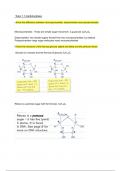
ii Know the structure of the hexose glucose (alpha and beta) and the pentose ribose
Glucose is a hexose and the formula of glucose C6H12O6
Ribose is a pentose sugar with the formula C5H10O5
,iii Understand how monosaccharides (glucose, fructose, galactose) join to form
disaccharides (sucrose, lactose and maltose) and polysaccharides (starch formed from
amylose and amylopectin; glycogen) through condensation reactions forming glycosidic
bonds, and how these can be split through hydrolysis reactions.
Disaccharides are formed when two monosaccharides join together in a condensation
reaction. The disaccharide is formed along with a molecule of water, the link between the
two monosaccharides is called a glycosidic bond
Disaccharides are split by adding water in a hydrolysis reaction to break the glycosidic bond
, Polysaccharides have many sugar units they can be unbranched like in amylose or
branched like in amylopectin
Starch is an important energy store in plants; the glucose from photosynthesis is rapidly
converted into starch which is insoluble and compact but can be rapidly broken down to
release glucose when needed.
Starch is made up of long chains of 𝛼-glucose but contains two compounds
Amylose: an unbranched monomer made from 1-4 glycosidic bonds
Amylopectin: Made from 1-4 and few 1-6 glycosidic bonds which is why it is branched
iv Understand how the structure of glucose, starch, glycogen and cellulose relates to their
function.
Glycogen is stored as excess glucose in the liver which is the energy stored in animals.
Glycogen is similar to the structure of amylopectin being made from 1-4 and 1-6 glycosidic
bonds. It is very compact (maximising the amount it can store)and contains many side
branches. As a result they can be rapidly broken down and glucose can be released quickly.
Starch is made from amylose and amylopectin. The amylose is coiled and thus very compact
maximising the amount of energy it can store. Amylopectin contains many side branches
therefore it is rapidly digested by enzymes and energy is released quickly.
Cellulose is an important structure used in the cell walls of plants. It consists of long chains
of 𝜷-glucose by 1-4 glycosidic bonds. Microfibers and microfibrils are long threads made
from cellulose which provide structural support. One of the monomer units have to be
inverted so the glycosidic bond can take place
1.2 Lipids
i Understand how a triglyceride is synthesised, including the formation of ester bonds during
condensation reactions between glycerol and three fatty acids.
Lipids are major energy source and are also used to store energy
Lipids are organic molecules with two main types triglycerides and phospholipids
Triglycerides lipids made from one molecule of glycerol (C3H8O3)and three molecule of fatty
acids joined by ester bonds in a condensation reaction
i Know the difference between monosaccharides, disaccharides and polysaccharides
Monosaccharides- These are simple sugar monomers e.g glucose C6H12O6
Disaccharides- Are double sugars formed from two monosaccharides e.g maltose
Polysaccharides- large sugar molecules many monosaccharides
ii Know the structure of the hexose glucose (alpha and beta) and the pentose ribose
Glucose is a hexose and the formula of glucose C6H12O6
Ribose is a pentose sugar with the formula C5H10O5
,iii Understand how monosaccharides (glucose, fructose, galactose) join to form
disaccharides (sucrose, lactose and maltose) and polysaccharides (starch formed from
amylose and amylopectin; glycogen) through condensation reactions forming glycosidic
bonds, and how these can be split through hydrolysis reactions.
Disaccharides are formed when two monosaccharides join together in a condensation
reaction. The disaccharide is formed along with a molecule of water, the link between the
two monosaccharides is called a glycosidic bond
Disaccharides are split by adding water in a hydrolysis reaction to break the glycosidic bond
, Polysaccharides have many sugar units they can be unbranched like in amylose or
branched like in amylopectin
Starch is an important energy store in plants; the glucose from photosynthesis is rapidly
converted into starch which is insoluble and compact but can be rapidly broken down to
release glucose when needed.
Starch is made up of long chains of 𝛼-glucose but contains two compounds
Amylose: an unbranched monomer made from 1-4 glycosidic bonds
Amylopectin: Made from 1-4 and few 1-6 glycosidic bonds which is why it is branched
iv Understand how the structure of glucose, starch, glycogen and cellulose relates to their
function.
Glycogen is stored as excess glucose in the liver which is the energy stored in animals.
Glycogen is similar to the structure of amylopectin being made from 1-4 and 1-6 glycosidic
bonds. It is very compact (maximising the amount it can store)and contains many side
branches. As a result they can be rapidly broken down and glucose can be released quickly.
Starch is made from amylose and amylopectin. The amylose is coiled and thus very compact
maximising the amount of energy it can store. Amylopectin contains many side branches
therefore it is rapidly digested by enzymes and energy is released quickly.
Cellulose is an important structure used in the cell walls of plants. It consists of long chains
of 𝜷-glucose by 1-4 glycosidic bonds. Microfibers and microfibrils are long threads made
from cellulose which provide structural support. One of the monomer units have to be
inverted so the glycosidic bond can take place
1.2 Lipids
i Understand how a triglyceride is synthesised, including the formation of ester bonds during
condensation reactions between glycerol and three fatty acids.
Lipids are major energy source and are also used to store energy
Lipids are organic molecules with two main types triglycerides and phospholipids
Triglycerides lipids made from one molecule of glycerol (C3H8O3)and three molecule of fatty
acids joined by ester bonds in a condensation reaction