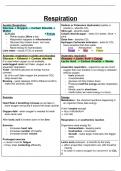
Respiration
Aerobic Respiration: Sodium or Potassium Hydroxide(crystals or
Glucose + Oxygen → Carbon Dioxide + solution) - absorbs CO2
Water Silica gel - absorbs water
(C6H12O6) + Energy Cobalt chloride paper - tests for water, blue →
- Plants respire 24hrs a day pink
- Respiration happens in mitochondria Soda lime - absorbs CO2
- Glucose fully broken down, non toxic Hydrogen Carbonate Indicators - tests for CO2
products, sustainable more sensitive than lime water
- Need energy for homeostasis Less Atmosphere More
Lime water - cloudy if CO2 is present Purple ← Red → Yellow
Anaerobic respiration in plants and microbes Anaerobic respiration
Glucose → Ethanol + Carbon dioxide Glucose → Lactic Acid + Energy
It is used when oxygen is not available, Lactic Acid → Carbon Dioxide + Water
waterlogged roots can't take oxygen so do
anaerobic respiration Anaerobic respiration - organisms use too much
Yeast - ferments glucose as energy source, oxygen than can breathe in so energy is released
covered without oxygen
by oil so can't take oxygen but produces CO2, - toxic products
helps bread rise - Unsustainable
Brewing - yeast releases CO2 to Ethanol is left to - glucose not fully broken down
make into alcoholic drinks - Produces half the energy aerobic respiration
does
- Mostly used in short term
- Useful when we need energy in a hurry
Exercise Energy
Metabolism - the chemical reactions happening in
Heart Rate & breathing increase so we take in an organism these take energy
more oxygen and pump it around the body quicker
If don’t respire enough
Oxygen debt - when oxygen is needed to break → less metabolism
down lactic acid → can die
After lactic acid is broken down in the liver Respiration is an exothermic reaction
Exercise: Organisms need energy for:
- Increases heart rate - Homeostasis - keeping warm
- Increases number of breaths - Contraction - movement
- Increases breath volume - Growth - make larger molecules into bigger
ones
Prolonged exercise __________________________________________
→ cause muscle fatigue Lactic acid produced - is harmful to the body
→ they stop contacting efficiently → after anaerobic respiration we still breathe
heavily
→ to take in extra oxygen to convert it to CO2
&
Aerobic Respiration: Sodium or Potassium Hydroxide(crystals or
Glucose + Oxygen → Carbon Dioxide + solution) - absorbs CO2
Water Silica gel - absorbs water
(C6H12O6) + Energy Cobalt chloride paper - tests for water, blue →
- Plants respire 24hrs a day pink
- Respiration happens in mitochondria Soda lime - absorbs CO2
- Glucose fully broken down, non toxic Hydrogen Carbonate Indicators - tests for CO2
products, sustainable more sensitive than lime water
- Need energy for homeostasis Less Atmosphere More
Lime water - cloudy if CO2 is present Purple ← Red → Yellow
Anaerobic respiration in plants and microbes Anaerobic respiration
Glucose → Ethanol + Carbon dioxide Glucose → Lactic Acid + Energy
It is used when oxygen is not available, Lactic Acid → Carbon Dioxide + Water
waterlogged roots can't take oxygen so do
anaerobic respiration Anaerobic respiration - organisms use too much
Yeast - ferments glucose as energy source, oxygen than can breathe in so energy is released
covered without oxygen
by oil so can't take oxygen but produces CO2, - toxic products
helps bread rise - Unsustainable
Brewing - yeast releases CO2 to Ethanol is left to - glucose not fully broken down
make into alcoholic drinks - Produces half the energy aerobic respiration
does
- Mostly used in short term
- Useful when we need energy in a hurry
Exercise Energy
Metabolism - the chemical reactions happening in
Heart Rate & breathing increase so we take in an organism these take energy
more oxygen and pump it around the body quicker
If don’t respire enough
Oxygen debt - when oxygen is needed to break → less metabolism
down lactic acid → can die
After lactic acid is broken down in the liver Respiration is an exothermic reaction
Exercise: Organisms need energy for:
- Increases heart rate - Homeostasis - keeping warm
- Increases number of breaths - Contraction - movement
- Increases breath volume - Growth - make larger molecules into bigger
ones
Prolonged exercise __________________________________________
→ cause muscle fatigue Lactic acid produced - is harmful to the body
→ they stop contacting efficiently → after anaerobic respiration we still breathe
heavily
→ to take in extra oxygen to convert it to CO2
&