Tutorial 1 - Free movement of goods: financial restrictions
Case 1
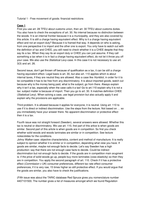
First you use art. 28 TFEU about customs union, then art. 30 TFEU about customs duties.
You also have to check the exceptions of art. 30. No internal because no distinction between
the woods. It is an internal frontier because it is a municipality, and they are also covered by
this article. It is still a charge having equivalent effect. Why is it a charge having equivalent
effect and not an export duty? Because it is framed that way. It depends on who is asking,
from one perspective it is import and the other one is export. You only have to watch out with
the definition of tax and CHEE, you still need to check whether it is a CHEE despite that they
say its a tax. When they say its an export duty or CHEE you can just assume. If they call
something a tax when it is in fact a charge having equivalent effect, do not let it throw you off
your case. We also use the Statistical Levy-case. In this case it is not necessary to use art.
3(3) and art. 26.
Second issue, don’t get thrown off because of qualification as a tax, it can be still a charge
having equivalent effect. Legal basis is art. 30, but also art. 110 applies which is about
internal taxes, if they are neutral they are allowed. Also a case like Humblot, in order for it to
be compatible it has to be free from any discriminatory. It is about imported goods, watch out
because why is the money being paid, what is the subject, go from there. Always explain
why it isn’t a tax, especially when the case calls it a tax! Go to art.110 explain why it is not a
tax: subject matter is because of import. Then you go to art. 30. It matches definition CHEE
(Statistical Levy). When solving a case, use legal provision but also actually apply it and
explain why the provisions are applicable.
Third problem. It is allowed because it applies for everyone, it is neutral. Using art. 110 to
use if it is direct or indirect discrimination. Use the steps from the lecture. Not based on … so
you immediately have your answer there. No apparent discrimination or protective effect
then it is a tax.
Fourth issue was not straight forward (Sweden), several answers were allowed. Whether this
tax is neutral or discriminatory. We use art. 110, first part of this artice is when goods are
similar. Second part of this article is when goods are in competition. So first you check
whether solid woods and woods laminates are similar or in competition. See lecture
notes/slides for the conditions.
Johny Walker case: objective characteristics, content and method of manufacture. It is really
subject to opinion whether it is similar or in competition, depending what view you have. If
goods are similar, maybe not enough facts to decide. Let’s say Sweden has a high
production: say that there are not enough case facts to decide. Could be indirect
discrimination but not enough facts to decide. If the goods are in competition main arugment
is: if the price of solid woods go up, people buy more laminates (coss-elasticity) so then they
are in competition. You apply the second paragraph of art. 110. Check if it has a protective
effect (Commission v UK) consumer preferences, different tax rate effect consumer
preferences, if it is very raw, 15 times higher so still protective effect. If you would argue that
the goods are similar, you also have to check the justifications.
(Fifth issue was about the TARIC database Red Spruce gives you nomenclature number
4407101500. The number gives a list of measures amongst which we found Regulation
Case 1
First you use art. 28 TFEU about customs union, then art. 30 TFEU about customs duties.
You also have to check the exceptions of art. 30. No internal because no distinction between
the woods. It is an internal frontier because it is a municipality, and they are also covered by
this article. It is still a charge having equivalent effect. Why is it a charge having equivalent
effect and not an export duty? Because it is framed that way. It depends on who is asking,
from one perspective it is import and the other one is export. You only have to watch out with
the definition of tax and CHEE, you still need to check whether it is a CHEE despite that they
say its a tax. When they say its an export duty or CHEE you can just assume. If they call
something a tax when it is in fact a charge having equivalent effect, do not let it throw you off
your case. We also use the Statistical Levy-case. In this case it is not necessary to use art.
3(3) and art. 26.
Second issue, don’t get thrown off because of qualification as a tax, it can be still a charge
having equivalent effect. Legal basis is art. 30, but also art. 110 applies which is about
internal taxes, if they are neutral they are allowed. Also a case like Humblot, in order for it to
be compatible it has to be free from any discriminatory. It is about imported goods, watch out
because why is the money being paid, what is the subject, go from there. Always explain
why it isn’t a tax, especially when the case calls it a tax! Go to art.110 explain why it is not a
tax: subject matter is because of import. Then you go to art. 30. It matches definition CHEE
(Statistical Levy). When solving a case, use legal provision but also actually apply it and
explain why the provisions are applicable.
Third problem. It is allowed because it applies for everyone, it is neutral. Using art. 110 to
use if it is direct or indirect discrimination. Use the steps from the lecture. Not based on … so
you immediately have your answer there. No apparent discrimination or protective effect
then it is a tax.
Fourth issue was not straight forward (Sweden), several answers were allowed. Whether this
tax is neutral or discriminatory. We use art. 110, first part of this artice is when goods are
similar. Second part of this article is when goods are in competition. So first you check
whether solid woods and woods laminates are similar or in competition. See lecture
notes/slides for the conditions.
Johny Walker case: objective characteristics, content and method of manufacture. It is really
subject to opinion whether it is similar or in competition, depending what view you have. If
goods are similar, maybe not enough facts to decide. Let’s say Sweden has a high
production: say that there are not enough case facts to decide. Could be indirect
discrimination but not enough facts to decide. If the goods are in competition main arugment
is: if the price of solid woods go up, people buy more laminates (coss-elasticity) so then they
are in competition. You apply the second paragraph of art. 110. Check if it has a protective
effect (Commission v UK) consumer preferences, different tax rate effect consumer
preferences, if it is very raw, 15 times higher so still protective effect. If you would argue that
the goods are similar, you also have to check the justifications.
(Fifth issue was about the TARIC database Red Spruce gives you nomenclature number
4407101500. The number gives a list of measures amongst which we found Regulation