TEST BANK FOR GENERAL ORGANIC AND BIOCHEMISTRY 8TH EDITION KATHERINE
Chapter 2: The Structure of the Atom and the Periodic Table 1. What are the three primary particles found in an atom? A) neutron, positron, and electron B) electron, neutron, and proton C) electron, proton, and nucleon D) positron, electron, and nucleon E) proton, electron, and neutrino Ans: B 2. What is the value of the mass number in the isotope 131 53I? A) 53 B) 78 C) 126.9 D) 131 E) 184 Ans: D 3. What term is used to describe atoms of the same element that have different masses? A) radioactive B) constituents C) isotopes D) telomers E) isomers Ans: C 4. Which statement explains why isotopes have different mass numbers? A) Isotopes differ in the number of protons each contains. B) Isotopes differ in the number of electrons each contains. C) Isotopes differ in the number of neutrons each contains. D) Isotopes differ in the number of protons and neutrons each contains. E) Isotopes differ in the number of protons and electrons each contains. Ans: C 5. When a neutral atom gains one or more electrons, what type of particle is formed? A) an anion B) an isotope C) a proton D) a positron E) a cation Ans: A

Gekoppeld boek
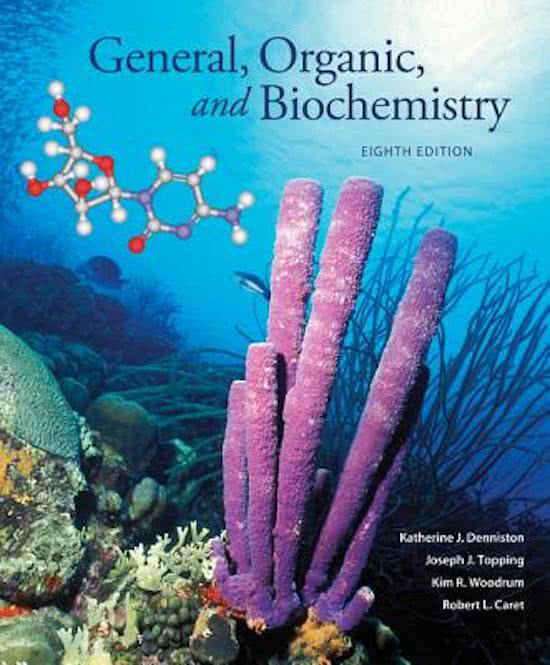
- februari 2013
- 9780073402765
- Onbekend
Geschreven voor
- Instelling
- Duke University
- Vak
- CHEMISTRY
Documentinformatie
- Geüpload op
- 10 augustus 2023
- Aantal pagina's
- 18
- Geschreven in
- 2023/2024
- Type
- Tentamen (uitwerkingen)
- Bevat
- Vragen en antwoorden
Onderwerpen
-
general chemistry
-
biochemistry
-
organic chemistry
-
katherine
-
general organic and biochemistry
-
test bank for general organic and biochemistry