NR 226 Final Exam Study Outline
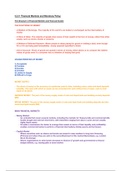
The Nursing Process o The purpose of the nursing process is to diagnose and treat human responses (e.g., patient symptoms, need for knowledge) to actual or potential health problems. Use of the process allows nurses to help patients meet agreed-on outcomes for better health. o The nursing process requires a nurse to use the general and specific critical thinking competencies described earlier to focus on a particular patient's unique needs. The format for the nursing process is unique to the discipline of nursing and provides a common language and process for nurses to “think through” patients' clinical problems • 5 Steps of the Nursing Process (ADPIE) o Assessment ▪ Phases of interview/assessment • An interview is an approach for gathering subjective and objective data from a patient through an organized conversation. An initial interview involves collecting a nursing health history and gathering information about a patient's condition • 1. Orientation and Setting an Agenda o Begin an interview by introducing yourself and your position and explaining the purpose of the interview. Explain why you are collecting data and assure patients that all of the information will be confidential. o Your aim is to set an agenda for how you will gather information about a patient's current chief concerns or problems. Remember, the best clinical interview focuses on a patient's goals, preferences, and concerns and not on your agenda. • 2. Working Phase-Collecting Assessment or Nursing Health History o Start an assessment or a nursing health history with open- ended questions that allow patients to describe more clearly their concerns and problems. For example, begin by having a patient explain symptoms or physical concerns and describe what he or she knows about the health problem or ask him or her to describe health care expectations. o Use attentive listening and other therapeutic communication techniques that encourage a patient to tell his or her story. • 3. Terminating an Interview o Termination of an interview requires skill. You summarize your discussion with a patient and check for accuracy of the information collected. Give your patient a clue that the interview is coming to an end. For example, say, “I have just two more questions. We'll be finished in a few more minutes.” o This helps a patient maintain direct attention without being distracted by wondering when the interview will end. ▪ Methods of obtaining data • An assessment is necessary for you to gather information to make accurate judgments about a patient's current condition. Your information comes from: • The patient through interview, observations, and physical examination. • Family members or significant others' reports and response to interviews. • Other members of the health care team. • Medical record information (e.g., patient history, laboratory work, x-ray film results, multidisciplinary consultations). • Scientific and medical literature (evidence about disease conditions, assessment techniques, and standards). ▪ Subjective Data • Subjective data are your patients' verbal descriptions of their health problems. For example, Mr. Lawson's self-report of pain at the area where his incision slightly separated is an example of subjective data. Subjective data include patients' feelings, perceptions, and self-report of symptoms. • Only patients provide subjective data relevant to their health condition. The data often reflect physiological changes, which you further explore through objective review of body systems. ▪ Objective Data • Objective data are observations or measurements of a patient's health status. Inspecting the condition of a surgical incision or wound, describing an observed behavior, and measuring blood pressure are examples of objective data. o Diagnosis • Objective data is measured on the basis of an accepted standard such as the Fahrenheit or Celsius measure on a thermometer, inches or centimeters on a measuring tape, or a rating scale (e.g., pain). • When you collect objective data, apply critical thinking intellectual standards (e.g., clear, precise, and consistent) so you can correctly interpret your findings. ▪ Identify components of the nursing diagnostic statement • The diagnostic reasoning process involves using the assessment data you gather about a patient to logically explain a clinical judgment, in this case a nursing diagnosis. • The diagnostic process flows from the assessment process and includes decision-making steps. These steps include data clustering, identifying patient health problems, and formulating the diagnosis. ▪ Identify assessment findings, goals, interventions, evaluations appropriate to a specific nursing diagnosis. • Be able to recognize the difference between each category. Context clues like “The Patient will…” means it is a goal. o Planning ▪ Components of goal/outcome statement • A patient-centered goal reflects a patient's highest possible level of wellness and independence in function. It is realistic and based on patient needs, abilities, and resources. A patient-centered goal or outcome reflects a patient's specific behavior, not your own goals or interventions. • Goals and expected outcomes direct your nursing care. Once you set a patient-centered goal for a nursing diagnosis, the expected outcomes provide the desired physiological, psychological, social, developmental, or spiritual responses that indicate resolution of the patient's health problems. • Usually you develop several expected outcomes for each nursing diagnosis and goal. For a patient to resolve a goal, several measurable outcomes are needed to ensure that the goal is met. In the case of Mr. Lawson's diagnosis of Risk for Infection, Tonya knows that more than one outcome is needed to ensure that the patient is infection free. • The SMART acronym (Specific, Measurable, Attainable, and Realistic, Timely) is a useful approach for writing goals and outcome statements more effectively. o Implementation ▪ Independent nursing interventions • Nurse-initiated interventions are the independent nursing interventions or actions that a nurse initiates without supervision or direction from others. • Examples include positioning patients to prevent pressure ulcer formation, instructing patients in side effects of medications, or providing skin care to an ostomy site. Independent nursing interventions do not require an order from another health care provider. ▪ Dependent nursing interventions • Health care provider–initiated interventions are dependent nursing interventions, or actions that require an order from a health care provider. The interventions are based on the health care provider's response to treating or managing a medical diagnosis. • Advanced practice nurses who work under collaborative agreements with physicians or who are licensed independently by state practice acts are also able to write dependent interventions. • As a nurse you intervene by carrying out the health care provider's written and/or verbal orders. Administering a medication, implementing an invasive procedure (e.g., inserting a Foley catheter, starting an intravenous [IV] infusion) and preparing a patient for diagnostic tests are examples of health care provider- initiated interventions. ▪ Direct care activities • Direct care interventions are treatments performed through interactions with patients. For example, a patient receives direct intervention in the form of medication administration, insertion of a urinary catheter, discharge instruction, or counseling during a time of grief. ▪ Indirect care activities • Indirect care interventions are treatments performed away from a patient but on behalf of the patient or group of patients (e.g., managing a patient's environment [e.g., safety and infection control]), documentation, and interdisciplinary collaboration. o Evaluation ▪ Elements of the evaluation process • Evaluation, the final step of the nursing process, is crucial to determine whether, after application of the first four steps of the nursing process, a patient's condition or well-being improves. • You conduct evaluative measures to determine if your patients met expected outcomes, not if nursing interventions were completed. The expected outcomes established during planning are the standards against which you judge whether goals have been met and if care is successful. • You examine the results of care by using evaluative measures, which are assessment skills and techniques (e.g., observations, physiological measurements, use of measurement scales, patient interview). • In fact, evaluative measures are the same as assessment measures, but you perform them at the point of care when you make decisions about a patient's status and progress. The intent of assessment is to identify which, if any, problems exist. The intent of evaluation is to determine if the known problems have remained the same, improved, worsened, or otherwise changed. .................................................................................................CONTINUE.

Geschreven voor
- Instelling
- Chamberlain College Of Nursing
- Vak
- NR 226 /
Documentinformatie
- Geüpload op
- 4 augustus 2023
- Aantal pagina's
- 63
- Geschreven in
- 2023/2024
- Type
- Tentamen (uitwerkingen)
- Bevat
- Vragen en antwoorden
Onderwerpen
-
subjective data
-
objective data
-
deontology