Financial Accounting Man1061- Notes
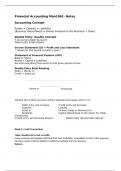
Accounting Concept
Assets = Capitals + Liabilities
(Business Owns/Owed) = Owner Invested in the Business + Owes
Double Entry- Duality Concept
T Accounts/ Ledger Accounts
Debit (Left), Credit (Right).
Income Statement (IS) = Profit and Loss Statement
^ Shows for that period (usually a year).
Statement of Financial Position (SFP)
Balance Sheet.
Assets = Capital + Liabilities.
Records everything that exists at that given period of time.
Double Entry Book Keeping
Debit = Money in.
Credit = Debit out.
Money In Money Out
Identify which other account will be impacted and apply DEAD CLIC
Debit entry will increase Credit entry will Increase
Expense Liability
Asset or Income (Sales or Revenue) or
Drawings Capital (Owed back to the owner for initial
investment)
(Credit entry will decrease above). (Debit entry will decrease above).
Week 2- Credit Transactions
Sales- Double Entry Cash vs Credit
Every customer and supplier will have their own tradeable/ receivables account. After payment
has been made it will be debited/ credited accordingly into the accounts.
Returns
,Create a new account called Sales Returns, upon receiving the goods we credit the trade
receivable and therefore debit the Sales Return account.
With purchases same principle applies. Upon returning the goods back to suppliers we create a
Purchases Returns account, reduce trade payables by debiting it and then credit Purchases
Returns.
Carriage outwards is when the company pays for delivery to their customers.
Carriage Inwards is when we pay for delivery of goods/ materials to ourselves.
Week 3
Daybooks, The Journal, The Cashbook and The Petty Cash Book, Inventory and Cost of Sales
(COS)
The journal is another way of getting information into the ledger. It is used for getting three
types of transactions into are general ledger:
1. Non-Trading Entries to the GIL- (E.g. Non-Current Assets).
2. Opening Entries to GIL- (E.g. a takeover).
3. Year End Adjustments- (E.g. Depreciation, Bad Debt Adjustments, Accruals and
Prepayments).
The Basic Layout of a Journal
Date Details / Account Debit Credit
Discount Allowed- Part of the IS. Always going to be a debit balance. (Expense)
Discount Received- Part of the IS. Always going to be a credit balance.
Sales Ledger Entries- Are trade receivable accounts.
Purchase Ledger Accounts- Are trade payable accounts.
IS
Sales less cost of Sales (COS) = Gross Profit (Trading Statement)
^ + Other Income – Expenses = Net Profit/ Profit for the Year.
COS Calculation
Opening inventory + [Purchases - (Purchases Returns + Carriage In)] – Closing Inventory = COS
Example of COS
, Year 1-
Purchases 10 bikes @ £100 each = £1000
Sold 8 bikes @ £150 each = £1200
Sales (8)
COS
Opening Inv. 0
Purchases. 1000
Less Closing Inv. (200)
Gross Profit 400
Year 2
Purchases 10 Bikes @ £100 each = £1,000
Sold 9 Bikes @150 each = £1,350
Sales = (9) 1350
COS
Opening Inv. (2) 200
Purchases (10) 1,000
Less Closing Inv. (3) 300 (900)
Gross Profit = 450
Week 3 Activity 1
Pg 191 Q11.6
(Done on Paper)
Pg 223 Q13.4
a) (100u + 500u) – 400n= 200 Units = £2,000 (Closing Inventory)
b) Sales less cost of sales = Gross Profit for the year.
8,000 – (5,000 – 1,000) + 2,000 = £4,000
c) Year 2/x-
Purchases 500 units @ £10 each = £5,000
Sold 400 units @ £20 each = £8,000
Sales (400) 8,000
COS
Opening Inv. (100) 1,000
Purchases (500) 5,000
Less Closing Inv. (200) 2,000 (4,000)
Gross Profit = £4,000
Week 3
Accounting Concept
Assets = Capitals + Liabilities
(Business Owns/Owed) = Owner Invested in the Business + Owes
Double Entry- Duality Concept
T Accounts/ Ledger Accounts
Debit (Left), Credit (Right).
Income Statement (IS) = Profit and Loss Statement
^ Shows for that period (usually a year).
Statement of Financial Position (SFP)
Balance Sheet.
Assets = Capital + Liabilities.
Records everything that exists at that given period of time.
Double Entry Book Keeping
Debit = Money in.
Credit = Debit out.
Money In Money Out
Identify which other account will be impacted and apply DEAD CLIC
Debit entry will increase Credit entry will Increase
Expense Liability
Asset or Income (Sales or Revenue) or
Drawings Capital (Owed back to the owner for initial
investment)
(Credit entry will decrease above). (Debit entry will decrease above).
Week 2- Credit Transactions
Sales- Double Entry Cash vs Credit
Every customer and supplier will have their own tradeable/ receivables account. After payment
has been made it will be debited/ credited accordingly into the accounts.
Returns
,Create a new account called Sales Returns, upon receiving the goods we credit the trade
receivable and therefore debit the Sales Return account.
With purchases same principle applies. Upon returning the goods back to suppliers we create a
Purchases Returns account, reduce trade payables by debiting it and then credit Purchases
Returns.
Carriage outwards is when the company pays for delivery to their customers.
Carriage Inwards is when we pay for delivery of goods/ materials to ourselves.
Week 3
Daybooks, The Journal, The Cashbook and The Petty Cash Book, Inventory and Cost of Sales
(COS)
The journal is another way of getting information into the ledger. It is used for getting three
types of transactions into are general ledger:
1. Non-Trading Entries to the GIL- (E.g. Non-Current Assets).
2. Opening Entries to GIL- (E.g. a takeover).
3. Year End Adjustments- (E.g. Depreciation, Bad Debt Adjustments, Accruals and
Prepayments).
The Basic Layout of a Journal
Date Details / Account Debit Credit
Discount Allowed- Part of the IS. Always going to be a debit balance. (Expense)
Discount Received- Part of the IS. Always going to be a credit balance.
Sales Ledger Entries- Are trade receivable accounts.
Purchase Ledger Accounts- Are trade payable accounts.
IS
Sales less cost of Sales (COS) = Gross Profit (Trading Statement)
^ + Other Income – Expenses = Net Profit/ Profit for the Year.
COS Calculation
Opening inventory + [Purchases - (Purchases Returns + Carriage In)] – Closing Inventory = COS
Example of COS
, Year 1-
Purchases 10 bikes @ £100 each = £1000
Sold 8 bikes @ £150 each = £1200
Sales (8)
COS
Opening Inv. 0
Purchases. 1000
Less Closing Inv. (200)
Gross Profit 400
Year 2
Purchases 10 Bikes @ £100 each = £1,000
Sold 9 Bikes @150 each = £1,350
Sales = (9) 1350
COS
Opening Inv. (2) 200
Purchases (10) 1,000
Less Closing Inv. (3) 300 (900)
Gross Profit = 450
Week 3 Activity 1
Pg 191 Q11.6
(Done on Paper)
Pg 223 Q13.4
a) (100u + 500u) – 400n= 200 Units = £2,000 (Closing Inventory)
b) Sales less cost of sales = Gross Profit for the year.
8,000 – (5,000 – 1,000) + 2,000 = £4,000
c) Year 2/x-
Purchases 500 units @ £10 each = £5,000
Sold 400 units @ £20 each = £8,000
Sales (400) 8,000
COS
Opening Inv. (100) 1,000
Purchases (500) 5,000
Less Closing Inv. (200) 2,000 (4,000)
Gross Profit = £4,000
Week 3